
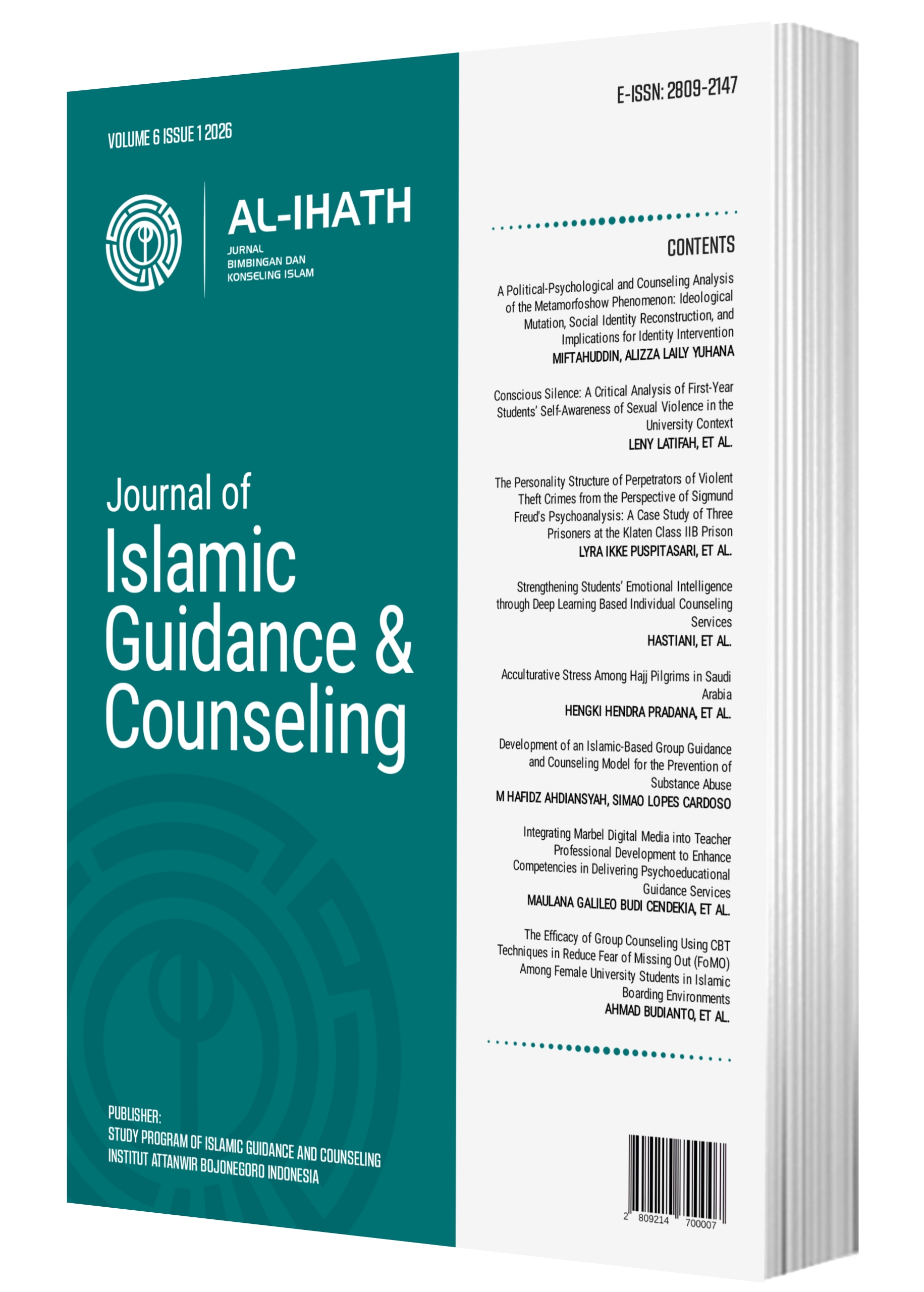
Acculturative Stress Among Hajj Pilgrims in Saudi Arabia
DOI:
https://doi.org/10.53915/jbki.v6i1.73Keywords:
Acculturative Stress, Adaptive Coping, Hajj Pilgrims, Saudi ArabiaAbstract
The Hajj pilgrimage constitutes a complex cross-cultural journey that demands significant social and psychological adjustment from participants. For Indonesian pilgrims, profound differences in language, cultural norms, and environmental conditions often trigger multidimensional acculturative stress, which can jeopardize both their personal well-being and the spiritual quality of their worship. Consequently, this study was conducted to identify the critical factors contributing to this stress and to analyze the specific social adaptation strategies employed by pilgrims to maintain their equilibrium in Saudi Arabia. Utilizing a qualitative phenomenological approach, this research focuses on the lived experiences of three elderly Indonesian pilgrims aged over 50 years. The findings reveal that participants encountered significant stressors across five distinct dimensions: physical, biological, social, cultural, and functional. Physically, the extreme arid climate led to exhaustion and dizziness, necessitating strategies such as hydration and activity regulation. Biologically, foreign dietary patterns caused decreased appetite, while social isolation and homesickness emerged from pervasive language barriers. Culturally, the pilgrims grappled with divergent communication styles and strict social norms that provoked anxiety. Functionally, navigating foreign currency and complex transportation systems created additional hurdles. To overcome these pressures, the pilgrims implemented a combination of problem-focused and emotion-focused coping mechanisms, including cognitive reframing, reliance on national group support, and nonverbal communication. Ultimately, these adaptive strategies fostered behavioral adjustment and acculturative resilience, enabling the pilgrims to perform their religious rituals with safety and optimal spiritual focus despite the challenging environment.
References
Ali, H., & Yupeng, C. (2025). The impact of life satisfaction on acculturation and institutional recommendation among international students in China : does acculturative stress matter ? July. https://doi.org/10.3389/fpsyg.2025.1584210
Al-Karam, C. Y. (2022). Advanced Islamically integrated psychotherapy: Clinical applications and theoretical innovations. Routledge. https://doi.org/10.4324/9781003182108
Anwar, A., Syabibi, M. F., & Sholikhah, A. M. (2025). Psychospiritual resilience: The contemporary role of sabar and tawakkul in managing travel stress among Indonesian pilgrims. Journal of Islamic Psychology, 11(1), 12-28. https://doi.org/10.1037/rel0000456
Arikunto, S. (2021). Prosedur Penelitian: Suatu Pendekatan Praktik. Rineka Cipta.
Azwar, S. (2020). Metode penelitian. Pustaka Pelajar.
Bashir, A. (2020). Development and Validation of the Acculturative Stress Scale for Pakistani Muslim Students. Cogent Psychology, 7(1). https://doi.org/https://doi.org/10.1080/23311908.2020.1714101
Berry W, J. (2006). psikologi lintas budaya : Riset dan Aplikasi. PT Gramedika Pustaka Utama.
Berry, J. W., Phinney, J. S., Sam, D. L., & Vedder, P. (2006). Immigrant youth: Acculturation, identity, and adaptation. Applied Psychology, 55(3), 303–332. https://doi.org/10.1111/j.1464-0597.2006.00256.x
Braun, V., & Clarke, V. (2006). Using thematic analysis in psychology. Qualitative Research in Psychology, 3(2), 77–101. https://doi.org/10.1191/1478088706qp063oa
Creswell, J. W., & Poth, C. N. (2018). Qualitative Inquiry and Research Design: Choosing Among Five Approaches (4th ed.). SAGE Publications.
Feba, T. & Sumathi, G. N. (2018). Length of stay and acculturative stress of international students empirical study. International Journal of Pure and Applied Mathematics, 120(6), 10253–10264.
Furnham, A. (2022). The psychology of money and financial behavior. Routledge. https://doi.org/10.4324/9781003264422
Garcia, A. F., Wilborn, K., & Mangold, D. L. (2017). he cortisol awakening response mediates the relationship between acculturative stress and self-reported health in Mexican Americans. Annals of Behavioral Medicine, 51(6), 787–798. https://doi.org/https://doi.org/10.1007/s12160-017-9901-5
Guerra, R. (2019). chool achievement and well-being of immigrant children: The role of acculturation orientations and perceived discrimination. Journal of School Psychology, 75(1), 104–118.
Hofstede, G., & Minkov, M. (2024). Cultures and organizations: Software of the mind (4th ed.). McGraw-Hill.
Johnson. (2018). Developing culturally responsive programs to promote international student adjustment: A participatory approach. Journal of International Students, 8(4), 1865–1878.
Kemenag. (2013). Kementerian Agama RI Direktorat Jendral Penyelenggaraan Haji dan Umroh Jakarta. Kemenag.
Krismonika, O., Purbasari, W., Riyandari, L., & Purnomo, J. (2024). Hambatan Komunikasi Multikultur Antar Mahasiswa Perantau. 8, 40282–40292.
Kurniawan. (2020). The Relationship between Stress Levels and Blood Pressure in Patients with Type 2 Diabetes Mellitus (DMT2) at Karsa Husada General Hospital. Universitas Islam Negeri Maulana Malik Ibrahim Malang.
Kusek, W. A. (2021). Evaluating the struggles with international students and local community participation. Journal of International Students, 5(2), 121–131.
Masgoret, A. M., & Ward, C. (2023). Language and acculturation: New perspectives on communicative competence. In D. L. Sam & J. W. Berry (Eds.), The Cambridge handbook of acculturation psychology (3rd ed., pp. 58–80). Cambridge University Press. https://doi.org/10.1017/9781108855471.006
Miller, T., Birch, M., Mauthner, M., & Jessop, J. (2012). Ethics in Qualitative Research (2nd ed.). SAGE Publications. https://doi.org/10.4135/9781473913912
Patoni. (2025). Jamaah haji lansia tahun 2025 meningkat hingga 47.384 orang. Nu Online.
Patton, M. Q. (2015). Qualitative Research & Evaluation Methods: Integrating Theory and Practice (4th ed.). SAGE Publications.
Pradana, H. H., Suryanto, S., & Meiyuntariningsih, T. (2021). Stres Akulturatif Pada Mahasiswa Luar Jawa Yang Studi Di Universitas 17 Agustus 1945. Jurnal Psikologi Perseptual, 6(1), 16–23. https://doi.org/10.24176/perseptual.v6i1.5145
Rahman, S. (2016). Faktor-faktor yang Mendasari Stres pada Lansia. Jurnal Pendiidkan Indonesia, 16(1), 1–7.
Ren, Q. & Jiang, S. (2021). Acculturation stress, satisfaction, and frustration of basic psychological needs andmental health of chinese migrant children: Perspective from basic psychological needs theory. Internataional Journal of Environmental Research and Public Health, 18(9), 4751.
Sam, D. L., & Berry, J. W. (Eds.). (2023). The Cambridge handbook of acculturation psychology (3rd ed.). Cambridge University Press. https://doi.org/10.1017/9781108855471
Sari, A. (2022). Communication And Digitality In Anti-Vaccine Community Behavior Reconstruction. Jurnal Komunikasi, 14(2), 263–276.
Saunders, B., Sim, J., Kingstone, T., Baker, S., Waterfield, J., Bartlam, B., ... & Jinks, C. (2018). Saturation in qualitative research: Exploring its conceptualization and operationalization. Quality & Quantity, 52(4), 1893–1907. https://doi.org/10.1007/s11135-017-0574-8
Searle, W., & Ward, C. (2021). Psychological and sociocultural adjustment: A 30-year retrospective. International Journal of Intercultural Relations, 80, 250-265. https://doi.org/10.1016/j.ijintrel.2020.11.011
Sugiyono. (2016). Metode Penelitian Kuantitatif, Kualitatif Dan R & D. Alfabeta, CV.
Suryanto. (2021). “Pelayanan Jamaah Haji: Pendekatan Spiritual dan Teknis.” Jurnal Manajemen Haji Dan Umroh, 4(1), 10–15.
Ward, C., Bochner, S., & Furnham, A. (2001). The Psychology of Culture Shock (2nd ed.). Routledge. https://doi.org/10.4324/9780203714904
Ward, C., & Geeraert, N. (2022). The psychology of culture shock: New research and clinical applications. Routledge. https://doi.org/10.4324/9781003023029
Downloads
Published
Issue
Section
License
Copyright (c) 2026 Hengki Hendra Pradana, Nur Ida Fitria, Wiwik Suatin, Saphira Bilqis Unzila Rohmah, Tarisatul Mu'awanah, Bilal Mujiburahman Abdulahi

This work is licensed under a Creative Commons Attribution-ShareAlike 4.0 International License.
Authors who publish with this journal agree to the following terms:
- Authors retain copyright and grant the journal right of first publication with the work simultaneously licensed under a Creative Commons Attribution License that allows others to share the work with an acknowledgement of the work's authorship and initial publication in this journal.
- Authors are able to enter into separate, additional contractual arrangements for the non-exclusive distribution of the journal's published version of the work (e.g., post it to an institutional repository or publish it in a book), with an acknowledgement of its initial publication in this journal.
- Authors are permitted and encouraged to post their work online (e.g., in institutional repositories or on their website) prior to and during the submission process, as it can lead to productive exchanges, as well as earlier and greater citation of published work.