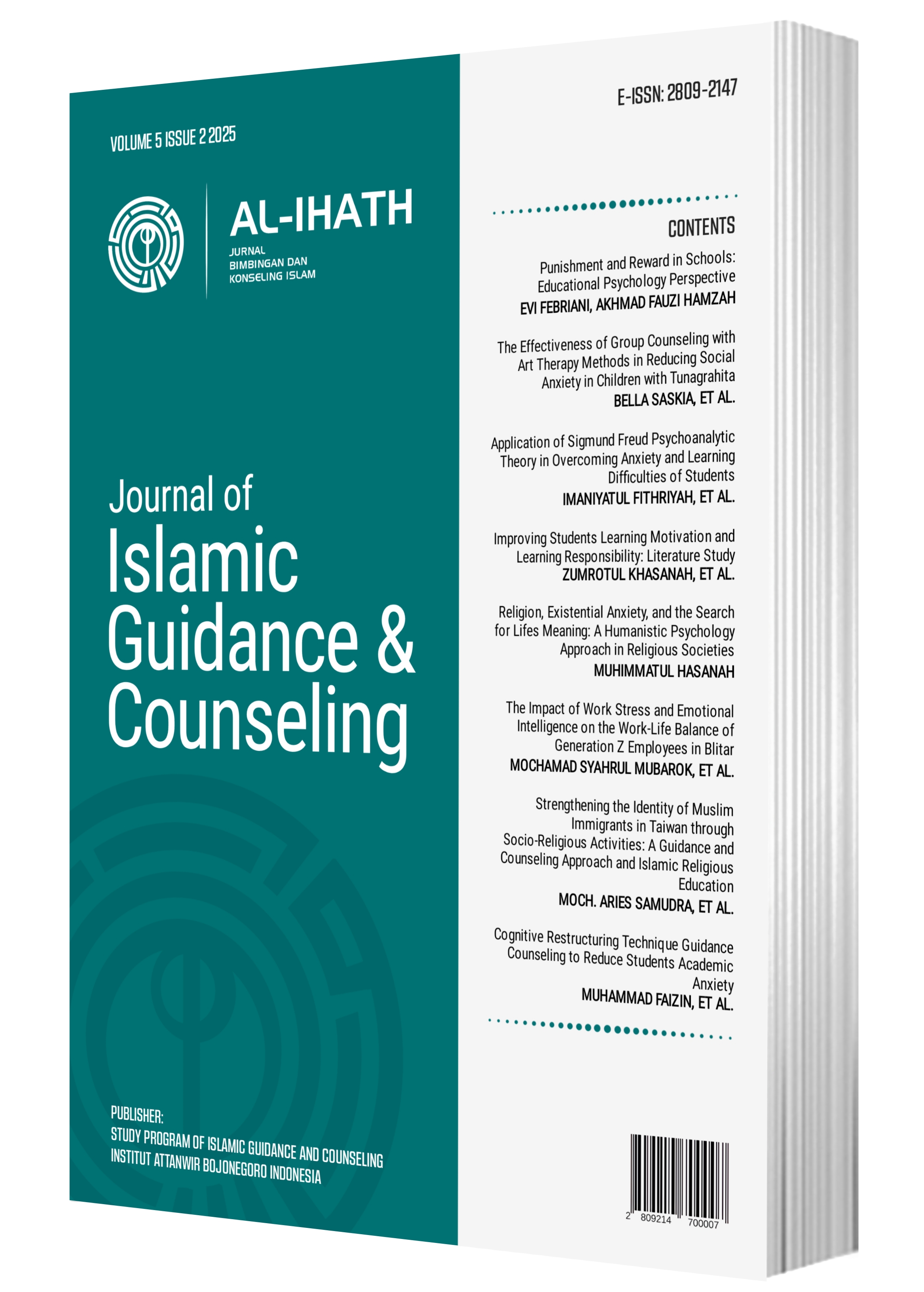
Cognitive Restructuring Technique Guidance Counseling to Reduce Students Academic Anxiety
DOI:
https://doi.org/10.53915/jbki.v5i2.500Keywords:
Guidance and Counseling, Cognitive Restructuring Techniques, Academic AnxietyAbstract
This study aims to test the effectiveness of group counseling cognitive restructuring techniques to reduce academic anxiety using the mixed methods embedded experimental model. Using an academic anxiety scale with research subjects consisting of 14 people who were divided into an experimental group and a control group. The average pretest result for the experimental group = 105.4, the control group = 105.7 and after being given the treatment, the average posttest for the experimental group = 80.28 and the control group = 90.14. The results of the Wilcoxon signed-rank test are Z = -2,371 with a p value of 0.018. The p value is less than 0.05 (0.183 <0.05), thus Ha is accepted and Ho is rejected, which means that group counseling is an effective cognitive restructuring technique for reducing academic anxiety. Qualitatively seen from the analysis of counseling conversations with high academic anxiety focused on feeling depressed, elements of one's abilities, fear, worry, demands around, dislike, lack of confidence. Changes that occur lead to the high category to the medium to low category. This shows that group counseling interventions with cognitive restructuring techniques have a therapeutic impact on counselors.
References
Andy, & Chsris, A. (2018). Perbedaan tingkat stres, kecemasan, dan depresi pada mahasiswa preklinik dan klinik Fakultas Kedokteran Universitas Tarumanagara. Tarumanagara Medical Journal, 1(1), 21–26.
Anisanti, M. D. (2020). Pengaruh Penggunaan Strategi Restrukturisasi Kognitif dalam Konseling Kelompok Terhadap Stres Akademik Peserta didik. PD ABKIN JATIM Open Journal System, 1(1), 89-94.
Apriyani, F and Imami, A. I. (2022). “Kemampuan Pemecahan Masalah Matematis Pada Siswa SMK Ditinjau Dari Kecemasan Matematika,” Jurnal Educatio FKIP UNMA 8, no. 1, https://doi.org/10.31949/educatio.v8i1.1973.
Assyifa, F., Fadilah, S., Wasilah, S., Fitria, Y., & Muthmainah, N. (2023). Hubungan Jenis Kelamin Dengan Tingkat Kecemasan Pada Mahasiswa Pskps Fk Ulm Tingkat Akhir Dalam Pengerjaan Tugas Akhir. Homeostasis, 6(2), 333. https://doi.org/10.20527/ht.v6i2.9980
Azmy, A. N., Nurihsan, A. J., & Yudha, E. S. (2017). Deskripsi gejala stres akademik dan kecenderungan pilihan strategi koping peserta didik berbakat. Indonesian Journal of Educational Counseling, 1(2), 197-208.
Bandura, A. (1997). Self-efficacy: The exercise of control. New York: W.H Freeman and Company.
Bariyyah, K., Atmoko, A., Zen, E. F., Apriani, R., & Maizura, N. (2024). Optimalisasi Peran Guru Bimbingan dan Konseling melalui Cognitive Behavior Stress Management untuk Mendukung Peer Counselor dalam Penanggulangan Stres Akademik Siswa. Abdimas Pedagogi: Jurnal Ilmiah Pengabdian Kepada Masyarakat, 7(2), 116-125.
Barseli, M., Ifdil, I., & Nikmarijal, N. (2017). Cognitive behavior therapy: Basics Publications.stres and beyond. Guilford akademik peserta didik. Jurnal konseling dan pendidikan, 5(3), 143-148.
Beck, Judith S. (2011). Cognitive-Behavior Therapy: Basic and Beyond (2nd ed). New York: The Guilford Press.
Budianto, A., Faizin, M., & Azizah, S. N. (2025). Efektivitas Bimbingan Kelompok Teknik Rasional Emotive Behavioral Therapy terhadap Kecemasan Menghadapi Ujian Siswa SMK Negeri 1 Kanor Bojonegoro. DA'WA: Jurnal Bimbingan Penyuluhan & Konseling Islam, 4(2), 41-49.
Creswell, J. (2015). Research Design: Pendekatan Kualitatif, Kuantitatif dan Mixed. Yogyakarta: Pustaka Pelajar.
Eseadi, C., Anyanwu, J. I., Ogbuabor, S. E., & Ikechukwu-Ilomuanya, A. B. (2016). Effects of cognitive restructuring intervention program of rational-emotive behavior therapy on adverse childhood stress in Nigeria. Journal of Rational Emotive & Cognitive-Behavior Therapy, 34(1), 51-72.
Fahrianti, F., & Nurmina. (2021). Perbedaan Kecemasan Mahasiswa Baru Ditinjau dari Jenis Kelamin pada Masa Pandemi Covid-19. Jurnal Pendidikan Tambusai, 5(1), 1297–1302. https://jptam.org/index.php/jptam/article/view/1101
Faizin, M. (2024). Bimbingan Kelompok Teknik Diskusi untuk Mereduksi Kecemasan Karir Mahasiswa Tingkat Akhir. DA'WA: Jurnal Bimbingan Penyuluhan & Konseling Islam, 3(2), 1-11.
Faizin, M. (2024). Urgensi Psikologi Komunikasi dalam Layanan Konseling Individu. Psycho Aksara: Jurnal Psikologi, 2(1), 53-62.
Faizin, M. (2024). Pengaruh Bimbingan Kelompok Teknik Diskusi Untuk meningkatkan Pemahaman Etika Pergaulan Siswa. As-Suluk: Jurnal Manajemen Pendidikan Islam, 2(2).
Faizin, M., & Umah, A. K. (2025). Pengaruh Bimbingan Kelompok Teknik Diskusi untuk Mengurangi Kejenuhan Belajar Al-Qur’an pada Santri. SHINE: Jurnal Bimbingan dan Konseling, 5(2), 1-11. https://doi.org/10.36379/shine.v5i2.876
Fatkhiyah, N., Fauziah, H., & Masturoh, M. (2021). Hubungan Dukungan Sosial Ibu dengan Tingkat Kecemasan Dalam Menghadapi Sindrom Premenstruasi Pada Remaja Putri. JIK Jurnal Ilmu Kesehatan, 5(2), 222-226.
Firmansyah, Q. D., Qorahman, W., & Ningtyas, N. W. R. (2022). Hubungan Kecemasan Dengan Kualitas Tidur Mahasiswa dalam Penyelesaian Tugas Akhir di Sekolah Tinggi Ilmu Kesehatan Borneo Cendekia Medika. Jurnal Borneo Cendekia, 5(2), 148. https://doi.org/10.54411/jbc.v5i2.253
Galdding, Samuel T. 2012. Konseling: Profesi yang Menyeluruh, edisi keenam. Alih Bahasa: winarno dan Lilian Y. Jakarta: Indeks
Goetz, thomas.et all. (2015). Affect and Motivation Within and Between school aubjects: Development and validation of an Intergrative structural model of academic self concept, interest, and anxiety. International Jurnal Contemporary Educational Psychilogy.
Hikmah, M., Japar, M., & Sunawan, S. (2020). Improving Control Beliefs and Reducing Academic Burnout Using Cognitive Behavioral Therapy Group Counseling With Cognitive Restructuring Technique. Jurnal Bimbingan Konseling, 9(3), 138-144
Ilham, L., & Farid, A. (2019). Teori Klasik Dan Kontemporer: Dari Rational Emotive Behavioral Therapy (REBT) Hingga Cognitive Restructuring (CR). MISYKAT: Jurnal Ilmu ilmu Al-Quran, Hadist, Syari'ah dan Tarbiyah, 4(2), 151-166.
Julika, S., & Setiyawati, D. (2019). Kecerdasan emosional, stres akademik, dan kesejahteraan subjektif pada mahapeserta didik. Gadjah Mada Journal of Psychology (GamaJoP), 5(1), 50-59.
Karneli, Y., Ardimen, A., & Netrawati, N. (2019). Keefektifan konseling modifikasi kognitif perilaku untuk menurunkan stres akademik peserta didik. JKI (Jurnal Konseling Indonesia), 4(2), 42-47
Matthew S. Abbott, Kimberly A. Stauss, and Allen F. Burnett. (2022). Table-Top Role-Playing Games as a Therapeutic Intervention with Adults to Increase Social Connectedness. Social Work with Groups. 45(1). https://doi.org/10.1080/01609513.2021.1932014.
Modouw, H. B., & Nugroho, P. I. (2021). Faktor-Faktor Yang Mempengaruhi Penyelesaian Tugas Akhir Mahasiswa Program Studi Akuntansi Universitas Kristen Satya Wacana. Jurnal Akuntansi Profesi, 12(1), 59-66.
Ningtias, D. A. S. A., Wibowo, M. E. W. M. E., & Purwanto, E. P. E. (2019). The Effectiveness of CBT Group Counseling with Stress Inoculation Training and Cognitive Restructuring Techniques to Reduce Students’ Academic Stress. Jurnal Bimbingan Konseling, 8(4), 159-164.
Nursalim, Mochamad. (2014). Strategi dan Intervensi Konseling. Jakarta: Indeks
Olson, Matthew & Hergenhahn, B.R. (2013). Pengantar Teori-Teori Kepribadian. Yogyakarta: Pustaka Pelajar.
Pekrun, R., Frenzel, A. C., Goetz, T., & Perry, R. P. (2007). The Control Value Theory of Achievement Emotions: An Integrative Approach to Emotions in Education. In P. A. Schutz & R. Pekrun (Eds.), Emotion in Education. Burlington: Elsevier Inc Vitasari et al. 2010. A Research for Identifying Study Anxiety Sources Among University Student. International Education Studies. 3(2):189-193.
Prawitarsa, JE. 2012. Psikologi Terapan Melintasi Batas Disiplin Ilmu. Jakarta: Erlangga.
Sanitria, Nazriati, E & Firdaus. Hubungan kecemasan akademik dengan regulasi diri dalam belajar pada mahasiswa tahun pertama fakultas kedokteran universitas riau tahun 2013/2014. Jurnal Fakultas Kedokteran UNRI. 1(2).
Sari, K. I. P., Muthoharoh, S., & Widiyawati, R. (2023). Kecemasan Akademik Mahasiswa Kebidanan; Literature Review. Jurnal Pengembangan Ilmu Dan Praktik Kesehatan, 2, 166–175. https://doi.org/10.56586/pipk.v2i3.265
Sitorus, R., & Simbolon, I. (2023). Kajian Tingkat Kecemasan Mahasisw Dalam Menyusun Tugas Akhir Berdasarkan Visual Analogue Scales. Nutrix, 7(2), 173–186. https://doi.org/10.37771/nj.v7i2.1028
Sobur, A. (2003). Psikologi Umum. Pustaka Setia.
Sugiharno, R. T., Ari Susanto, W. H., & Wospakrik, F. (2022). Faktor-Faktor yang Mempengaruhi Kecemasan Mahasiswa dalam Menghadapi Tugas Akhir. Jurnal Keperawatan Silampari, 5(2), 1189–1197. https://doi.org/10.31539/jks.v5i2.3760
Suhaibah, Nelyahrdi, H. W. (2022). Pengaruh Media Sosial Terhadap Kecemasan Mahasiswa dalam Mengerjakan Skripsi. Counseling and Sprituality, 1(1), 38–45. https://journal.poins.or.id/index.php/cs/article/view/3
Suherman, M. (2018). Akademik mahasiswa di kota bandung hubungan antara tingkat kecemasan dengan prestasi. Jurnal Fokus, 1(3), 111–116.
Susilo, T. E. P., & Eldawaty. (2019). Tingkat Kecemasan Mahasiswa dalam Penyusunan Skripsi di Prodi Penjaskesrek Fakultas Ilmu Keolahragaan Universitas Negeri Padang. Jurnal Consilia, 2(1), 66–74. https://ejournal.unib.ac.id/index.php/j_consilia/article/view/14905
Vitasari et al. 2010. A Research for Identifying Study Anxiety Sources Among University Student. International Education Studies. 3(2):189-193.
Wakhyudin, H., & Putri, A. D. S. (2020). Analisis Kecemasan Mahasiswa Dalam Menyelesaikan Skripsi. WASIS : Jurnal Ilmiah Pendidikan, 1(1), 14–18. https://doi.org/10.24176/wasis.v1i1.4707
Zahro, I. F., & Amrullah, M. A. (2021). Memelihara Kestabilan Emosional dengan Terapi Emotional Freedom Technique (EFT) di Masa Pandemi Covid–19. TAAWUN, 1(02), 149-161. 10.37850/taawun.v1i02.196
Zuhaebah, N., & Milkhatun, M. (2022). Hubungan antara jenis kelamin dengan tingkat kecemasan pada mahasiswa saat pembelajaran daring di Universitas Muhammadiyah Kalimantan Timur. Borneo Studies and Research, 3(3), 2621-2627. https://journals.umkt.ac.id/index.php/bsr/article/view/2934
Downloads
Published
Issue
Section
License
Copyright (c) 2025 Muhammad Faizin, Indah Fajrotuz Zahro, Ahmad Budianto, Birdie J Bezanson

This work is licensed under a Creative Commons Attribution-ShareAlike 4.0 International License.
Authors who publish with this journal agree to the following terms:
- Authors retain copyright and grant the journal right of first publication with the work simultaneously licensed under a Creative Commons Attribution License that allows others to share the work with an acknowledgement of the work's authorship and initial publication in this journal.
- Authors are able to enter into separate, additional contractual arrangements for the non-exclusive distribution of the journal's published version of the work (e.g., post it to an institutional repository or publish it in a book), with an acknowledgement of its initial publication in this journal.
- Authors are permitted and encouraged to post their work online (e.g., in institutional repositories or on their website) prior to and during the submission process, as it can lead to productive exchanges, as well as earlier and greater citation of published work.