
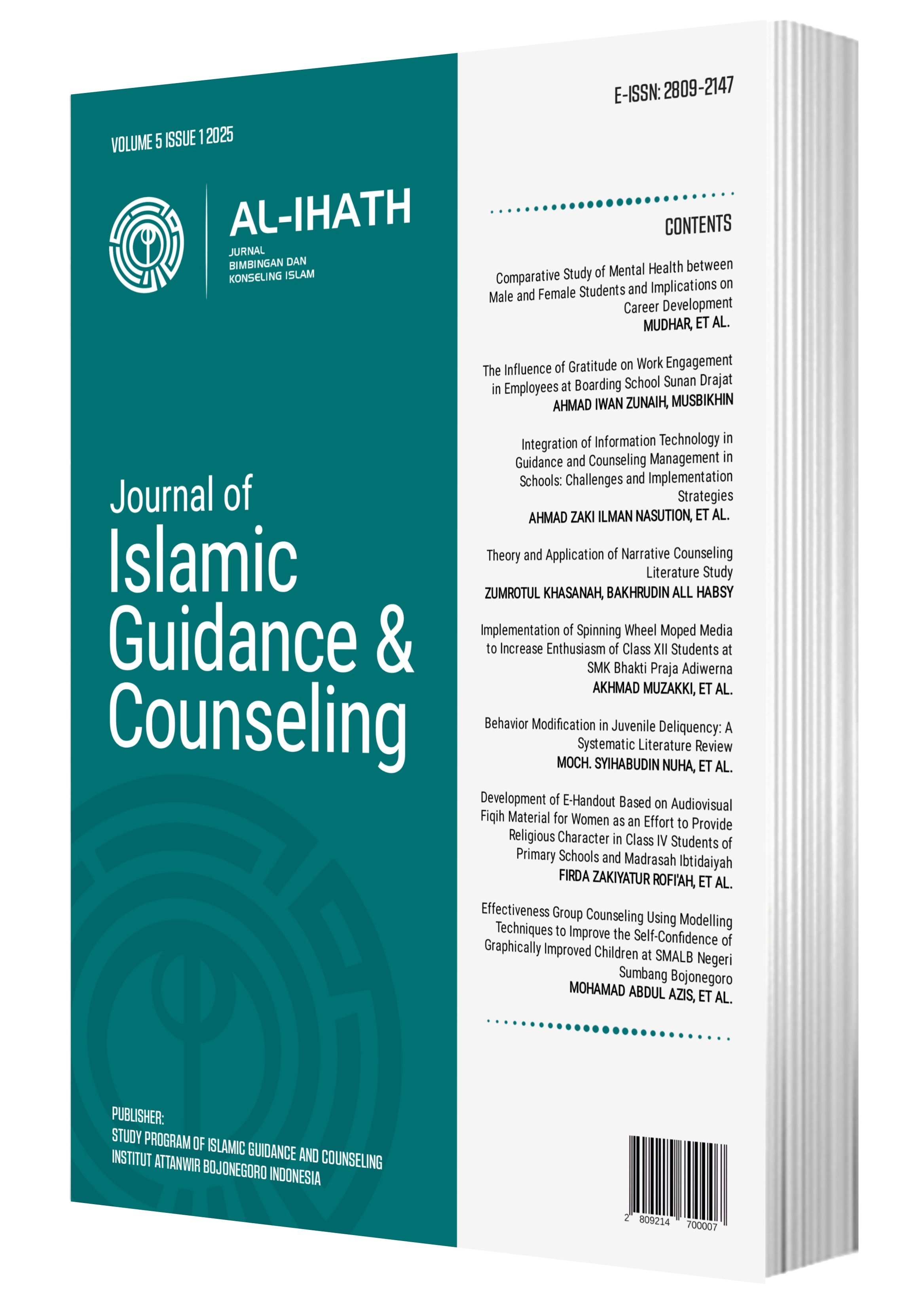
Development of E-Handout Based on Audiovisual Fiqih Material for Women as an Effort to Provide Religious Character in Class IV Students of Primary Schools and Madrasah Ibtidaiyah
DOI:
https://doi.org/10.53915/jbki.v5i1.617Keywords:
Development, E-Handout, Women's Fiqh, Religious CharacterAbstract
One of the religious characters is obedience to God Almighty. This character can be achieved if students have a good understanding of obedience material, one of which is women's jurisprudence. Based on observations, 78% of class IV students at SD Bojonegoro do not understand this material well. Apart from that, the content of material about women's jurisprudence in class IV students of primary schools and madrasah ibtidaiyah textbooks is very minimal, so accompanying teaching materials are needed. Then, students' interest in reading using books or worksheets is very low, students prefer to use devices, because there are videos, pictures and animations. Therefore, developing audio-visual based teaching materials via the google site is considered very necessary. This teaching material is presented in electronic form by displaying videos, images and animations. This research aims to determine the results of the development of an e-handout on women's fiqh material. The research method used is the Borg & Gall model Research and Development (R&D) method. The results of the development of an audio-visual based e-handout on women's jurisprudence material were declared suitable for use. This is proven by the material expert validation results being 80% (feasible), the media expert validation results being 77% (valid category), and the language expert validation being 76% (feasible), then the question expert validation results being 86% (very feasible) and the student response results were 83% (very interesting).
References
Abraham H Maslow. 200. Motivation and Personality”. Jakarta Rajawali
Amin Wahyudi, Mujiyati, Nurbowo Budi Utomo, “Upaya Meningkatkan Kepercayaan Diri Siswa Melalui Konseling Behavioral Dengan Teknik Modeling Pada Siswa Kelas VIII Tunagrahita di SLB Dharna Bhakti, Piyungan Tahun Pelajaran 2020/2021”,
Budianto, A., & Sugiharto, D. Y. P. (2020). EFFECTIVENESS OF GUIDANCE GROUP ROLE PLAYING AND SYMBOLIC MODELLING TO IMPROVE STUDENTS'INTERPERSONAL COMMUNICATION SKILLS. European Journal of Psychological Research Vol, 7(2).
Departemen Pendidikan Nasional. 2011. “Undang-undang SISDIKNAS UU RI NO.20 Th. 2003”. Sinar Grafika, Jakarta.
Depdiknas. 2008. “Peraturan Pemerintah RI No. 19 Tahun 2005 tentang Standar Nasional Pendidikan”. Depdiknas Jakarta.
Ekhsan Muh Rifai. “Pentingnya Kepercayaan Diri Dan Dukungan Keluarga”.
Faizin, M., & Ummah, N. R. (2022). Penerapan Keterampilan Batik Ciprat dalam Melatih Perkembangan Kognitif Anak Tunagrahita. Al-Ihath: Jurnal Bimbingan dan Konseling Islam, 2(1), 32-41.
G. J. Privitera and L. A. Delzell. “Quasy-Experimental and Single- Case Experimental Designs, “in Research Methods for Education, SAGE Pubicaions, Inc., 2019, pp. 333-370
Hakim. 2002. “Mengatasi Rasa Tidak Percaya Diri”. Jakarta: Puspa Swara.
Hafid, A., Zahro, I. F., & Kasih, D. A. (2023). Penerapan Pendekatan Behavioral dengan Teknik Modeling untuk Meningkatkan Kemandirian Anak Tunagrahita SDLB Negeri Sumbang Bojonegoro. Attanwir: Jurnal Keislaman Dan Pendidikan, 14(1), 103-117.
J. R. Fraenkel. N. E. Wallen, and H. H. Hyun. 2022. How to Design and Evaluate Reserch in Education, 8th ed. New York: Mc Graw Hill.
Komalasari Gantina, 2011. “Teori dan Teknik Konseling”. Jakarta: Indesk Press.
Johnsen. 2003. “Pendidikan Kebutuhan Khusus”. Bandung: Unipub Forlag.
Lauster. 1992. Tes kepribadian Terjemahan D.H. Gulo. Jakarta: PT. Gramedia Bumi Aksara
Mumpuniarti. 2000. Penanganan Anak Tunagrahita Kajian Dari Segi Pendidikan, Sosial-Psikologis, Dan Tindak Lanjut Usia Dewasa. Yogyakarta: Jurusan PLB FIP UNY.
Prayitno. Erman Amti. 2013. Dasar-Dasar Bimbingan dan Konseling Jakarta:PT Rineka Cipta.
Repita. “Implementasi Teknik Modeling untuk Meminimalisasi Perilaku Bermasalah Oppositional Defiant Pada Anak Kelompok B. E-Journal Pendidikan Anak Usia Dini Universitas Pendidikan Ganesh”.
Sugiyono. 2014. Metode Penelitian Pendekatan Kuantitatif. Kualitatif. dan R&D. Bandung: Eidos.
Sutarno.1982. “Mengapa Anak Berkelainan Perlu Mendapat Pendidikan”. Jakarta: PN Balai Pustaka, 1982.
Somantri Sutjihati. 2016. Psikologi Anak LuarBiasa. Bandung: RefikaAditama.
Syamsudin, Teknik Modelling dalam Bimbingan Kelompok untuk Meningkatkan Kepercayaan Diri Peserta Didik Kelas VIII G SMP PGRI 6 Bandar Lampung T.P 2017/2018. In Journal
Venni Harivmah, Muhammad Anas. Syamsul Bachri Thalib. 2023. “Penerapan Teknik Modeling Simbolik Dalam Bimbingan Kelompok Untuk Meningkatkan Kepercayaan Diri Siswa Sekolah Menengah Atas di Kabupaten Gowa”, Vol. 3 No. 3.
Zahro, I. F. (2018). Pengaruh bina diri untuk meningkatkan kemandirian anak tunagrahita SDLBN Sumbang III Bojonegoro. Attanwir: Jurnal Keislaman dan Pendidikan, 9(2), 18-28.
Downloads
Published
Issue
Section
License
Copyright (c) 2025 Firda Zakiyatur Rofi’ah, Khoirotus Silfiyah, Putri Isnawati, Mia Shovia

This work is licensed under a Creative Commons Attribution-ShareAlike 4.0 International License.
Authors who publish with this journal agree to the following terms:
- Authors retain copyright and grant the journal right of first publication with the work simultaneously licensed under a Creative Commons Attribution License that allows others to share the work with an acknowledgement of the work's authorship and initial publication in this journal.
- Authors are able to enter into separate, additional contractual arrangements for the non-exclusive distribution of the journal's published version of the work (e.g., post it to an institutional repository or publish it in a book), with an acknowledgement of its initial publication in this journal.
- Authors are permitted and encouraged to post their work online (e.g., in institutional repositories or on their website) prior to and during the submission process, as it can lead to productive exchanges, as well as earlier and greater citation of published work.