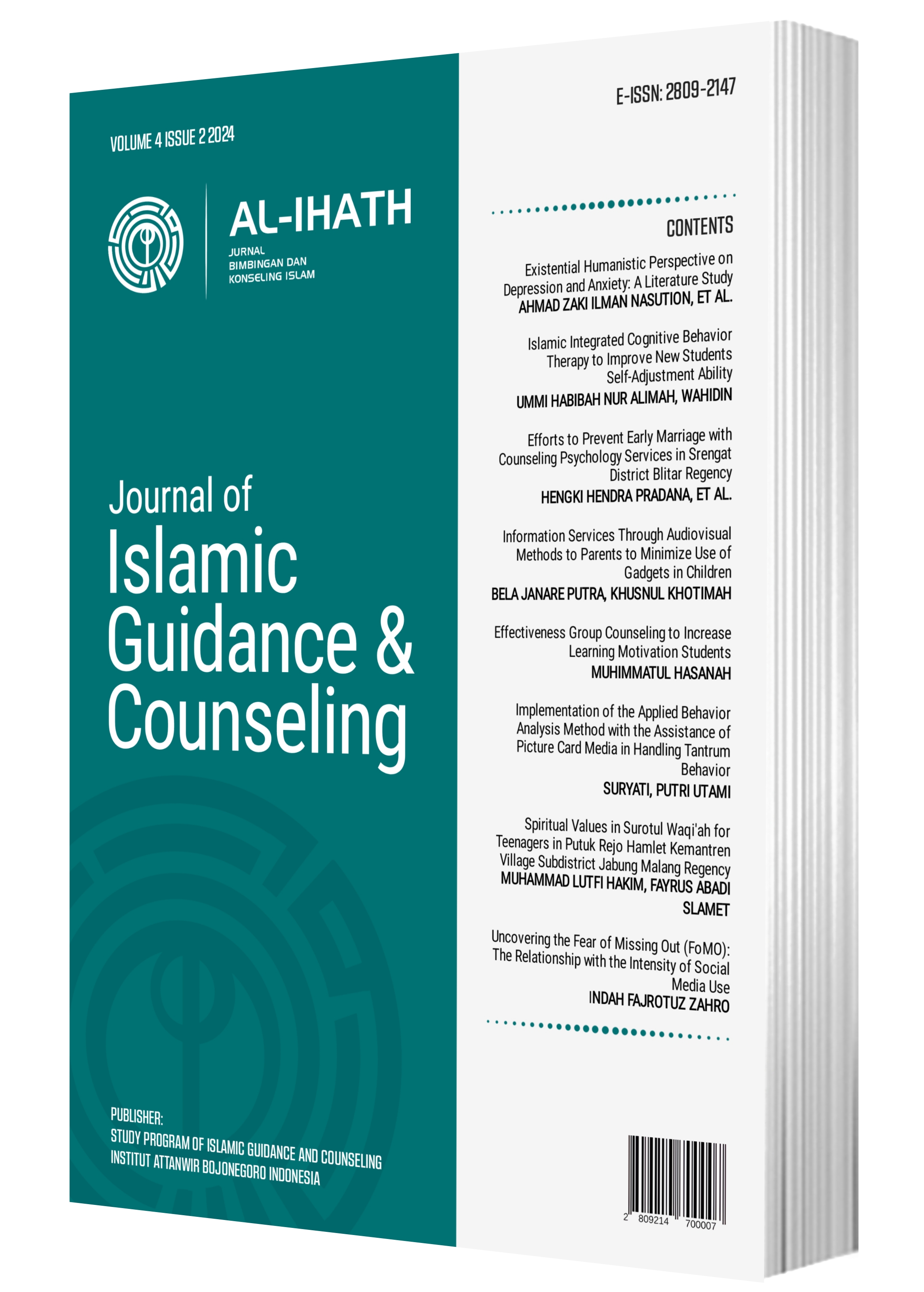
Effectiveness Group Counseling to Increase Learning Motivation Students
DOI:
https://doi.org/10.53915/jbki.v4i2.535Keywords:
Group Counseling, Learning Motivation, StudentsAbstract
The purpose of this study was to test the effectiveness of group counseling to increase learning motivation in student, the number of subjects participating was 10 people with low and very low categories. The treatment was given to subjects in the experimental group for five meetings. This study used the learning Motivation Scale as a pre-test and post-test to measure the level of learning motivation before and after treatment. The data analysis technique used in this study was the Wilcoxon Test. The results showed that there was a significant difference in learning motivation scores on pretests and posttests (N experiment=10, Z=-2.829; p=0.005). This can be seen from the increase in learning motivation scores in the experimental group, group counseling is proven effective for increasing learning motivation in boarding school students.
References
Ames, C & Archer, J. 1998.Achievement goals in the classroom: Students’ learning strategies and motivation processes. Journal of Educational Psychology. Vol. 80, no. 3, 260-267. The American psychological Assiciation, Inc . www.digilib.uinsby.ac.id.Maret 2017
Arikunto. S. Prosedur Penelitian: Suatu Pendekatan Praktek. Jakarta: Rineka Cipta. 2002.
Bimo Walgito. (2010). Bimbingan dan Konseling Studi Karir. Yogyakarta: Andi
Corno, L., & Mandinach, E. B. 1983. The Role of Cognitive Engagement in Classroom Learning and Motivation. Educational Psychologist, 18(2), 1-8
Daki, J., & Savage, R. S. 2010. Solution Focused Brief Therapy: Impacts on Academic and Emotional Difficulties. The Journal of Educational Research, 103, 309-326. https://doi.org/10.1080/00220670903383127
Daki, J., & Savage, R. S. Solution Focused Brief Therapy: Impacts on Academic and Emotional Difficulties. The Journal of Educational Research, 103, 2010. 309-326. https://doi.org/10.1080/00220670903383127
Djamarah, Syaiful Bahri. 2011. Psikologi Belajar. Jakarta: Rineka Cipta.
Hamdu, G., & Agustina, L. Pengaruh Motivasi Belajar Siswa Terhadap Prestasi Belajar IPA di Sekolah Dasar. Jurnal Penelitian Pendidikan, 2011.
Prayitno dan Erman Anti, Dasar-dasar Bimbingan Dan konselieng (Jakarta: PT. Rineka Cipta, 2008)
Prayitno. Seri Panduan Layanan dan Kegiatan Pendukung Konseling. Padang: BK FIP UNP, 2013)
Rafiqah, M. Pengaruh Motivasi Belajar Siswa Terhadap Prestasi Belajar Siswa. Jurnal Bimbingan Konseling. Volume 2. No. 2. 2013: 4.
Ramadhan Dwi Marvianto, Wahyu Widhiarso. Adaptasi Academic Motivation Scale (AMS) versi Bahasa Indonesia. Gadjah Mada Journal of Psychology. Vol 4. No.1, 2018. DOI: 10.22146/gamajop.45785
Sampurnawati, Endang. 2013. Artikel Upaya peningkatan motivasi belajar melalui Bimbingan Kelompok (PTBK pada siswa SMK Perintis 29 Semarang. Jurnal Ilmiah Pendidikan Bimbingan dan Konseling Vol 1, No 2. IKIP Veteran Semarang .
Sardiman, A.M. Interaksi dan Motivasi Belajar Mengajar. Jakarta: PT Raja Grafindo Persada. (2014).
Setyowati. Pengaruh Motivasi Belajar Terhadap Hasil Belajar Siswa Kelas VII SMPN 13 Semarang. Skripsi. Semarang: Universitas Negeri Semarang (2007).
Supriatna, Mamat. Bimbingan dan Konseling Berbasis Kompetensi. Jakarta: Raja Grafindo Persada, 2018.
Walgito, Bimo. Bimbingan dan Penyulihan di Sekolah. Yogyakarta: Andi Ofset. 1995.
Wibawa Byu Priam Bada, “Pengaruh Layanan Konseing Kelompok menggunakan tehnik Self Regulated Learning Untuk Mseningkatkan Motivasi Belajar siswa Penelitian Pada Siswa kelas X Tata Busana di SMK Muhammadiyah 1 Borobudur)”, 2018.
Wibowo, Eddy Mungin. Konseling Kelompok Perkembangan. Semarang: Unnes Press, 2005.
Downloads
Published
Issue
Section
License
Copyright (c) 2024 Muhimmatul Hasanah

This work is licensed under a Creative Commons Attribution-ShareAlike 4.0 International License.
Authors who publish with this journal agree to the following terms:
- Authors retain copyright and grant the journal right of first publication with the work simultaneously licensed under a Creative Commons Attribution License that allows others to share the work with an acknowledgement of the work's authorship and initial publication in this journal.
- Authors are able to enter into separate, additional contractual arrangements for the non-exclusive distribution of the journal's published version of the work (e.g., post it to an institutional repository or publish it in a book), with an acknowledgement of its initial publication in this journal.
- Authors are permitted and encouraged to post their work online (e.g., in institutional repositories or on their website) prior to and during the submission process, as it can lead to productive exchanges, as well as earlier and greater citation of published work.