
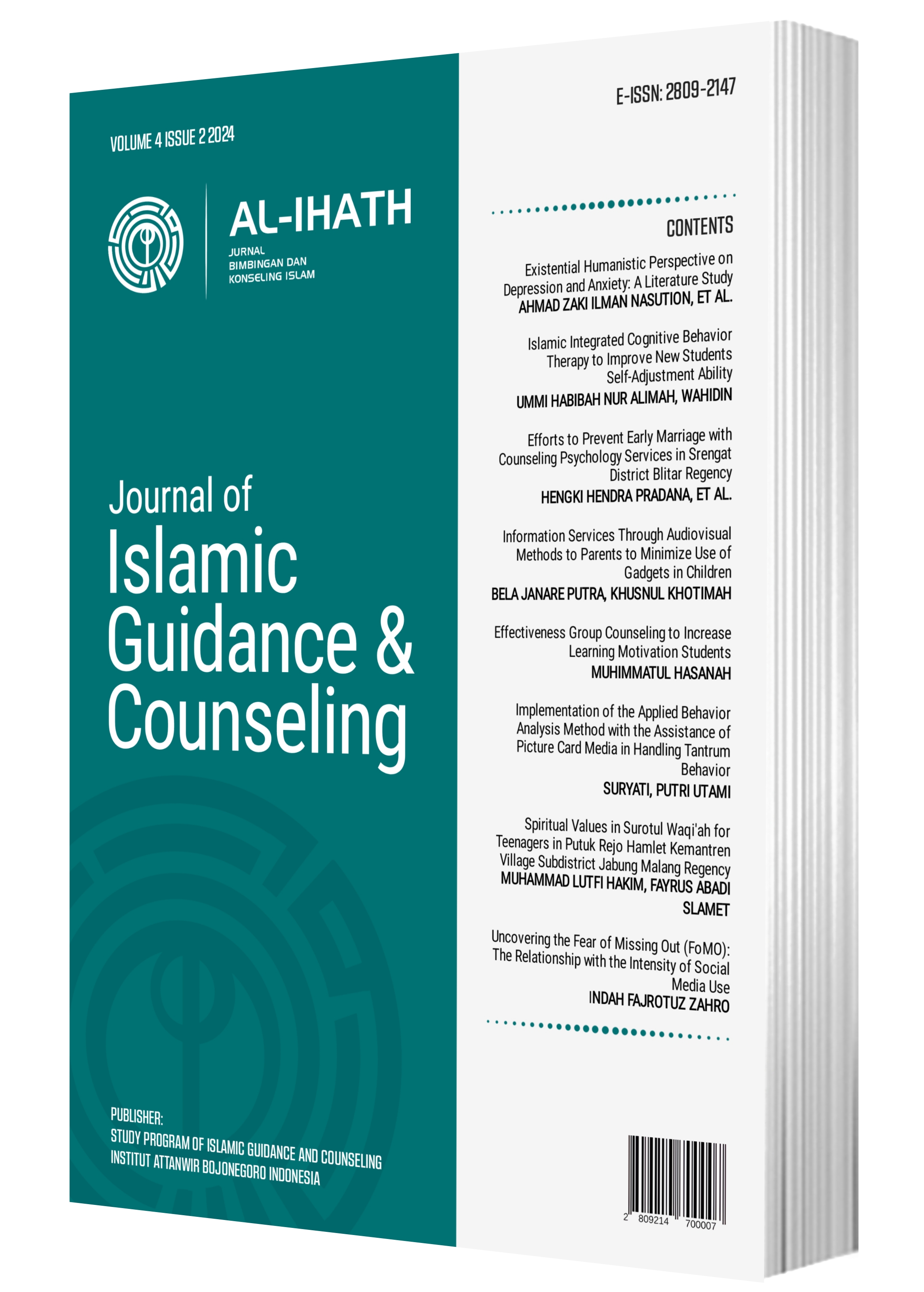
Existential Humanistic Perspective on Depression and Anxiety: A Literature Study
DOI:
https://doi.org/10.53915/jbki.v4i2.530Keywords:
Existential Humanistic, Depression, AnxietyAbstract
This research aims to describe the Humanistic Existential Perspective on depression and anxiety. The literature study on this perspective highlights the complexity of human experience in dealing with mental challenges. Being in the World is a key concept in existential humanism that highlights the interaction between humans and their environment. Humans are not only physically in the world, but also actively involved in cultural, social, and environmental influences. In their existence, humans experience a wide range of experiences, including joy, suffering, anxiety, and the search for the meaning of life. This approach emphasizes the importance of existence, meaning of life, self-awareness, responsibility, freedom of choice, openness, and individual involvement in overcoming depression and anxiety. Depression is seen as related to feelings of loss of meaning in life and dissatisfaction with existence, while anxiety often arises from fear and uncertainty. The results of this study provide valuable insights into how an existential humanistic approach can assist individuals in dealing with the mental challenges of depression and anxiety.
References
Adawiah, R. (2015). Aliran Eksistensialisme Dalam Pandangan Filsafat Pendidikan Islam. Al-Banjari: Jurnal Ilmiah Ilmu-Ilmu Keislaman, 14(1).
Adhi, N. K. J. (2017). Efektivitas Konseling Eksistensi Humanistik dengan Kebermaknaan Hidup pada Tunanetra. Jurnal Psikologi Mandala, 1(1).
Adwas, A. A., Jbireal, J. M., & Azab, A. E. (2019). Anxiety: Insights into signs, symptoms, etiology, pathophysiology, and treatment. East African Scholars Journal of Medical Sciences, 2(10), 580-591.
American Psyciatric Association. (1994). Diagnostic and Statististical Manual of Mental Disorder, 4thed, Washington DC; American Psychiatric Association.
Annisa, D. F., & Ifdil, I. (2016). Konsep kecemasan (anxiety) pada lanjut usia (lansia). Konselor, 5(2), 93-99.
Arbayah. (2013). Model Pembelajaran Humanistik. Jurnal Dinamika Ilmu, 13(2), 206– 207.
Asarnow, L. D., & Manber, R. (2019). Cognitive behavioral therapy for insomnia in depression. Sleep medicine clinics, 14(2), 177-184.
Aulia, Z. S. (2023). Pelaksanaan Konseling Kelompok Dengan Teknik Self-Talk Dalam Menumbuhkan Kesadaran Tanggung Jawab Belajar Peserta Didik SMK YPI Seputih Mataram Lampung Tengah (Doctoral dissertation, Uin Raden Intan Lampung).
Beck, A. (1979). Cognitive therapy and emotional disorders. New York, NY: Penguin Books.
Bhuiyan, M. A. H., Griffiths, M. D., & Mamun, M. A. (2020). Depression literacy among Bangladeshi pre-university students: Differences based on gender, educational attainment, depression, and anxiety. Asian journal of psychiatry, 50, 101944.
Bugental, J. F., Pierson, J. F., & Schneider, K. J. (Eds.). (2001). The handbook of humanistic psychology: Leading edges in theory, research, and practice. Sage Publications.
Corey, G. (2009). Theory and Practice of Counseling and Psychotherapy. Cengage Learning.
Dianovinina K. (2018). Depresi pada remaja: gejala dan permasalahannya. Jurnal Psikogenes. 6(1):69–78.
Dragioti E, Levin LÅ, Bernfort L, Larsson B, Gerdle B. (2017). Insomnia severity and its relationship with demographics, pain features, anxiety, and depression in older adults with and without pain: Cross-sectional population-based results from the PainS65+ cohort. Ann Gen Psychiatry. 16(1):1–10.
Ellis, A. (1973). Humanistic psychotherapy: The rational-emotive approach. New York, NY: McGraw-Hill.
Fazeli, S., Zeidi, I. M., Lin, C. Y., Namdar, P., Griffiths, M. D., Ahorsu, D. K., & Pakpour, A. H. (2020). Depression, anxiety, and stress mediate the associations between internet gaming disorder, insomnia, and quality of life during the COVID-19 outbreak. Addictive Behaviors Reports, 12, 100307.
Freud, S. (1967). Studi sull’isteria. Turin, Italy: Bollati Boringhieri. Original work published, 1892-1895.
Ginting, S. A. B., Arsini, Y., & Tarigan, S. A. R. B. (2024). Pendekatan Eksistensial Humanistik Untuk Menurunkan Prilaku Bullying. MADANI: Jurnal Ilmiah Multidisiplin, 1(12).
Hasna, A. (2019). Konseling kelompok dengan pendekatan eksistensial-humanistik untuk melatih penyesuaian diri melalui randai dari minangkabau [group counseling using an existential-humanistic approach to develop self-adjustment combined with the expressive arts techniques of randai of minangkabau]. Polyglot: Jurnal Ilmiah, 15(1), 124-139.
Hendrika, D. S. (2022). Gambaran Self Regulated Learning Pada Mahasiswa Di Masa Pandemi Covid-19. EDUCATIVO: Jurnal Pendidikan, 1(1), 60-66.
Jamil, J. (2018). Sebab dan akibat stres, depresi dan kecemasan serta penanggulangannya. Al AMIN: Jurnal Kajian Ilmu Dan Budaya Islam, 1(01), 123-138.
Khairati, A., Karneli, Y., & Netrawati, N. (2024). Pentingnya Konseling Eksistensial Dalam Meningkatkan Makna Hidup Korban Pelecehan Seksual Pada Remaja. Counselia; Jurnal Bimbingan Konseling Pendidikan Islam, 5(1), 84-91.
Khatibah. (2011). Penelitian Kepustakaan. Jurnal Iqra’, 5(1), 36-39.
Khoirina, N. (2018, August). Pentingnya pemahaman nilai-nilai budaya lokal dalam Pendekatan Konseling Humanistik. In Prosiding Seminar Nasional Bimbingan dan Konseling, 2(1), 260-268.
Maulida, N. C., & Pranajaya, S. A. (2018). Pengentasan degradasi minat belajar pada siswa remaja. Tarbiyah Wa Ta'lim: Jurnal Penelitian Pendidikan dan Pembelajaran, 5(1), 7-16.
Mubarok, A. (2004). Tasawuf dan Psikologi Islam. Refleksi, 6(1), 33-44.
Multazam, A. (2015). Pendidikan Islam Berbasis Humanisme Religius (Studi Pemikiran Abdurrahman Mas’ ud). Unpublished master’s thesis). UIN Walisongo Semarang, Semarang, Indonesia.
Musthafa Fahmi (1977). Kesehatan Jiwa Dalam Keluarga Sekolah dan Masyarakat, alih bahasa oleh Zakiah Daradjat. Jakarta: Bulan Bintang, Jilid 3.
Nurwan, D. (2019). Layanan Konseling dengan Pendekatan Eksistensial Humanistik dalam Penyesuaian Diri Remaja (Penelitian Tindakan Konseling di Panti Asuhan Nurul Islam Kebaharan Kota Serang Banten) (Doctoral dissertation, UIN SMH BANTEN).
Odgers, C. L., & Jensen, M. R. (2020). Annual research review: Adolescent mental health in the digital age: Facts, fears, and future directions. Journal of Child Psychology and Psychiatry, 61(3), 336-348.
Suwandi, G. R., & Malinti, E. (2020). Hubungan Tingkat Pengetahuan Dengan Tingkat Kecemasan Terhadap Covid-19 Pada Remaja Di SMA Advent Balikpapan. Malahayati Nursing Journal, 2(4), 677–685.
Tambunan, S., & Mulkiyan, M. (2021). Strategi mengatasi trauma pada korban bullying melalui konseling eksistensial. JURNAL MIMBAR: Media Intelektual Muslim Dan Bimbingan Rohani, 7(2), 214-234.
Tillich, P. (1952). The courage to be. New Haven, CN: Yale University Press.
Vijayanti, N. P. D. H., MP, S. P. P. L., & Kartinawati, K. T. (2022). Hubungan Kematangan Emosi dengan Psikosomatis pada Mahasiswa Tingkat Akhir di Fakultas Kedokteran dan Ilmu Kesehatan Universitas Warmadewa. AMJ (Aesculapius Medical Journal), 1(2), 7-12.
Yulianti, A. Y., & Karneli, Y. (2019). IMPLEMENTASI EKSISTENSIAL HUMANISTIK DENGAN TEHNIK MODELING UNTUK MENINGKATKAN EMPATI PADA MAHASISWA. Jurnal Al-Fatih, 2(2), 247-260.
Zulfikar, Z., Hariko, R., Muwakhidah, M., & Aritonang, N. (2017). Konseling Humanistik: Sebuah Tinjauan Filosofi. Jurnal Konseling GUSJIGANG, 3(1). 146-151.
Published
Issue
Section
License
Copyright (c) 2024 Ahmad Zaki Ilman Nasution, Yeni Karneli, Netrawati Netrawati

This work is licensed under a Creative Commons Attribution-ShareAlike 4.0 International License.
Authors who publish with this journal agree to the following terms:
- Authors retain copyright and grant the journal right of first publication with the work simultaneously licensed under a Creative Commons Attribution License that allows others to share the work with an acknowledgement of the work's authorship and initial publication in this journal.
- Authors are able to enter into separate, additional contractual arrangements for the non-exclusive distribution of the journal's published version of the work (e.g., post it to an institutional repository or publish it in a book), with an acknowledgement of its initial publication in this journal.
- Authors are permitted and encouraged to post their work online (e.g., in institutional repositories or on their website) prior to and during the submission process, as it can lead to productive exchanges, as well as earlier and greater citation of published work.