
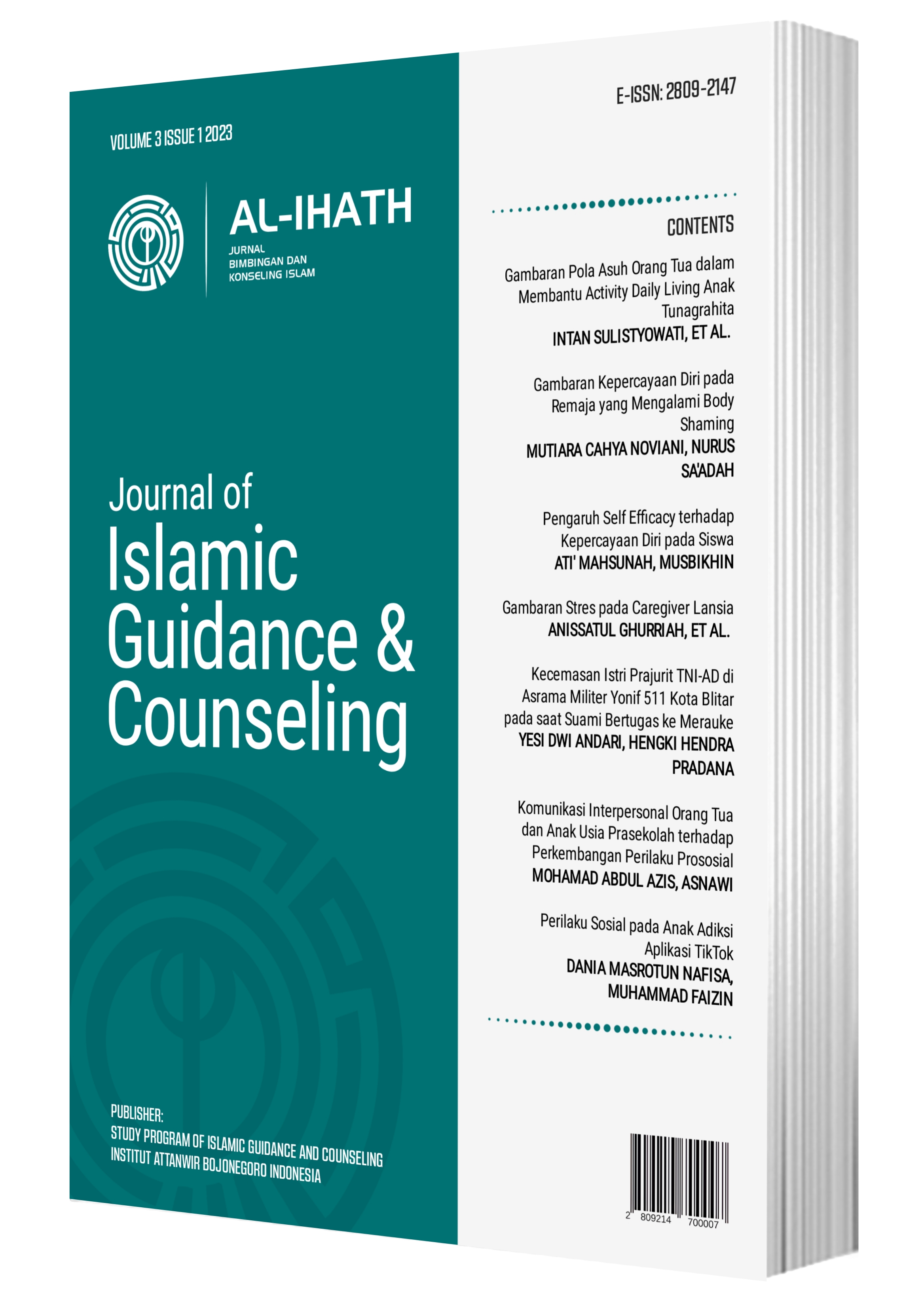
Gambaran Stres pada Caregiver Lansia
DOI:
https://doi.org/10.53915/jbki.v3i1.304Keywords:
Caregiver, Lansia, StresAbstract
Perawatan lansia harus dilakukan dengan teliti, sabar, dan penuh cinta. Pemberian perawatan pada lansia diharapkan para lansia tetap merasa bahagia dan bisa menjalani hari tuanya, sehingga kualitas hidup lansia mengalami peningkatan. Dalam perawatan caregiver besar kemungkinan memunculkan berbagai beban pekerjaan yang tinggi dan stres yang begitu besar pada caregiver. Tujuan penelitian ini menggambarkan stress dan koping yang dimiliki oleh caregiver lansia. Metode penelitian yang digunakan adalah metode kualitatif dengan desain penelitian fenomenologi. Hasil penelitian menunjukkan bahwa terdapat stres akibat beban kerja yang berlebihan dalam menguruh kebutuhan rumah, bisnis dan perawatan lansia. Adapun koping yang dimiliki muncul dalam bentuk kontrol diri dengan berendam dalam waktu yang lama dan dukungan sosial dari afiliasi bisnis. Selain itu terdapat aspek religius yang dapat menjadi koping dalam meredakan stres yang berlebihan.
References
Amanullah, S., & Shankar, R. R. (2020). The impact of covid-19 on physician burnout globally: A review. Healthcare (Switzerland), 8(4), 1–12. https://doi.org/10.3390/healthcare8040421
Ambali, D. D. W., & Mangapi, Y. H. (2022). Hubungan dukungan keluarga dengan mekanisme koping pada lansia di lembang rindingallo kecamatan rindingallo tahun 2021. Jurnal Ilmiah Kesehatan Promotif, 6(2), 104–120.
Arini Rahmawati, D., Raihana, P. A., & Psi, S. (2020). Kesejahteran Subjektif Pada Lansia PWRI. Universitas Muhammadiyah Surakarta.
BPS. (2021). Statistik Penduduk Lanjut Usia 2021.
Brosschot, J. F., Benschop, R. J., Godaert, G. L., Olff, M., De Smet, M. B. M., Heijnen, C. J., & Ballieux, R. E. (1994). Influence of life stress on immunological reactivity to mild psychological stress. Psychosomatic Medicine, 56(3), 216–224.
Carver, C. S., Scheier, M. F., & Weintraub, J. K. (1989). Assessing coping strategies: a theoretically based approach. Journal of Personality and Social Psychology, 56(2), 267.
Dwiyantoro, D., Susanti, H., Mustikasari, M., Panjaitan, R. U., & Wardani, I. Y. (2022). Psikoedukasi Keluarga pada Klien dan Caregiver Lansia dengan Hipertensi. Jurnal Keperawatan Silampari, 6(1), 274–283.
Folkman, S., Lazarus, R. S., Pimley, S., & Novacek, J. (1987). Age differences in stress and coping processes. Psychology and Aging, 2(2), 171.
Gratão, A. C. M., Brigola, A. G., Ottaviani, A. C., Luchesi, B. M., Souza, É. N., Rossetti, E. S., Oliveira, N. A. de, Terassi, M., & Pavarini, S. C. I. (2019). Brief version of Zarit Burden Interview (ZBI) for burden assessment in older caregivers. Dementia & Neuropsychologia, 13, 122–129.
Masitoh, A. (2020). Strategi koping siswa dalam menghadapi stres akademik di era pandemi Covid-19. Academica: Journal of Multidisciplinary Studies, 4(2), 185–198.
Maslihah, S. (2018). Strategi Koping, Dukungan Petugas, dan Kesejahteraan Psikologis Anak Berkonflik dengan Hukum. Psympathic: Jurnal Ilmiah Psikologi, 5(1), 13–22. https://doi.org/10.15575/psy.v5i1.2320
Mubin, M. F., Ignatius, I., Soewadi, S., Sakti, H., & Erawati, E. (2020). The influence of psychoeducation on family’s emotional expressions in caring patients with paranoid schizophrenia. Rawal Medical Journal, 45(4), 915.
Panzeri, A., Rossi Ferrario, S., & Vidotto, G. (2019). Interventions for psychological health of stroke caregivers: a systematic review. Frontiers in Psychology, 10, 2045.
Prabasari, N. A., Juwita, L., & Maryuti, I. A. (2017). Pengalaman keluarga dalam merawat lansia di rumah (studi fenomenologi). Jurnal Ners LENTERA, 5(1), 56–68.
Putri, Y. S. E., Sitthimongkol, Y., Wirojratana, V., & Chansatitporn, N. (2021). Predictors of Depressive Symptoms among Family Caregivers of Patients with Dementia in Java, Indonesia. Siriraj Medical Journal, 73(8), 549–558.
Santrock, J. W. (2012). Perkembangan masa hidup (13th ed.). Erlangga.
Sarafino, E. P., & Smith, T. W. (2014). Health psychology: Biopsychosocial interactions. John Wiley & Sons.
Stanley, M., & Patricia, G. (2006). Buku Ajar Keperawatan Gerontik EGC (2nd ed.).
Sugiyono, D. (2013). Metode penelitian pendidikan pendekatan kuantitatif, kualitatif dan R&D.
Sullivan, M. T. (2002). Caregiver strain index (CSI). In Journal of Gerontological Nursing (Vol. 28, Issue 8, pp. 4–5). SLACK Incorporated Thorofare, NJ.
Tangiisuran, B., Rajendran, V., Sha’aban, A., Daud, N. A. A., & Nawi, S. N. M. (2022). Physicians’ perceived barriers and enablers for deprescribing among older patients at public primary care clinics: a qualitative study. International Journal of Clinical Pharmacy, 44(1), 201–213.
Tersiana, A. (2018). Metode penelitian. Anak Hebat Indonesia.
Triyanto, E. (2010). Hubungan antara dukungan suami dengan mekanisme koping istri yang menderita kista ovarium di Purwokerto. Jurnal Keperawatan Soedirman, 5(1), 1–7.
Unit, W. H. O. A. and L. C., & Gérontologie, U. de G. C. interfacultaire de. (2008). A global response to elder abuse and neglect: building primary health care capacity to deal with the problem world-wide: main report. World Health Organization. https://apps.who.int/iris/handle/10665/43869.
Wahyuni, N. T., Kep, S. K. M., & Hayati, D. (2021). Buku Ajar Keperawatan Keluarga. Cv. Jejak.
Walter, E., & Pinquart, M. (2020). How effective are dementia caregiver interventions? An updated comprehensive meta-analysis. The Gerontologist, 60(8), e609–e619.
Wulandari, E. S., Fazriana, E., & Apriani, S. (2019). Hubungan hipertensi dengan fungsi kognitif pada lansia di uptd panti sosial rehabilitasi lanjut usia dan pemeliharaan makam pahlawan ciparay kabupaten bandung. Jurnal Sehat Masada, 13(2), 60–67.
Zheng, D., Luo, Q., & Ritchie, B. W. (2021). Afraid to travel after COVID-19? Self-protection, coping and resilience against pandemic ‘travel fear.’ Tourism Management, 83, 104261.
Downloads
Published
Issue
Section
License
Copyright (c) 2023 Laila Markhamah Izzati , Aisyiyah Nila Almira, Anissatul Ghurriah , Tatik Mukhoyyaroh (Author)

This work is licensed under a Creative Commons Attribution-ShareAlike 4.0 International License.
Authors who publish with this journal agree to the following terms:
- Authors retain copyright and grant the journal right of first publication with the work simultaneously licensed under a Creative Commons Attribution License that allows others to share the work with an acknowledgement of the work's authorship and initial publication in this journal.
- Authors are able to enter into separate, additional contractual arrangements for the non-exclusive distribution of the journal's published version of the work (e.g., post it to an institutional repository or publish it in a book), with an acknowledgement of its initial publication in this journal.
- Authors are permitted and encouraged to post their work online (e.g., in institutional repositories or on their website) prior to and during the submission process, as it can lead to productive exchanges, as well as earlier and greater citation of published work.