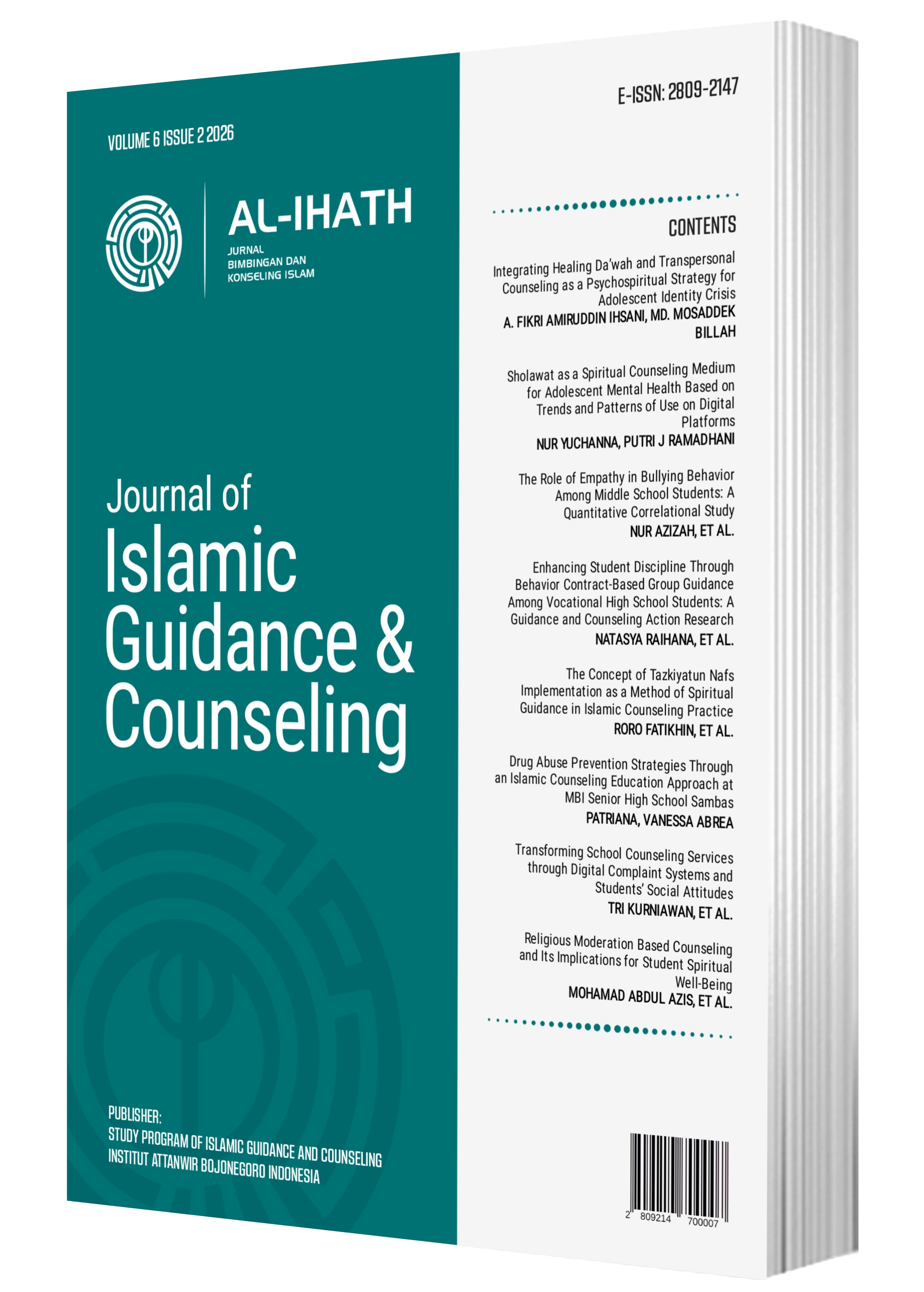
Sholawat as a Spiritual Counseling Medium for Adolescent Mental Health Based on Trends and Patterns of Use on Digital Platforms
DOI:
https://doi.org/10.53915/jbki.v6i2.175Keywords:
digital sholawat, adolescent mental health, self-compassion, emotional regulation, digital spiritualityAbstract
The rapid expansion of digital media has transformed religious practices among adolescents, enabling spiritual engagement through online platforms. This study investigates the role of digital sholawat engagement in supporting adolescent mental health through psychospiritual mechanisms. A quantitative netnographic design was employed to analyze 1,765 publicly accessible sholawat contents distributed across YouTube, TikTok, Instagram, Spotify, and X between January 2020 and December 2025. A total of 8,675 adolescent-generated interactions were examined to identify patterns of engagement and psychological responses. Partial Least Squares Structural Equation Modeling (PLS-SEM) using SmartPLS 4 was applied to evaluate the relationships among Digital Sholawat Engagement (DSE), Self-Compassion (SC), Emotional Regulation (ER), and Mental Health (MH). The findings revealed a substantial increase in digital sholawat consumption and interaction over the observation period. Thematic analysis showed that emotional calmness, stress reduction, and spiritual connectedness were the most dominant outcomes reported by adolescents. The structural model demonstrated significant positive relationships between DSE and SC (β = 0.345, p < 0.001), DSE and ER (β = 0.412, p < 0.001), SC and ER (β = 0.287, p < 0.001), SC and MH (β = 0.389, p < 0.001), and ER and MH (β = 0.361, p < 0.001). The model explained 45.8% of the variance in adolescent mental health. These findings indicate that digital sholawat functions as a culturally relevant psychospiritual resource that promotes self-compassion, strengthens emotional regulation, and contributes positively to adolescent mental health. The study offers empirical evidence for integrating digital spirituality into preventive mental health interventions and adolescent counseling practices.
References
Afrashteh, M. Y., & Hasani, F. (2022). Mindfulness and psychological well-being in adolescents: The mediating role of self-compassion, emotional dysregulation and cognitive flexibility. Borderline Personality Disorder and Emotion Dysregulation, 9(22), 1–12. https://doi.org/10.1186/s40479-022-00192-y
Aggarwal, S., Wright, J., Morgan, A., Patton, G., & Reavley, N. (2023). Religiosity and spirituality in the prevention and management of depression and anxiety in young people: A systematic review and meta-analysis. BMC Psychiatry, 23(1), 729. https://doi.org/10.1186/s12888-023-05091-2
Anggraini, R. (2024). The role of Islamic spirituality in promoting mental health and well-being: A systematic literature review. Islamic Studies Journal, 1(2), 92–111. https://doi.org/10.62207/qzs01c23
Azam, A. N., Rahmatullah, A. S., & Khilmiyah, A. (2023). Effects of self-compassion and self-disclosure on mental health through spirituality: A study on adolescents in orphanages. Islamic Guidance and Counseling Journal, 6(2), 233–248. https://doi.org/10.25217/0020236395700
Best, P., Manktelow, R., & Taylor, B. (2021). Online communication and adolescent well-being. Cyberpsychology, Behavior, and Social Networking, 24(2), 83–89. https://doi.org/10.1089/cyber.2020.0291
Bluth, K., Campo, R. A., Mullarkey, M., Broderick, P. C., & Gaylord, S. A. (2016). Within-person changes in mindfulness and self-compassion predict enhanced emotional well-being in healthy but stressed adolescents. Journal of Adolescence, 49, 204–217. https://doi.org/10.1016/j.adolescence.2016.03.016
Captari, L. E., Hook, J. N., Hoyt, W., Davis, D. E., McElroy-Heltzel, S., & Worthington, E. L. (2020). Integrating clients’ religion and spirituality within psychotherapy. Psychotherapy, 57(3), 301–316. https://doi.org/10.1037/pst0000279
Cetinkaya, M., & Billings, J. (2024). Systematic review of the relationship between Islamic-Sufi spirituality and practice and mental well-being. Mental Health, Religion & Culture, 26(10), 1065–1080. https://doi.org/10.1080/13674676.2023.2256265
Cowden, R. G., & Worthington, E. L. (2021). Religious coping and psychological adjustment. Mental Health, Religion & Culture, 24(5), 455–471. https://doi.org/10.1080/13674676.2021.1912047
Creswell, J. D. (2017). Mindfulness interventions. Annual Review of Psychology, 68, 491–516. https://doi.org/10.1146/annurev-psych-042716-051139
Davis, E. B., Choe, E., Meyers, J., Wade, N., Varjas, K., Gifford, A., Quinn, A., Hook, J. N., Van Tongeren, D. R., Griffin, B. J., & Worthington, E. L. (2021). Thankful for the little things: Gratitude and mental health. The Journal of Positive Psychology, 16(2), 230–238. https://doi.org/10.1080/17439760.2020.1716055
Dawel, A., O’Kearney, R., McKone, E., & Palermo, R. (2020). Not just ‘sticky eyes’: Social attention and emotion regulation. Emotion, 20(1), 62–75. https://doi.org/10.1037/emo0000548
Domhardt, M., Steubl, L., Boettcher, J., & Baumeister, H. (2021). Digital health interventions for youth mental health. European Child & Adolescent Psychiatry, 30(5), 743–757. https://doi.org/10.1007/s00787-020-01595-9
Fusar-Poli, P., Correll, C. U., Arango, C., Berk, M., Patel, V., & Ioannidis, J. P. A. (2021). Preventive psychiatry: A blueprint for improving adolescent mental health. World Psychiatry, 20(2), 200–221. https://doi.org/10.1002/wps.20869
Helmy, F. R., Perdina, G., & Ludfia, L. (2025). Digital da’wah content as spiritual and mental support for adolescents. El-Hikmah: Jurnal Ilmu Dakwah dan Komunikasi, 22(13), 79–89. https://doi.org/10.71287/elhikmah.v22i13.434
Huda, F., Syahrudin, & Cahyanti, A. (2025). Peran majelis sholawat dalam meningkatkan kesehatan jiwa: Perspektif psikologis dan sosial. Taqorrub: Journal Bimbingan Konseling dan Dakwah, 6(1). https://doi.org/10.55380/taqorrub.v6i01.1147
King, P. E., & Boyatzis, C. J. (2020). Religious and spiritual development in adolescence. In E. M. Dowling & J. S. Gurland (Eds.), The Wiley Encyclopedia of Child and Adolescent Development. Wiley. https://doi.org/10.1002/9781119171492.wecad254
Kozinets, R. V. (2020). E-tourism research, cultural understanding, and netnography. In Z. Xiang, M. Fuchs, U. Gretzel, & W. Höpken (Eds.), Handbook of e-Tourism. Springer. https://doi.org/10.1007/978-3-030-05324-6_43-1
Lim, E. J., Wong, C. H., & Chin, Y. S. (2022). Mental health and social media use among adolescents. Frontiers in Psychiatry, 13, 1012345. https://doi.org/10.3389/fpsyt.2022.1012345
Loades, M. E., Chatburn, E., Higson-Sweeney, N., Reynolds, S., Shafran, R., Brigden, A., Linney, C., McManus, M. N., Borwick, C., & Crawley, E. (2020). Rapid systematic review: The impact of social isolation and loneliness on the mental health of children and adolescents in the context of COVID-19. Journal of the American Academy of Child & Adolescent Psychiatry, 59(11), 1218–1239.e3. https://doi.org/10.1016/j.jaac.2020.05.009
López, A., Sanderman, R., Smink, A., Zhang, Y., van Sonderen, E., Ranchor, A., & Schroevers, M. J. (2018). A reconsideration of the self-compassion scale’s total score. PLoS ONE, 13(7), e0200936. https://doi.org/10.1371/journal.pone.0200936
MacBeth, A., & Gumley, A. (2016). Exploring compassion: A meta-analysis. Clinical Psychology Review, 40, 1–12. https://doi.org/10.1016/j.cpr.2015.06.003
Marsh, I. C., Chan, S. W. Y., & Macbeth, A. (2018). Self-compassion and psychological distress. Clinical Psychology Review, 58, 1–12. https://doi.org/10.1016/j.cpr.2017.09.004
Nasim, A., & Kausar, R. (2020). Spirituality and resilience among Muslim adolescents. Journal of Religion and Health, 59(5), 2425–2440. https://doi.org/10.1007/s10943-019-00924-8
Neff, K. D., & Germer, C. K. (2018). The mindful self-compassion program. Current Opinion in Psychology, 28, 1–6. https://doi.org/10.1016/j.copsyc.2018.10.026
Owens, J., Rassool, G. H., Bernstein, J., Latif, S., & Aboul-Enein, B. H. (2023). Interventions using the Qur'an to promote mental health: A systematic scoping review. Journal of Mental Health, 32(4), 842–862. https://doi.org/10.1080/09638237.2023.2232449
Odgers, C. L., & Jensen, M. R. (2020). Annual research review: Adolescent mental health in the digital age. Journal of Child Psychology and Psychiatry, 61(3), 336–348. https://doi.org/10.1111/jcpp.13190
Park, C. L. (2021). Religion and meaning-making in the context of stress and trauma. Journal of Social Issues, 77(4), 1018–1046. https://doi.org/10.1111/josi.12454
Razza, R. A., Liu, Q., & Feng, R. (2025). Cultivating adolescents’ self-compassion through mindfulness: The role of self-regulation at both the individual- and classroom-level. Contemporary School Psychology, 29, 843–854. https://doi.org/10.1007/s40688-025-00548-5
Rideout, V., & Fox, S. (2021). Digital health practices among adolescents. Journal of Medical Internet Research, 23(5), e23402. https://doi.org/10.2196/23402
Rosmalina, A. (2024). Urgensi pendidikan kesehatan mental secara Islami pada remaja di era digital. Prophetic: Professional, Empathy, Islamic Counseling Journal, 7(1), 1–15. https://doi.org/10.24235/prophetic.v7i1.18384
Rosmalina, A., Bilad, H. E., Handayani, H., & Affendi, H. (2022). Islamic mental health education for adolescents in the digital era. International Journal of Educational Qualitative Quantitative Research, 2(1), 1–12. https://doi.org/10.58418/ijeqqr.v2i1.39
Rosmarin, D. H., Pirutinsky, S., & Siev, J. (2020). Religion, spirituality, and mental health. The Lancet Psychiatry, 7(5), 410–411. https://doi.org/10.1016/S2215-0366(20)30048-1
Syafitri, N., Lubis, R., Indrawan, Y. F., & Choong, T. C. (2024). Self-compassion: Unveiling mental health through emotion regulation in high-school students. Tazkiya Journal of Psychology, 12(1), 1–14. https://doi.org/10.15408/tazkiya.v12i1.37794
Tanaka, S. (2025). Cultural diversity in beliefs regarding mental illness: Indonesian Muslim help-seeking patterns. Frontiers in Psychology, 16, 1524680. https://doi.org/10.3389/fpsyg.2025.1524680
Twenge, J. M. (2020). Increases in depression, self-harm, and suicide among adolescents. Journal of Adolescence, 79, 134–141. https://doi.org/10.1016/j.adolescence.2019.12.004
Utari, I. N. D., & Hamid, A. Y. S. (2021). Academic stress in adolescent students of an Islamic-based school: The correlation with parenting style and spirituality. Journal of Public Health Research, 10(2). https://doi.org/10.4081/jphr.2021.2330
Valkenburg, P. M., Meier, A., & Beyens, I. (2022). Social media use and its impact on adolescent mental health. Current Opinion in Psychology, 44, 58–68. https://doi.org/10.1016/j.copsyc.2021.08.017
Vannucci, A., Simpson, E. G., Gagnon, S., & Ohannessian, C. M. (2020). Social media use and anxiety in emerging adults. Journal of Affective Disorders, 207, 163–166. https://doi.org/10.1016/j.jad.2016.08.040
Verma, A., Islam, S., Moghaddam, V., & Anwar, A. (2023). Digital emotion regulation on social media. arXiv. https://arxiv.org/abs/2307.13187
Wardani, R. K., & Maulidia, R. D. J. (2026). Adolescents’ mental health: Can memorizing the Qur’an affect it? Jurnal Promkes, 14(1), 36–44. https://doi.org/10.20473/jpk.V14.I1.2026.36-44
Wulantika, W. (2025). The effectiveness of group-based interventions in enhancing self-compassion: A systematic literature review. Counsenesia Indonesian Journal of Guidance and Counseling, 6(2), 1–14. https://doi.org/10.36728/cijgc.v6i2.5701
Yıldırım, M., Arslan, G., & Wong, P. T. P. (2022). Meaningful living, resilience, affective balance, and psychological health. Current Psychology, 41(11), 8038–8050. https://doi.org/10.1007/s12144-020-01144-8
Zhang, H., Chi, P., Long, H., & Ren, X. (2021). Religious coping and mental health among adolescents. Journal of Religion and Health, 60(4), 2396–2414. https://doi.org/10.1007/s10943-021-01236-4
Downloads
Published
Issue
Section
License
Copyright (c) 2026 Nur Yuchanna, Putri J Ramadhani

This work is licensed under a Creative Commons Attribution-ShareAlike 4.0 International License.
Authors who publish with this journal agree to the following terms:
- Authors retain copyright and grant the journal right of first publication with the work simultaneously licensed under a Creative Commons Attribution License that allows others to share the work with an acknowledgement of the work's authorship and initial publication in this journal.
- Authors are able to enter into separate, additional contractual arrangements for the non-exclusive distribution of the journal's published version of the work (e.g., post it to an institutional repository or publish it in a book), with an acknowledgement of its initial publication in this journal.
- Authors are permitted and encouraged to post their work online (e.g., in institutional repositories or on their website) prior to and during the submission process, as it can lead to productive exchanges, as well as earlier and greater citation of published work.