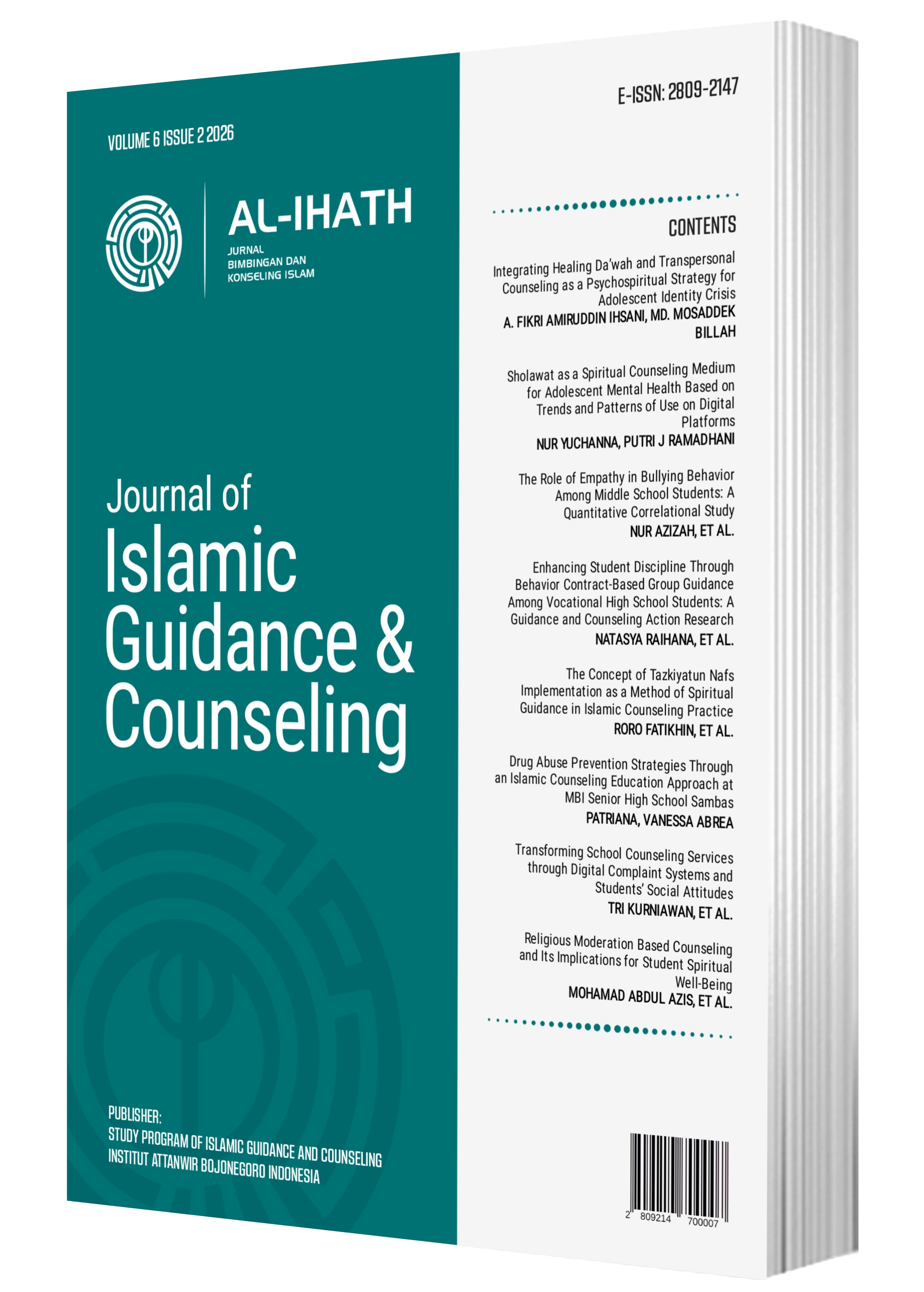
Integrating Healing Da’wah and Transpersonal Counseling as a Psychospiritual Strategy for Adolescent Identity Crisis
DOI:
https://doi.org/10.53915/jbki.v6i2.148Keywords:
adolescent identity crisis, psychospiritual counseling, healing da’wah, transpersonal psychology, spiritualityAbstract
Adolescent identity crisis has increasingly emerged as a multidimensional psychosocial phenomenon characterized not only by emotional instability and social confusion but also by spiritual disconnection and existential uncertainty. This study aims to synthesize contemporary literature on adolescent identity crisis and propose an integrative psychospiritual framework combining healing da’wah and transpersonal counseling as a holistic intervention strategy. A qualitative literature review design was employed, drawing from peer-reviewed international publications indexed in reputable databases over the last two decades. The findings indicate that adolescent identity development is strongly influenced by digital exposure, social comparison, weakened interpersonal relationships, and declining spiritual engagement. Conventional counseling approaches, while effective in addressing cognitive and behavioral aspects, are often insufficient in resolving deeper existential and spiritual concerns. The synthesis further reveals that spirituality-based interventions contribute significantly to emotional regulation, resilience enhancement, and meaning reconstruction among adolescents. Healing da’wah emphasizes compassionate communication, moral reflection, and spiritual reorientation, while transpersonal counseling focuses on consciousness expansion, mindfulness, and self-transcendence. The integration of both approaches demonstrates strong potential as a culturally responsive and psychospiritually grounded framework for addressing adolescent identity crisis in a more comprehensive manner. The study concludes that adolescent mental health interventions require a shift toward holistic models that incorporate psychological, social, and spiritual dimensions simultaneously.
References
Aldao, A., Sheppes, G., & Gross, J. J. (2016). Emotion regulation flexibility. Cognitive Therapy and Research, 40(3), 263–278. https://doi.org/10.1007/s10608-014-9662-4
Arnett, J. J. (2015). Emerging adulthood: The winding road from the late teens through the twenties. Oxford University Press. https://doi.org/10.1093/acprof:oso/9780199929382.001.0001
Badri, M. B. (2017). Counseling and psychotherapy from an Islamic perspective. International Journal of Psychotherapy, 21(2), 34–45. https://doi.org/10.1080/13548506.2017.1288436
Berkeljon, A., & Baldwin, S. A. (2009). An introduction to meta-analysis for psychotherapy outcome research. Psychotherapy Research, 19(4–5), 511–518. https://doi.org/10.1080/10503300802621172
Booker, C. L., Kelly, Y. J., & Sacker, A. (2018). Gender differences in social media interaction and well-being. BMC Public Health, 18(1), 321. https://doi.org/10.1186/s12889-018-5220-4
Burrow, A. L., & Hill, P. L. (2015). Purpose buffers negative mood. Personality and Social Psychology Bulletin, 41(10), 1359–1369. https://doi.org/10.1177/0146167215599749
Captari, L. E., Hook, J. N., Hoyt, W., Davis, D. E., McElroy-Heltzel, S. E., & Worthington, E. L. (2018). Integrating religion and spirituality in psychotherapy. Psychology of Religion and Spirituality, 10(1), 3–12. https://doi.org/10.1037/rel0000149
Casey, B. J., Jones, R. M., & Hare, T. A. (2019). The adolescent brain. Annals of the New York Academy of Sciences, 1021(1), 111–126. https://doi.org/10.1196/annals.1308.009
Compas, B. E., Jaser, S. S., Bettis, A. H., Watson, K. H., Gruhn, M. A., Dunbar, J. P., Williams, E., & Thigpen, J. C. (2017). Emotion regulation in adolescence. Developmental Psychology, 53(9), 1719–1739. https://doi.org/10.1037/dev0000395
Davis, D. L., & Vago, D. R. (2013). Mindfulness and mental health. Clinical Psychology Review, 33(6), 777–790. https://doi.org/10.1016/j.cpr.2013.05.004
Davis, D. L., Hook, J. N., Van Tongeren, D. R., & Worthington, E. L. (2021). Psychology of religion in counseling. The Counseling Psychologist, 49(1), 5–35. https://doi.org/10.1177/0011000020951336
Eisenberg, N., Spinrad, T. L., & Eggum, N. D. (2010). Emotion-related self-regulation and its relation to children's maladjustment. Annual Review of Clinical Psychology, 6, 495–525. https://doi.org/10.1146/annurev.clinpsy.121208.131208
Exline, J. J., Pargament, K. I., Grubbs, J. B., & Yali, A. M. (2020). The psychology of religion and spirituality. Annual Review of Psychology, 71, 203–226. https://doi.org/10.1146/annurev-psych-010419-050934
George, M. J., Russell, M. A., Piontak, J. R., & Odgers, C. L. (2018). Digital technology and adolescent mental health. Child Development, 89(1), 78–88. https://doi.org/10.1111/cdev.12819
Glück, J., & Bluck, S. (2019). Wisdom and well-being. Journal of Personality, 87(5), 1089–1106. https://doi.org/10.1111/jopy.12441
Goldberg, S. B., et al. (2018). Mindfulness-based interventions. Clinical Psychology Review, 59, 52–60. https://doi.org/10.1016/j.cpr.2017.10.003
Gross, J. J. (2015). Emotion regulation: Current status and future prospects. Psychological Inquiry, 26(1), 1–26. https://doi.org/10.1080/1047840X.2014.940781
Gunn III, J. F., Lester, D., Haines, J., & Williams, C. L. (2017). Suicide ideation predictors. Current Psychology, 36(3), 688–695. https://doi.org/10.1007/s12144-016-9443-7
Hadden, B. W., & Smith, C. V. (2019). Meaning in life and adolescent well-being. Journal of Positive Psychology, 14(4), 1–12. https://doi.org/10.1080/17439760.2018.1497693
Hartelius, G., Caplan, M., & Rardin, M. A. (2017). Transpersonal psychology overview. Journal of Transpersonal Psychology, 49(2), 1–20. https://doi.org/10.1177/0022167817746306
Hölzel, B. K., et al. (2011). Mindfulness practice and brain changes. Psychiatry Research: Neuroimaging, 191(1), 36–43. https://doi.org/10.1016/j.pscychresns.2010.08.006
Hook, J. N., Davis, D. E., Owen, J., Worthington, E. L. (2016). Cultural humility in psychotherapy. Journal of Clinical Psychology, 72(3), 193–205. https://doi.org/10.1002/jclp.22266
Keles, B., McCrae, N., & Grealish, A. (2020). Social media and adolescent mental health. International Journal of Adolescence and Youth, 25(1), 79–93. https://doi.org/10.1080/02673843.2019.1590851
King, P. E., & Boyatzis, C. J. (2015). Spiritual development in adolescence. In R. M. Lerner (Ed.), Handbook of child psychology and developmental science. Wiley. https://doi.org/10.1002/9781118963418
Klimstra, T. A., & Denissen, J. J. A. (2017). Personality development in adolescence. European Journal of Personality, 31(3), 221–223. https://doi.org/10.1002/per.2108
Koenig, H. G. (2018). Religion and mental health. Harvard Review of Psychiatry, 26(5), 282–293. https://doi.org/10.1097/HRP.0000000000000183
Kroger, J., Martinussen, M., & Marcia, J. E. (2019). Identity development in adolescence. Journal of Adolescence, 72, 1–10. https://doi.org/10.1016/j.adolescence.2019.01.001
Li, S., et al. (2016). Spirituality and adolescent resilience. Journal of Adolescence, 49, 1–10. https://doi.org/10.1016/j.adolescence.2016.02.003
Malinakova, K., et al. (2018). Spiritual experience scale validation. International Journal of Environmental Research and Public Health, 15(7), 1480. https://doi.org/10.3390/ijerph15071480
Martela, F., & Steger, M. F. (2016). Meaning in life. Journal of Positive Psychology, 11(5), 1–14. https://doi.org/10.1080/17439760.2015.1137623
McLaughlin, K. A., et al. (2019). Emotion dysregulation in youth. Annual Review of Clinical Psychology, 15, 1–25. https://doi.org/10.1146/annurev-clinpsy-050718-095709
Meeus, W. (2018). Adolescent identity formation. Child Development Perspectives, 12(2), 95–100. https://doi.org/10.1111/cdep.12260
Nesi, J., Choukas-Bradley, S., & Prinstein, M. J. (2018). Social media and peer relations. Clinical Psychological Science, 6(3), 393–405. https://doi.org/10.1177/2167702617747055
Odgers, C. L. (2018). Smartphones and adolescent health. Nature Human Behaviour, 2, 345–350. https://doi.org/10.1038/s41562-018-0308-0
Odgers, C. L., & Jensen, M. R. (2020). Adolescent mental health in digital age. Journal of Child Psychology and Psychiatry, 61(3), 336–348. https://doi.org/10.1111/jcpp.13190
Orben, A., & Przybylski, A. K. (2019). Digital technology and well-being. Nature Human Behaviour, 3, 173–182. https://doi.org/10.1038/s41562-018-0506-1
Paad, N. S., Syed Muhsin, S. B., & Zainal Abidin, M. S. (2021). Islamic psychospiritual implementation in motivational model of adolescents' self-development. Afkar: Jurnal Akidah & Pemikiran Islam, 23(2), 405–444. https://doi.org/10.22452/afkar.vol23no2.11
Park, C. L. (2017). Meaning systems and health. Journal of Behavioral Medicine, 40(5), 735–746. https://doi.org/10.1007/s10865-017-9847-7
Pargament, K. I. (2013). Meaning-making and spirituality. American Psychologist, 68(6), 457–474. https://doi.org/10.1037/a0033142
Pearce, M. J., et al. (2018). Religion and adolescent well-being. Social Science & Medicine, 210, 1–10. https://doi.org/10.1016/j.socscimed.2018.04.023
Patel, V., et al. (2018). Global mental health in adolescents. The Lancet, 392(10163), 1553–1598. https://doi.org/10.1016/S0140-6736(18)31533-1
Rosmarin, D. H., et al. (2019). Spirituality in clinical practice. Psychotherapy Research, 29(6), 1–14. https://doi.org/10.1080/10503307.2017.1393573
Ryff, C. D. (2019). Psychological well-being. Psychological Inquiry, 30(4), 1–10. https://doi.org/10.1080/1047840X.2019.1639222
Sawyer, S. M., et al. (2018). Adolescence and global health. The Lancet, 379(9826), 1630–1640. https://doi.org/10.1016/S0140-6736(12)60072-5
Schnell, T. (2021). Meaning in life. Journal of Happiness Studies, 22(5), 1–25. https://doi.org/10.1007/s10902-020-00248-7
Seiffge-Krenke, I., Persike, M., & Silbereisen, R. K. (2016). Adolescent coping strategies. Anxiety, Stress & Coping, 29(1), 38–59. https://doi.org/10.1080/10615806.2015.1021249
Snyder, H. (2019). Literature review as a research methodology: An overview and guidelines. Journal of Business Research, 104, 333–339. https://doi.org/10.1016/j.jbusres.2019.07.039
Steger, M. F., et al. (2015). Meaning in life and well-being. Journal of Positive Psychology, 10(3), 1–10. https://doi.org/10.1080/17439760.2014.996760
Tang, Y. Y., et al. (2015). Mindfulness neuroscience. Nature Reviews Neuroscience, 16(7), 1–10. https://doi.org/10.1038/nrn3916
Twenge, J. M., Joiner, T. E., Rogers, M. L., & Martin, G. N. (2021). Digital media and mental health trends. Clinical Psychological Science, 9(1), 1–14. https://doi.org/10.1177/2167702620948168
Van der Kaap-Deeder, J., et al. (2019). Identity and motivation in adolescence. Journal of Youth and Adolescence, 48(2), 336–350. https://doi.org/10.1007/s10964-018-0923-7
Vieten, C., & Lukoff, D. (2022). Spiritual competencies in clinical practice. Spirituality in Clinical Practice, 9(1), 1–12. https://doi.org/10.1037/scp0000266
Wilt, J. A., Grubbs, J. B., Exline, J. J., & Pargament, K. I. (2017). Spiritual struggles and personality. Personality and Individual Differences, 105, 197–204. https://doi.org/10.1016/j.paid.2016.09.047
Wong, P. T. P. (2016). Meaning-centered counseling. Counselling Psychology Quarterly, 29(2), 1–20. https://doi.org/10.1080/09515070.2015.1131899
Worthington, E. L., Hook, J. N., Davis, E. D., & McDaniel, M. A. (2011). Religion and psychotherapy integration. Journal of Clinical Psychology, 67(2), 123–135. https://doi.org/10.1002/jclp.20754
Xiao, Y., & Watson, M. (2019). Guidance on conducting a systematic literature review. Journal of Planning Education and Research, 39(1), 93–112. https://doi.org/10.1177/0739456X17723971
Zoogman, S., Goldberg, S. B., Hoyt, W. T., & Miller, L. (2015). Mindfulness interventions for youth. Journal of Child and Family Studies, 24(8), 1–15. https://doi.org/10.1007/s10826-014-9998-9
Downloads
Published
Issue
Section
License
Copyright (c) 2026 A. Fikri Amiruddin Ihsani, Md. Mosaddek Billah

This work is licensed under a Creative Commons Attribution-ShareAlike 4.0 International License.
Authors who publish with this journal agree to the following terms:
- Authors retain copyright and grant the journal right of first publication with the work simultaneously licensed under a Creative Commons Attribution License that allows others to share the work with an acknowledgement of the work's authorship and initial publication in this journal.
- Authors are able to enter into separate, additional contractual arrangements for the non-exclusive distribution of the journal's published version of the work (e.g., post it to an institutional repository or publish it in a book), with an acknowledgement of its initial publication in this journal.
- Authors are permitted and encouraged to post their work online (e.g., in institutional repositories or on their website) prior to and during the submission process, as it can lead to productive exchanges, as well as earlier and greater citation of published work.