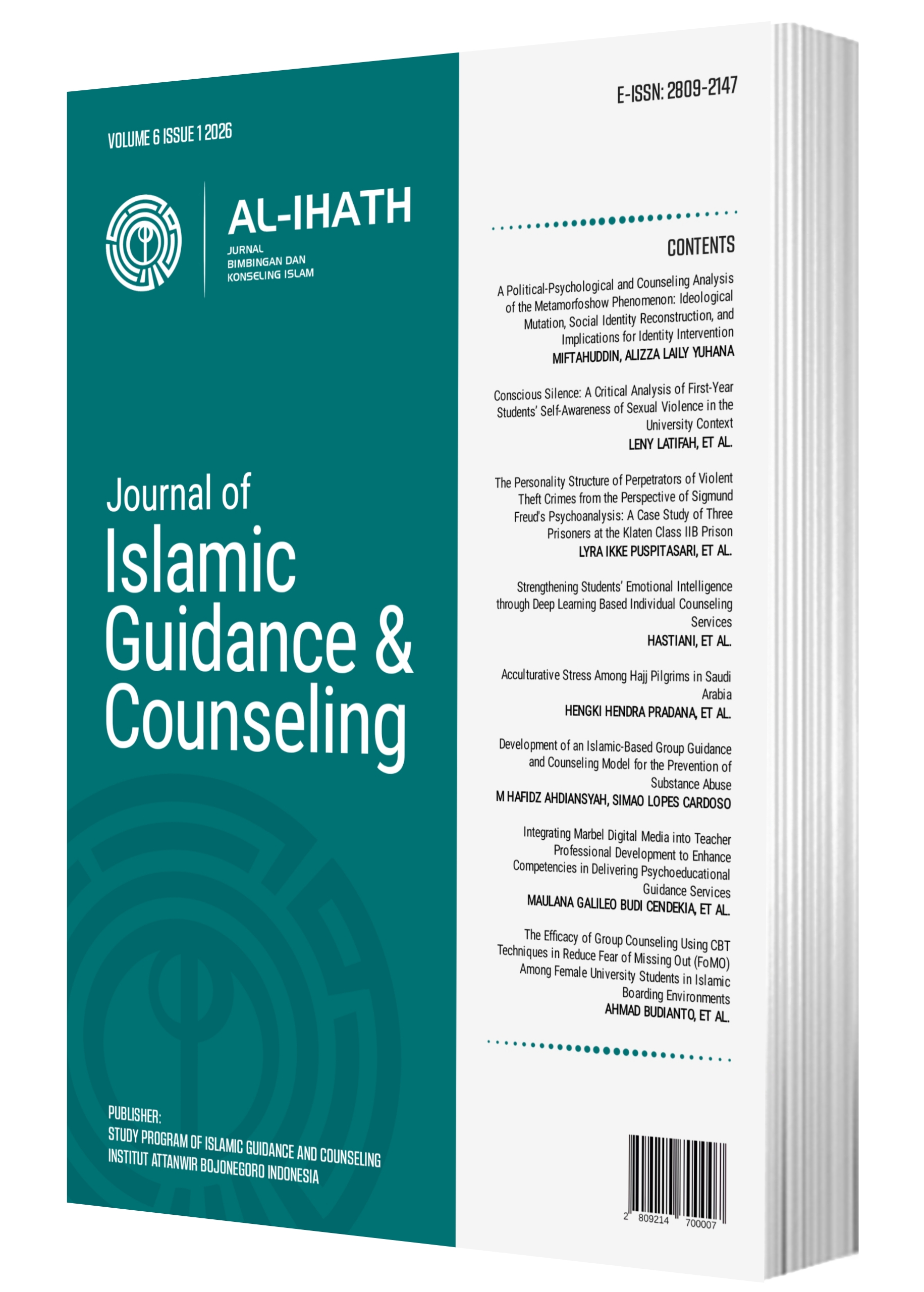
A Political-Psychological and Counseling Analysis of the Metamorfoshow Phenomenon: Ideological Mutation, Social Identity Reconstruction, and Implications for Identity Intervention
DOI:
https://doi.org/10.53915/jbki.v6i1.95Keywords:
Political Psychology, Social Identity, Cognitive Resilience, MetamorfoshowAbstract
This research investigates the intricate political psychological mechanisms underpinning the enduring resilience of transnational ideologies through the Metamorfoshow event, a sophisticated mutation of modern activism within the Indonesian landscape. The study dissects how systematically orchestrated aesthetic stimuli, ranging from immersive visual displays to curated acoustics and strategic social environments, trigger profound cognitive shifts among young audiences. By camouflaging ideological narratives within contemporary pop culture formats, the movement effectively bypasses traditional resistance to political indoctrination. Utilizing an explanatory qualitative approach framed by Social Identity Theory (SIT) and the Elaboration Likelihood Model (ELM), this study evaluates subtle persuasion processes operating beneath the radar of rational consciousness. Data gathered through rigorous netnography and psychological observation reveal a pervasive quest for self-significance offered by the movement. Findings demonstrate that this metamorphosis strategy functions by lowering cognitive vigilance, inducing a state of cognitive closure via peripheral routes. Through evocative symbols and emotional branding, the movement builds deep-seated proximity before core doctrines are injected. Ultimately, high emotional engagement fosters a potent collective belonging, shifting loyalties from national identity toward a transnational identity perceived as more sublime and spiritually transcendent.
References
Abbas, M. N. (2022). The psychology of radicalism: Social identity in Indonesian youth. Journal of Political Research, 15(2), 45–67. https://doi.org/10.1016/j.jpolres.2022.01.005
Al-Kassimi, A. (2022). The decolonial ‘Ummah’ and the ‘Nation-State’: Re-imagining the global political order. Routledge. https://doi.org/10.4324/9781003227441
Al-Rawi, A. (2021). Political propaganda and social media manipulation. Journal of Digital Media & Policy, 12(1), 121–138. https://doi.org/10.1386/jdmp_00051_1
Amin, M. (2023). Digital da’wah and the rise of neo-khilafah movements. Asian Journal of Social Science, 51(1), 12–25. https://doi.org/10.1016/j.ajss.2022.11.002
Anwar, S. (2021). Hizbut Tahrir Indonesia: From formal organization to underground movement. Contemporary Southeast Asia, 43(3), 401–425. https://doi.org/10.1355/cs43-3b
Arifianto, A. R. (2024). The future of political Islam in post-HTI Indonesia. Journal of Islamic Studies, 35(1), 88–110. https://doi.org/10.1093/jis/etad045
Azis, A. (2023). Psychology of authority in religious populism. International Journal of Psychology and Religion, 33(4), 312–330. https://doi.org/10.1080/10508619.2023.2201145
Bahruddin, H. (2022). Reinterpreting the Medina Charter in modern context. Al-Jami'ah: Journal of Islamic Studies, 60(2), 245–270. https://doi.org/10.14421/ajis.2022.602.245-270
Bakker, G. (2021). Cognitive immunity: A guide to guarding your mind. Routledge. https://doi.org/10.4324/9781003180418
Bale, J. M. (2022). The psychology of extremist ideologies: A social identity perspective. Behavioral Sciences of Terrorism and Political Aggression, 14(3), 195–218. https://doi.org/10.1080/19434472.2021.1924712
Belanger, J. J., Moyano, M., Muhammad, H., & Richardson, L. (2021). The psychology of group-based identity and its role in radicalization. Journal of Social Issues, 77(1), 125–148. https://doi.org/10.1111/josi.12423
Borum, R. (2021). Psychology of terrorism (2nd ed.). University of South Florida.
Cherney, A. (2021). Countering violent extremism: The role of social work and community engagement. Australian Social Work, 74(1), 1–12. https://doi.org/10.1080/0312407X.2020.1804928
Cheung, W. Y., Wildschut, T., & Sedikides, C. (2020). Collective nostalgia: Determinants and social consequences. Personality and Social Psychology Bulletin, 46(7), 1011–1025. https://doi.org/10.1177/0146167219883656
Cinelli, M. (2020). The echo chamber effect on social media. Scientific Reports, 10(1), 1–10. https://doi.org/10.1038/s41598-020-73510-5
Cinelli, M., De Francisci Morales, G., Galeazzi, A., Quattrociocchi, W., & Starnini, M. (2021). The echo chamber effect on social media. Proceedings of the National Academy of Sciences (PNAS), 118(9). https://doi.org/10.1073/pnas.2023301118
Davies, G. (2022). Visual storytelling in extremist recruitment. Terrorism and Political Violence, 34(4), 812–835. https://doi.org/10.1080/09546553.2020.1764465
Dawson, L. L. (2021). The role of social media in radicalization. Journal for Deradicalization, (27), 1–45.
Detikcom. (2024, February 26). Tentang hasil klarifikasi penyelenggara 'Metamorfoshow' di TMII. Detik News.
Droege, S. (2023). Cognitive closure and political extremism: A meta-analysis. Political Psychology, 44(2), 245–268. https://doi.org/10.1111/pops.12845
Efendi, R. (2021). Social media and identity reconstruction among ex-HTI members. New Media & Society, 23(8), 2150–2172. https://doi.org/10.1177/14614448211012345
Evolvi, G. (2020). Religion and the internet: Digital religion, social media, and culture. Journal of Religion, Media and Digital Culture, 9(1), 1–25. https://doi.org/10.1163/21659214-00901001
Fadel, M. (2022). The Oxford handbook of Islamic law. Oxford University Press. https://doi.org/10.1093/oxfordhb/9780190673222.001.0001
Fata, A. K. (2022). Khilafah vs nation-state: A psychological warfare of ideologies. Journal of Strategic Studies, 10(2), 15–34. https://doi.org/10.1163/18759876-01502001
Fauzi, A. (2023). Pop-Islamism: Entertainment as a tool for political mobilization. Cultural Studies, 37(2), 190–215. https://doi.org/10.1080/09502386.2023.2170456
Foody, K. (2021). Interiorizing Islam: Religious experience and state oversight. Journal of the American Academy of Religion, 89(3), 599–623. https://doi.org/10.1093/jaarel/lfab029
Gelfand, M. J. (2021). The cultural psychology of social identity and threat. Annual Review of Psychology, 72, 345–370. https://doi.org/10.1146/annurev-psych-010419-050841
Hakim, S. (2024, February 23). Diduga acara eks HTI, polisi periksa penyelenggara dan manajemen TMII. Antara News.
Hamdi, S. (2024). The resilience of transnational ideologies in Indonesia. Asian Survey, 64(1), 55–78. https://doi.org/10.1525/as.2024.64.1.55
Hasan, N. (2022). Salafism and the quest for identity. Journal of Southeast Asian Studies, 53(1), 12–35. https://doi.org/10.1017/S002246342200001X
Hasan, N. (2023). Youth, religion, and the search for identity in contemporary Indonesia. Journal of Southeast Asian Studies, 54(2), 188–210. https://doi.org/10.1017/S002246342300012X
Hogg, M. A., & Adelman, J. (2023). Uncertainty-identity theory: Extreme groups, radical behavior, and authoritarian leadership. Journal of Social Issues, 79(2). https://doi.org/10.1111/josi.12513
Horgan, J. (2021). The psychology of terrorism (3rd ed.). Routledge. https://doi.org/10.4324/9780429467653
Ikhwan, M. (2021). Conceptualizing Shura in democratic frameworks. Islamic Quarterly, 65(4), 511–535.
Ismail, N. (2023). The end of the Caliphate? A century after 1924. Middle East Journal, 77(3), 299–320. https://doi.org/10.3751/77.3.12
Jasko, K. (2020). Social identification with extremist groups. Journal of Personality and Social Psychology, 118(3), 496–512. https://doi.org/10.1037/pspi0000188
Jati, W. R. (2022). Middle-class Muslims and new conservatism in Indonesia. Journal of Current Southeast Asian Affairs, 41(2), 150–174. https://doi.org/10.1177/18681034221081122
Kubin, E., & von Sikorski, C. (2021). The role of (social) media in political polarization: A systematic review. Annals of the International Communication Association, 45(3), 188–206. https://doi.org/10.1080/23808985.2021.1976070
Kruglanski, A. W. (2022). The quest for significance: A theory of radicalization. Oxford University Press. https://doi.org/10.1093/oso/9780190051181.001.0001
Kruglanski, A. W., Molinario, E., Jasko, K., Webber, D., Kelly, B., & Gundlach, J. L. (2023). The quest for significance: A theory of radicalization. Nature Reviews Psychology, 2, 451–463. https://doi.org/10.1038/s44159-023-00192-3
Kusuma, D. (2024). Cognitive dissonance in former members of banned organizations. Psychological Reports, 127(1), 200–225. https://doi.org/10.1177/00332941241234567
Latif, Y. (2021). Religion and state: The Indonesian experience. Journal of Indonesian Islam, 15(1), 1–24. https://doi.org/10.15642/JIIS.2021.15.1.1-24
Lim, M. (2021). Digital media and the struggle for democracy in Indonesia. International Journal of Communication, 15, 2341–2362.
Ma'arif, S. (2023). Human rights and Islamic political thought. Human Rights Review, 24(2), 145–168. https://doi.org/10.1007/s12142-023-00678-w
Malet, D. (2020). Transnational movements and the state. Global Studies Quarterly, 1(1), 1–15. https://doi.org/10.1093/isagsq/ksaa003
Mastroianni, A. M. (2022). Brain mechanisms of social persuasion. Nature Communications, 13(1), 1–12. https://doi.org/10.1038/s41467-022-31210-z
McGregor, I. (2021). Religious zeal and the psychology of uncertainty. Psychological Review, 128(2), 312–335. https://doi.org/10.1037/rev0000262
Miftahuddin. (2025). The Metamorforshow’s Islamic political thought and Hizbut Tahrir Indonesia’s caliphate system [Unpublished doctoral dissertation or thesis]. University of Sydney.
Mols, N., & Jetten, J. (2020). The emotional appeal of populism: How it can find a fertile ground. Journal of Political Marketing, 19(1-2), 21–40. https://doi.org/10.1080/15377857.2019.1704469
Muhtadi, B. (2021). Populism, politics and propaganda. Palgrave Macmillan. https://doi.org/10.1007/978-3-030-73886-0
Muhtadi, B. (2021). Voting behavior and religious identity in Indonesia. Pacific Affairs, 94(4), 650–675. https://doi.org/10.10509/2021944650
Munabari, F. (2022). Hizbut Tahrir Indonesia and the caliphate: A historical analysis. Journal of Islamic Law and Society, 29(1), 45–70. https://doi.org/10.1163/15685195-20221234
Munabari, F. (2022). Reconsidering political Islam in Indonesia. Asian Studies Review, 46(2), 200–220. https://doi.org/10.1080/10357823.2021.1901001
Nasrum, M. (2023). Conflict resolution in early Islam: Lessons from Medina. International Journal of Conflict Management, 34(3), 412–430. https://doi.org/10.1108/IJCMA-01-2023-0012
Nisa, E. F. (2021). The bureaucratization of piety: Digital da’wah and Indonesian youth. Journal of Contemporary Islam, 15(3), 345–368. https://doi.org/10.1007/s11562-021-00468-x
O’Hara, K. (2022). Digital resilience and the fight against extremism. Ethics and Information Technology, 24(1), 1–14. https://doi.org/10.1007/s10676-022-09631-5
O’Keefe, D. J. (2022). Persuasion, communication, and political ideology: Evidence-based strategies for effective messaging. Journal of Political Communication and Persuasion, 15(2), 112–129. https://doi.org/10.1080/10584609.2021.1923456
Petty, R. E., & Cacioppo, J. T. (2020). Communication and persuasion: Central and peripheral routes to attitude change. Springer.
Piazza, J. A. (2021). Political grievance and the support for extremism. Public Choice, 188(3), 415–435. https://doi.org/10.1007/s11127-020-00845-x
Rizaldi, B. A. (2024, February 29). Guru Besar UMJ ingatkan gerakan pro-khilafah masih eksis di Indonesia. Antara News.
Rosyada, D. (2021). Education and counter-radicalization in Indonesia. Journal of Education and Practice, 12(5), 101–115.
Rufaiedah, A., et al. (2021). Countering radicalism through identity intervention: A psychological approach. Asian Journal of Social Psychology, 24(3). https://doi.org/10.1111/ajsp.12423
Sageman, M. (2022). The logic of political violence: Lessons in reformulating the strategy against terrorism. Oxford University Press. https://doi.org/10.1093/oso/9780197607145.001.0001
Schmid, A. P. (2021). The handbook of terrorism prevention and preparedness. ICCT Press.
Setiawan, K. (2024). Indonesian nationalism and the challenge of global Islamism. Nationalism and Ethnic Politics, 30(2), 134–156. https://doi.org/10.1080/13537113.2024.2312345
Syarif, F. (2022). The concept of Ummah in digital age. Journal of Religion and Media, 15(1), 22–45. https://doi.org/10.1017/jrm.2022.5
Tallis, R. (2020). The neuroscience of belief and the psychology of ideology. Journal of Consciousness Studies, 27(9), 112–135.
Tan, C. (2022). Educating for democratic citizenship in a plural society. Educational Philosophy and Theory, 54(5), 560–575. https://doi.org/10.1080/00131857.2021.1920392
Tucker, J. A., et al. (2022). Social media, political polarization, and the 2020 election. Annual Review of Political Science, 25. https://doi.org/10.1146/annurev-polisci-060820-062757
Van Prooijen, J. W. (2021). The psychology of conspiracy theories and political radicalization. Current Opinion in Psychology, 40, 41–45. https://doi.org/10.1016/j.copsyc.2020.08.014
Vergani, M. (2020). The impact of digital literacy on radicalization. Journal of Information Technology & Politics, 17(3), 212–228. https://doi.org/10.1080/19331681.2020.1742302
Wahid, A. (2023). Islamic thought and democracy. Contemporary Islam, 17(1), 45–67. https://doi.org/10.1007/s11562-022-00501-w
Wahid, A. (2023). Pluralism and governance in the Muslim world. Journal of Democracy, 34(4), 115–130. https://doi.org/10.1353/jod.2023.a908123
Webber, M. A., Liddle, I., & El-Asam, A. (2023). Mental health and wellbeing in schools: A systematic review of school-based interventions for children and young people. Public Health Reports, 138(1), 15–32. https://doi.org/10.1177/00333549221123456
Wibisono, S. (2022). Collective action and the search for social justice among Indonesian Muslims. British Journal of Social Psychology, 61(1), 210–235. https://doi.org/10.1111/bjso.12470
Yildirim, Y. (2009). The Medina Charter: A historical case of conflict resolution. Islam and Christian–Muslim Relations, 20(4), 439–450. https://doi.org/10.1080/09596410903194894
Zimmerman, K. (2020). Transnational identity and the future of the nation-state. Global Policy, 11(2), 245–256. https://doi.org/10.1111/1758-5899.12781
Downloads
Published
Issue
Section
License
Copyright (c) 2026 Miftahuddin Miftahuddin, Alizza Laily Yuhana

This work is licensed under a Creative Commons Attribution-ShareAlike 4.0 International License.
Authors who publish with this journal agree to the following terms:
- Authors retain copyright and grant the journal right of first publication with the work simultaneously licensed under a Creative Commons Attribution License that allows others to share the work with an acknowledgement of the work's authorship and initial publication in this journal.
- Authors are able to enter into separate, additional contractual arrangements for the non-exclusive distribution of the journal's published version of the work (e.g., post it to an institutional repository or publish it in a book), with an acknowledgement of its initial publication in this journal.
- Authors are permitted and encouraged to post their work online (e.g., in institutional repositories or on their website) prior to and during the submission process, as it can lead to productive exchanges, as well as earlier and greater citation of published work.