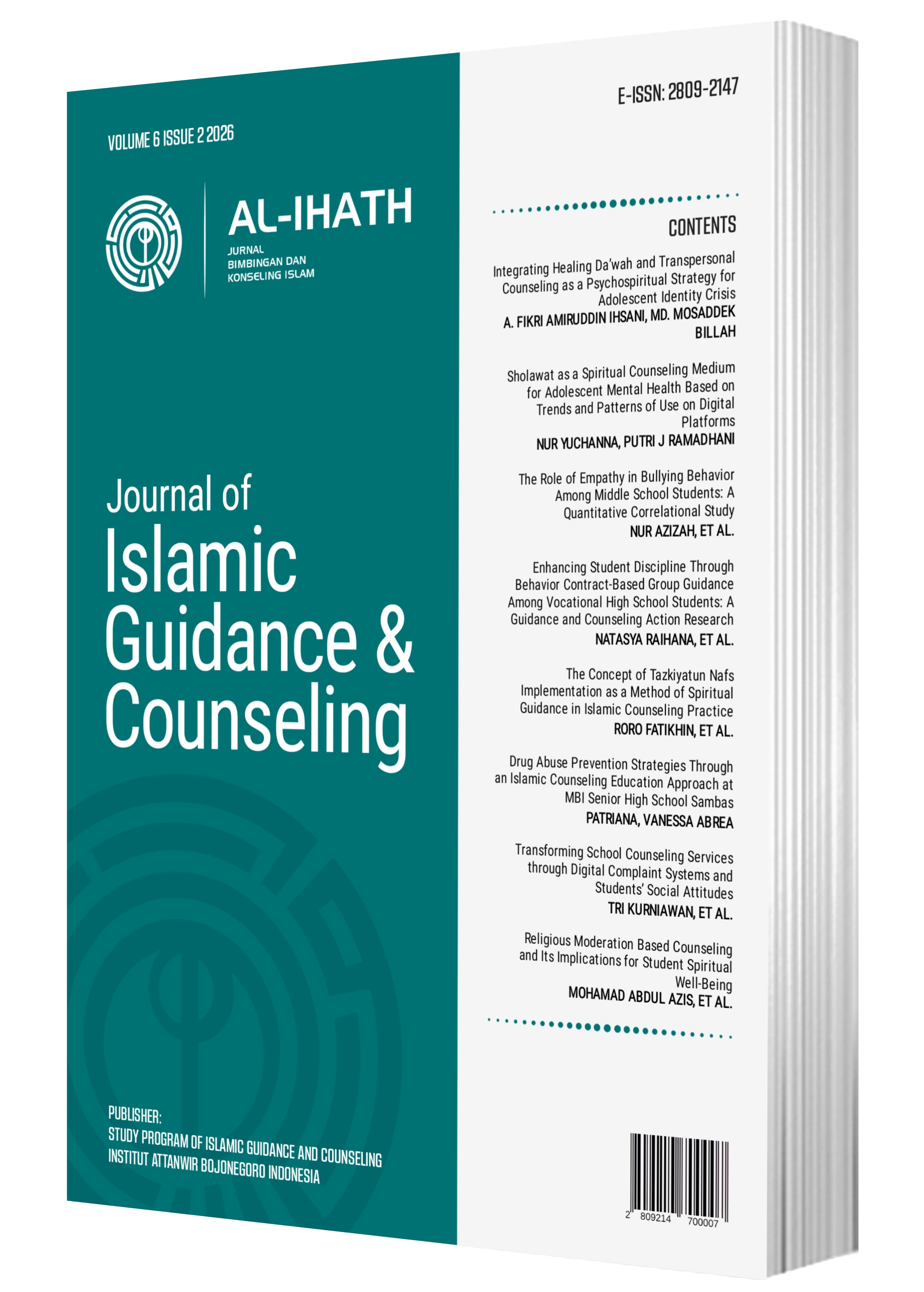
Religious Moderation Based Counseling and Its Implications for Student Spiritual Well-Being
DOI:
https://doi.org/10.53915/jbki.v6i2.94Keywords:
Religious Moderation, Religious Counseling, Spiritual Well-Being, Higher Education, Student Mental HealthAbstract
The increasing pressure of academic life, future uncertainty, and the rise of religious exclusivism among students necessitate a counseling approach that integrates spiritual values with psychological resilience. In this context, religious moderation-based counseling offers a potential framework for strengthening students' spiritual well-being while fostering an inclusive and harmonious campus environment. This study aims to explore the implementation and impact of religious moderation-based counseling on the spiritual well-being of students at the Institut Attanwir Bojonegoro. Using a qualitative phenomenological design, data were collected through in-depth intervidc vcdgy6rgc3ews with five key informants consisting of lecturers, students, and university leadership, participant observation of weekly halaqoh sessions, and relevant documentation. Data were analyzed using the Miles and Huberman model, encompassing data reduction, data display, and conclusion drawing. The findings reveal that moderation-based counseling, implemented through an inclusive curriculum, reflective activities, and humanistic dialogue, facilitates both cognitive and affective transformation among students. Students gradually shifted from rigid religious schemas toward a more adaptive, tolerant, balanced, and peaceful spiritual identity. This process contributed to reducing existential anxiety, strengthening emotional stability, and enhancing social harmony within the campus ecosystem. Religious moderation therefore serves as a robust foundation for spiritual well-being by providing students with cognitive filters and emotional resources to navigate religious diversity and the complexities of a pluralistic society. This study recommends the formal integration of moderate religious values into university counseling services as a strategic approach to strengthening students' spiritual resilience, psychological well-being, and harmonious social engagement.
References
Achmad, N., Harahap, R. H., & Ihsan, M. I. (2023). Radicalism movement in higher education in Indonesia: Students’ understanding and its prevention. Kasetsart Journal of Social Sciences, 44(1), 1–8. https://doi.org/10.34044/j.kjss.2023.44.1.13
Afwadzi, B., & Miski, M. (2021). Religious moderation in Indonesian higher educations: Literature review. Ulul Albab: Jurnal Studi Islam, 22(2), 203–231. https://doi.org/10.18860/ua.v22i2.13446
Afwadzi, B., Sumbulah, U., Ali, N., & Qudsy, S. Z. (2024). Religious moderation of Islamic university students in Indonesia: Reception of religious texts. HTS Teologiese Studies/Theological Studies, 80(1). https://doi.org/10.4102/hts.v80i1.9369
Andrian, P., & Padli, E. (2024). Religious moderation levels among the students of Islamic Education Department in the Faculty of Education and Teacher Training at UIN Mataram. Tahiro: Journal of Peace and Religious Moderation, 1(1). https://doi.org/10.20414/tahiro.v1i1.10633
Andrianto, A., Sutrisno, S., & Muqowim, M. (2025). Learning the values of religious moderation in the context of higher education. Tarbiyah: Jurnal Ilmiah Kependidikan, 14(2). https://doi.org/10.18592/tarbiyah.v14i2.15929
Belo, P., et al. (2022). Spiritual intelligence and its impact on social empathy among college students. International Journal of Educational Development, 89, 102521.
Chen, Z. J., et al. (2020). Spiritual well-being as a mediator between religiousness and depression. Journal of Happiness Studies, 21(5), 1827–1845. https://doi.org/10.1007/s10902-019-00159-y
Currier, J. M., et al. (2022). Spiritual struggle and psychological distress: A longitudinal study. Psychology of Religion and Spirituality, 14(3), 321–334.
Dabutar, R. D., Nur, W., & Al Farabi, M. (2025). Religious moderation as a strategy for student competence formation in multicultural schools. Academia Open, 10(2). https://doi.org/10.21070/acopen.10.2025.11582
Faizin, M., & Budianto, A. (2025). Cultural wisdom of the Samin tribe as a foundation for multicultural counseling practices. International Journal of Multicultural Counseling and Development, 2(2), 77–81. https://doi.org/10.31960/ijomcd.v2i2.3183
Faizin, M., Zahro, I. F., Budianto, A., & Bezanson, B. J. (2025). Cognitive Restructuring Technique Guidance Counseling to Reduce Students Academic Anxiety. Al-Ihath: Jurnal Bimbingan dan Konseling Islam, 5(2), 154-170. https://doi.org/10.53915/jbki.v5i2.500
Fisher, J. W. (2021). Assessing spiritual well-being: The SHALOM scale in educational research. Journal of Beliefs & Values, 42(3), 301–315. https://doi.org/10.1080/13617672.2020.1834241
Ghorbani, N., et al. (2019). Mindfulness and religious orientation: A study of spiritual health. Psychology of Religion and Spirituality, 11(4), 421–432. https://doi.org/10.1037/rel0000164
Hanafi, Y., Saefi, M., Diyana, T. N., Ikhsan, M. A., Faizin, N., Thoriquttyas, T., & Murtadho, N. (2022). Students’ perspectives on religious moderation: A qualitative study into religious literacy processes. HTS Teologiese Studies/Theological Studies, 78(1). https://doi.org/10.4102/hts.v79i2.9070
Halid, H., Sulaiman, S., Mantu, R., Sayogie, F., Al-Kaf, I., & Labib, M. (2025). Religion, state, and the campus: Religious moderation in the context of Islamic higher education in Indonesia. Lentera Pendidikan: Jurnal Ilmu Tarbiyah dan Keguruan, 28(2), 320–344. https://doi.org/10.24252/lp.2025v28n2i3
Helmawati, H., Marzuki, M., Hartati, R. S., & Huda, M. (2024). Islamic religious education and religious moderation at university. EDUKASI: Jurnal Penelitian Pendidikan Agama dan Keagamaan, 22(1). https://doi.org/10.32729/edukasi.v22i1.1689
Ibrahim, R., Rifa’i, A. A., Triana, Y., Supriyanto, Haryanto, S., & Mukhlasin, A. (2023). The correlation between attitude toward religious moderation and academic achievement of Islamic higher education students. Journal of Higher Education Theory and Practice, 23(18). https://doi.org/10.33423/jhetp.v23i18.6621
Ilmudinulloh, R., Gunawan, E., Bustomi, A., & Isroani, F. (2023). Strategies of Religious Moderation House in running its role on PTKI. Moderation: Jurnal Moderasi Beragama, 3(1), 16–25. https://doi.org/10.32332/moderatio.v3i1.5574
Khasanah, N., Hamzani, A. I., & Aravik, H. (2023). Religious moderation in the Islamic education system in Indonesia. QALAMUNA: Jurnal Pendidikan, Sosial, dan Agama, 15(1). https://doi.org/10.37680/qalamuna.v15i1.4115
Koenig, H. G. (2012). Religion, spirituality, and health: The research and clinical implications. ISRN Psychiatry, 2012, 278730. https://doi.org/10.5402/2012/278730
Krauss, S. E., et al. (2020). Muslim religiosity and its role in social stability among youth. Asian Journal of Social Psychology, 23(2), 214–225.
Li, M., et al. (2021). The role of spirituality in coping with academic stress. Higher Education, 82(4), 789–805.
Mahdiyyah, R., & Jasminto, J. (2025). Implementation of the concept of religious moderation in Islamic religious education for students. Urwatul Wutsqo: Jurnal Studi Kependidikan dan Keislaman, 14(1). https://doi.org/10.54437/urwatulwutsqo.v14i1.2226
Maulana, M., Suliyana, S., & Muru’uah, U. (2025). Bridging Indonesian cultures through Islam Wasatiyyah: International students’ insights on religious moderation in an Islamic higher education. Moderatio: Jurnal Moderasi Beragama, 5(2), 109–128. https://doi.org/10.32332/moderatio.v5i02.11527
Muliadi, M., Syamsidar, S., & Islam, N. (2025). Religious moderation by design: A comparative sociological da’wah study in Indonesian higher education. Jurnal Ilmiah Peuradeun, 13(2), 1549–1580. https://doi.org/10.26811/peuradeun.v13i2.1778
Murad, A. N., & Rizki, D. (2022). Development of religious moderation study on prevention of radicalism in Indonesia: A systematic literature review approach. Potensia: Jurnal Kependidikan Islam, 8(2). https://doi.org/10.24014/potensia.v8i2.20727
Naim, N., Aziz, A., & Teguh, T. (2022). Integration of madrasah diniyah learning systems for strengthening religious moderation in Indonesian universities. International Journal of Evaluation and Research in Education, 11(1), 108–116. https://doi.org/10.11591/ijere.v11i1.22210
Naim, N., Badruzaman, A., & Amalina, I. (2023). Madrasah diniyah and Ma’had Al-Jami’ah-based religious moderation policy in State Islamic University in Indonesia. Jurnal Penelitian, 20(2), 171–184. https://doi.org/10.28918/jupe.v20i2.1944
Nasir, M., & Rijal, M. K. (2021). Keeping the middle path: Mainstreaming religious moderation through Islamic higher education institutions in Indonesia. Indonesian Journal of Islam and Muslim Societies, 11(2), 213–241. https://doi.org/10.18326/ijims.v11i2.213-241
Nasution, S. M., Rosyada, D., & Iskarina, D. B. (2023). Exploring the perceptions of college students regarding radicalism and extremism: A qualitative study. IJGIE: International Journal of Graduate of Islamic Education, 4(2). https://doi.org/10.37567/ijgie.v4i2.2080
Pargament, K. I., & Lomax, J. W. (2013). Understanding and addressing religion and spirituality in clinical practice. World Psychiatry, 12(1), 26–32. https://doi.org/10.1002/wps.20033
Park, C. L. (2013). Religion and meaning. In R. F. Paloutzian & C. L. Park (Eds.), Handbook of the Psychology of Religion and Spirituality (2nd ed., pp. 357–379). Guilford Press.
Prayona, B. A., & Wahyudi, G. S. (2023). Construction of a religious moderation measuring tool for student of Mataram State Islamic University. TASAMUH: Jurnal Komunikasi dan Pengembangan Masyarakat Islam, 21(2). https://doi.org/10.20414/tasamuh.v21i2.9037
Rosmarin, D. H. (2021). Spirituality and cognitive behavioral therapy. Current Opinion in Psychology, 40, 119–124. https://doi.org/10.1016/j.copsyc.2020.09.006
Sa'idah, I., Aryani, A., Umam, A., & Toifur, T. (2024). Level of religious moderation of students: Survey analysis of attitudes and behavior. Al-Hiwar Jurnal Ilmu dan Teknik Dakwah, 12(2), 67–78. https://doi.org/10.18592/alhiwar.v12i2.14298
Syukrilla, W. A., Nihayah, Z., & Fayruz, M. (2024). Religious moderation of Indonesian Muslim adolescents. Tazkiya Journal of Psychology, 12(2). https://doi.org/10.15408/tazkiya.v12i2.38402
VanderWeele, T. J. (2021). On the promotion of human flourishing. Proceedings of the National Academy of Sciences, 118(20), e2014909118. https://doi.org/10.1073/pnas.2014909118
Villani, D., Sorgente, A., Iannello, P., & Antonietti, A. (2019). The role of spirituality and religiosity in subjective well-being of individuals with different religious status. Frontiers in Psychology, 10, 1520. https://doi.org/10.3389/fpsyg.2019.01520
Wang, Z., et al. (2020). The relationship between religiousness, spirituality, and mental health in university students. Journal of Affective Disorders, 273, 583–590.
Worthington, E. L., Jr., & Aten, J. D. (2019). Psychotherapy with religious and spiritual clients: A practical guide. Routledge.
Yasir, M., et al. (2023). Cultivating religious moderation in the digital age. Journal of Media and Religion, 22(2), 89–104.
Zahro, I. F., & Hafid, A. (2024). Pengembangan media bimbingan konseling Islam “Petualangan Menjaga Diri” untuk pencegahan sex abuse pada anak. Proceedings of International Conference on Education, Society, and Management 2024, 1(1), 166–178.
Zwingmann, C., et al. (2021). Religious and spiritual well-being in students: A cross-cultural study. Religions, 12(11), 932.
Downloads
Published
Issue
Section
License
Copyright (c) 2026 Mohamad Abdul Azis, Moch. Bakhtiar, Dawam Multazamy Rohmatullah

This work is licensed under a Creative Commons Attribution-ShareAlike 4.0 International License.
Authors who publish with this journal agree to the following terms:
- Authors retain copyright and grant the journal right of first publication with the work simultaneously licensed under a Creative Commons Attribution License that allows others to share the work with an acknowledgement of the work's authorship and initial publication in this journal.
- Authors are able to enter into separate, additional contractual arrangements for the non-exclusive distribution of the journal's published version of the work (e.g., post it to an institutional repository or publish it in a book), with an acknowledgement of its initial publication in this journal.
- Authors are permitted and encouraged to post their work online (e.g., in institutional repositories or on their website) prior to and during the submission process, as it can lead to productive exchanges, as well as earlier and greater citation of published work.