
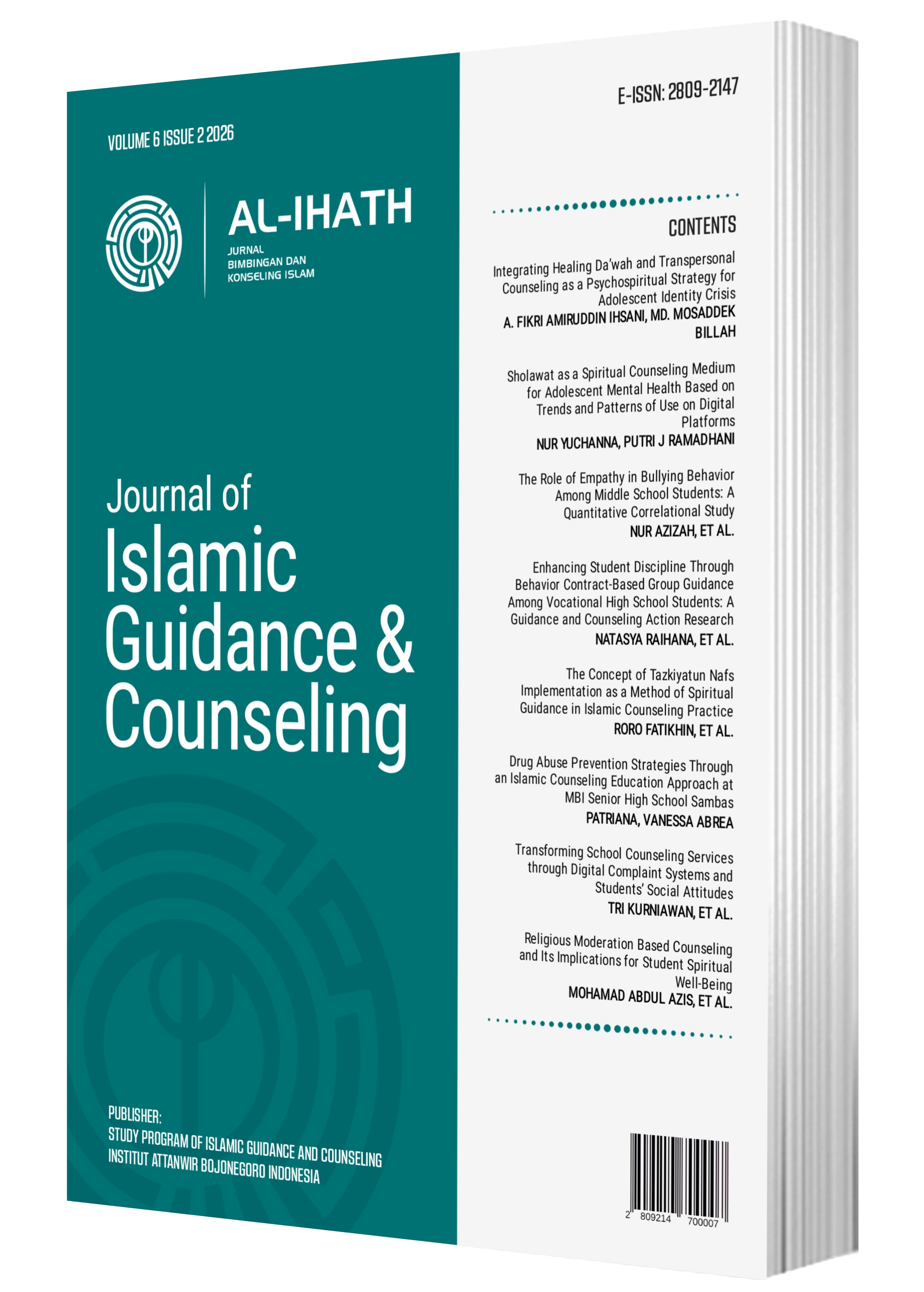
Transforming School Counseling Services through Digital Complaint Systems and Students’ Social Attitudes
DOI:
https://doi.org/10.53915/jbki.v6i2.85Keywords:
Digital Complaint System, Guidance and Counseling Management, Social AttitudesAbstract
The digital transformation of guidance and counseling services requires accessible and responsive communication channels to address students’ social and psychological concerns. This study examines the effect of implementing a digital complaint system within guidance and counseling management on the social attitudes of seventh-grade students at SMP Negeri 01 Kepahiang. A quantitative approach with an ex-post facto design was employed. The participants comprised 69 seventh-grade students selected through simple random sampling. Data were collected using two Likert-scale questionnaires measuring students’ perceptions of the digital complaint system and their social attitudes. Both instruments underwent validity and reliability testing before data collection. Data were analyzed using descriptive statistics and simple linear regression after the required assumption tests were fulfilled. The descriptive results showed that the implementation of the digital complaint system was categorized as high, while students’ social attitudes were predominantly in the medium-to-high category. Regression analysis revealed a significant positive relationship between the digital complaint system and students’ social attitudes (R = 0.672, R² = 0.452, p < .001). The coefficient of determination indicates that the digital complaint system statistically explained 45.2% of the variance in students’ social attitudes, while the remaining 54.8% was associated with other factors. These findings indicate that digital complaint systems can function beyond administrative reporting by supporting student help-seeking, early identification of social problems, and timely counseling interventions. Integrating digital complaint mechanisms into guidance and counseling management can therefore strengthen preventive and responsive services and support the development of students’ positive social attitudes.
References
Abura-Meerdink, G. A., & Albright, D. L. (2024). Effectiveness of adolescent school-based digital mental health interventions: A systematic review. Research on Social Work Practice, 34(6). https://doi.org/10.1177/10497315231201140
Acosta, J., Chinman, M., Ebener, P., Malone, P. S., Phillips, A., & Wilks, A. (2019). Understanding the relationship between perceived school climate and bullying: A mediator analysis. Journal of School Violence, 18(2), 200–215. https://doi.org/10.1080/15388220.2018.1453820
Agyapong, V. I. O., Hrabok, M., Vuong, W., Shalaby, R., Noble, A., Zolfaghari, S., & Jeyaratnam, J. (2022). Digital health interventions for the prevention and treatment of anxiety and depression in children and adolescents: A systematic review. Frontiers in Psychiatry, 13, 914331. https://doi.org/10.3389/fpsyt.2022.914331
Blomqvist, I., Gini, G., Thornberg, R., & Ttofi, M. M. (2020). Telling adults about one's plight as a victim of bullying: Student- and context-related factors predicting disclosure. Scandinavian Journal of Psychology, 61(6), 773–783. https://doi.org/10.1111/sjop.12521
Borghouts, J., Eikey, E., Mark, G., De Leon, C., Schueller, S. M., Schneider, M., Stadnick, N., Zheng, K., Mukamel, D., & Sorkin, D. H. (2021). Barriers to and facilitators of user engagement with digital mental health interventions: Systematic review. Journal of Medical Internet Research, 23(3), e24387. https://doi.org/10.2196/24387
Burns, J. M., Durkin, L. A., & Nicholas, J. (2009). Mental health of young people in the United States: What role can the internet play in reducing stigma and promoting help seeking? Journal of Adolescent Health, 45(1), 95–97. https://doi.org/10.1016/j.jadohealth.2008.12.006
Carlson, L. A., Portman, T. A. A., & Bartlett, J. R. (2006). Professional school counselors' approaches to technology. Professional School Counseling, 9(3), 252–259. https://doi.org/10.1177/2156759X0500900306
Christensen, H., Reynolds, J., & Griffiths, K. M. (2011). Electronic delivery of cognitive behavioural therapy: Current evidence and future challenges. Expert Review of Medical Devices, 8(5), 541–544. https://doi.org/10.1586/erd.11.39
Cornell, D., Shukla, K., & Konold, T. (2012). Relationships between bullying, school climate, and student risk behaviors. School Psychology Quarterly, 27(3), 154–169. https://doi.org/10.1037/a0029350
Creswell, J. W., & Creswell, J. D. (2018). Research design: Qualitative, quantitative, and mixed methods approaches (5th ed.). SAGE Publications.
Dow-Fleisner, S., Leong, A. D., & Lee, H. (2023). The interaction between peer bullying and school connectedness on youth health and wellbeing. Children and Youth Services Review, 155, 107147. https://doi.org/10.1016/j.childyouth.2023.107147
Dowling, M. J., & Carey, T. A. (2013). Victims of bullying: Whom they seek help from and why: An Australian sample. Psychology in the Schools, 50(8), 798–809. https://doi.org/10.1002/pits.21709
Dülsen, P., & Baumeister, H. (2025). Internet- and mobile-based anxiety and depression interventions for children and adolescents: Efficacy and negative effects—A systematic review and meta-analysis. European Child & Adolescent Psychiatry, 34, 101–121. https://doi.org/10.1007/s00787-024-02404-y
Farrer, L., Gulliver, A., Chan, J. K. Y., Batterham, P. J., Reynolds, J., Calear, A., Tait, R., Bennett, K., & Griffiths, K. M. (2013). Technology-based interventions for mental health in tertiary students: Systematic review. Journal of Medical Internet Research, 15(5), e101. https://doi.org/10.2196/jmir.2639
Gizzarelli, E., Burns, S., & Francis, J. (2023). School staff responses to student reports of bullying: A scoping review. Health Promotion Journal of Australia, 34(2), 508–517. https://doi.org/10.1002/hpja.680
Gulliver, A., Griffiths, K. M., & Christensen, H. (2010). Perceived barriers and facilitators to mental health help-seeking in young people: A systematic review. BMC Psychiatry, 10, 113. https://doi.org/10.1186/1471-244X-10-113
Gulliver, A., Griffiths, K. M., & Christensen, H. (2012). Barriers and facilitators to mental health help-seeking in young people: A systematic review. BMC Psychiatry, 12, 113. https://doi.org/10.1186/1471-244X-12-113
Hollis, C., Falconer, C. J., Martin, J. L., Whittington, C., Stockton, S., Glazebrook, C., & Davies, E. B. (2017). Annual Research Review: Digital health interventions for children and young people with mental health problems—A systematic and meta-review. Journal of Child Psychology and Psychiatry, 58(4), 474–503. https://doi.org/10.1111/jcpp.12663
Jin, Z., Wang, J., Xiang, G., Wang, P., Zhang, R., Li, H., & Gan, X. (2026). How does school bullying influence adolescent social adaptation? A serial mediation model of school connectedness and self-disclosure. Frontiers in Pediatrics, 14, 1747055. https://doi.org/10.3389/fped.2026.1747055
Kauer, S. D., Mangan, C., & Sanci, L. (2014). Do online mental health services improve help-seeking for young people? A systematic review. Journal of Medical Internet Research, 16(3), e66. https://doi.org/10.2196/jmir.3103
Kowalski, R. M., Giumetti, G. W., Schroeder, A. N., & Lattanner, M. R. (2014). Bullying in the digital age: A critical review and meta-analysis of cyberbullying research among youth. Psychological Bulletin, 140(4), 1073–1137. https://doi.org/10.1037/a0035618
Lattie, E. G., Adkins, E. C., Winquist, N., Stiles-Shields, C., Wafford, Q. E., & Graham, A. K. (2019). Digital mental health interventions for depression, anxiety, and enhancement of psychological well-being among college students: Systematic review. Journal of Medical Internet Research, 21(7), e12869. https://doi.org/10.2196/12869
Lehtimaki, S., Martic, J., Wahl, B., Foster, K. T., & Schwalbe, N. (2021). Evidence on digital mental health interventions for adolescents and young people: Systematic overview. Journal of Medical Internet Research, 23(4), e25847. https://doi.org/10.2196/25847
Livingstone, S., & Smith, P. K. (2014). Annual research review: Harm experienced by child users of online and mobile technologies: The nature, prevalence and management of sexual and aggressive risks in the digital age. Journal of Child Psychology and Psychiatry, 55(6), 635–654. https://doi.org/10.1111/jcpp.12197
McCabe, E., Grunin, L., Yu, G., & Strauss, S. M. (2026). The relationship between school connectedness and bullying in U.S. high school students. The Journal of School Nursing, 42(2), 163–171. https://doi.org/10.1177/10598405241311141
Mishna, F., McLuckie, A., & Saini, M. (2009). Real-world dangers in an online reality: A qualitative study examining online relationships and cyber abuse. Social Work Research, 33(2), 107–118. https://doi.org/10.1093/swr/33.2.107
Naslund, J. A., Aschbrenner, K. A., Marsch, L. A., & Bartels, S. J. (2017). The future of mental health care: Peer-to-peer support and social media. Epidemiology and Psychiatric Sciences, 26(2), 113–122. https://doi.org/10.1017/S2045796016000891
Noh, D., & Kim, H. (2022). Effectiveness of online interventions for the universal and selective prevention of mental health problems among adolescents: A systematic review and meta-analysis. Prevention Science, 24, 353–364. https://doi.org/10.1007/s11121-022-01443-8
O'Neill, A., Stapley, E., Rehman, I., & Humphrey, N. (2023). Adolescent help-seeking: An exploration of associations with perceived cause of emotional distress. Frontiers in Public Health, 11, 1183092. https://doi.org/10.3389/fpubh.2023.1183092
Odgers, C. L., & Jensen, M. R. (2020). Annual Research Review: Adolescent mental health in the digital age: Facts, fears, and future directions. Journal of Child Psychology and Psychiatry, 61(3), 336–348. https://doi.org/10.1111/jcpp.13190
Pretorius, C., Chambers, D., & Coyle, D. (2019). Young people's online help-seeking and mental health difficulties: Systematic narrative review. Journal of Medical Internet Research, 21(11), e13873. https://doi.org/10.2196/13873
Pretorius, C., Chambers, D., Cowan, B., & Coyle, D. (2019). Young people seeking help online for mental health: Cross-sectional survey study. Journal of Medical Internet Research, 21(8), e13524. https://doi.org/10.2196/13524
Rickwood, D., Deane, F. P., Wilson, C. J., & Ciarrochi, J. (2005). Young people's help-seeking for mental health problems. Australian e-Journal for the Advancement of Mental Health, 4(3), 218–251. https://doi.org/10.5172/jamh.4.3.218
Rickwood, D. J., Deane, F. P., & Wilson, C. J. (2007). When and how do young people seek professional help for mental health problems? Medical Journal of Australia, 187(7 Suppl.), S35–S39. https://doi.org/10.5694/j.1326-5377.2007.tb01334.x
Sabella, R. A., Poynton, T. A., & Isaacs, M. L. (2010). School counselors' perceived importance of counseling technology competencies. Computers in Human Behavior, 26(4), 609–617. https://doi.org/10.1016/j.chb.2009.12.014
Sampasa-Kanyinga, H., & Lewis, R. F. (2015). Frequent use of social networking sites is associated with poor psychological functioning among children and adolescents. Cyberpsychology, Behavior, and Social Networking, 18(7), 380–385. https://doi.org/10.1089/cyber.2015.0055
Scott, A. J., Webb, T. L., Martyn, K., Rowse, G., & Weich, S. (2021). Improving sleep quality leads to better mental health: A meta-analysis of randomised controlled trials. Sleep Medicine Reviews, 60, 101556. https://doi.org/10.1016/j.smrv.2021.101556
Springer, A. E., Cuevas Jaramillo, M. C., Ortiz Gómez, Y., Case, K., & Wilkinson, A. (2016). School social cohesion, student-school connectedness, and bullying in Colombian adolescents. Global Health Promotion, 23(4), 37–48. https://doi.org/10.1177/1757975915576305
Torous, J., Bucci, S., Bell, I. H., Kessing, L. V., Firth, J., & The Lancet Psychiatry Commission on Youth Mental Health. (2021). The growing field of digital psychiatry: Current evidence and the road ahead. World Psychiatry, 20(3), 318–335. https://doi.org/10.1002/wps.20883
Vogel, D. L., Wester, S. R., Larson, L. M., & others. (2007). Avoidance of counseling: Psychological factors that influence people's willingness to seek help. Journal of Counseling Psychology, 54(3), 259–267. https://doi.org/10.1037/0022-0167.54.3.259
Wright, M., Reitegger, F., Cela, H., Papst, A., & Gasteiger-Klicpera, B. (2023). Interventions with digital tools for mental health promotion among 11–18 year olds: A systematic review and meta-analysis. Journal of Youth and Adolescence, 52, 754–779. https://doi.org/10.1007/s10964-023-01735-4
Downloads
Published
Issue
Section
License
Copyright (c) 2026 Tri Kurniawan, Dedi Eka Putra, Hartini Hartini, Beni Azwar, Habab Osman Hassan

This work is licensed under a Creative Commons Attribution-ShareAlike 4.0 International License.
Authors who publish with this journal agree to the following terms:
- Authors retain copyright and grant the journal right of first publication with the work simultaneously licensed under a Creative Commons Attribution License that allows others to share the work with an acknowledgement of the work's authorship and initial publication in this journal.
- Authors are able to enter into separate, additional contractual arrangements for the non-exclusive distribution of the journal's published version of the work (e.g., post it to an institutional repository or publish it in a book), with an acknowledgement of its initial publication in this journal.
- Authors are permitted and encouraged to post their work online (e.g., in institutional repositories or on their website) prior to and during the submission process, as it can lead to productive exchanges, as well as earlier and greater citation of published work.