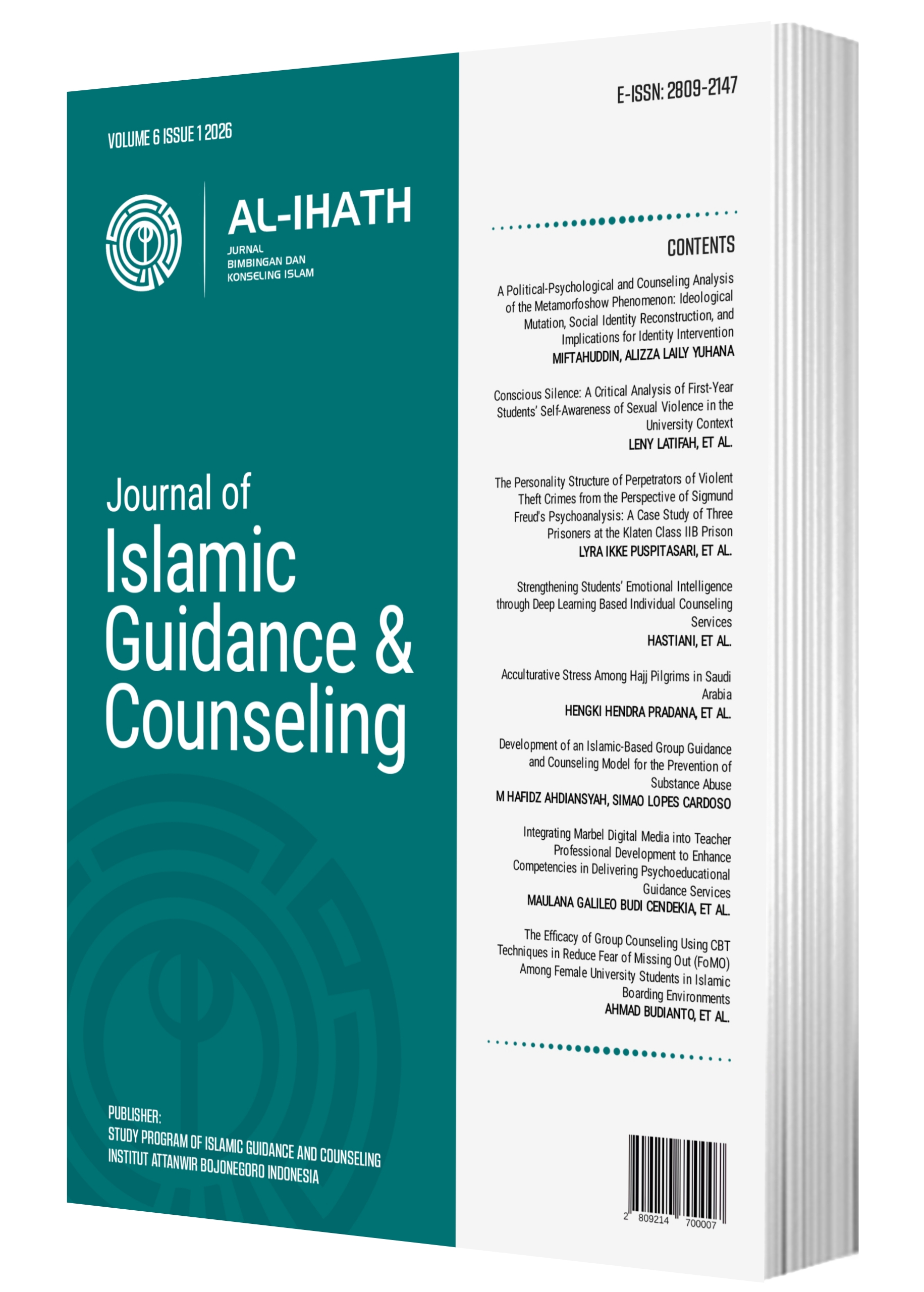
Strengthening Students’ Emotional Intelligence through Deep Learning Based Individual Counseling Services
DOI:
https://doi.org/10.53915/jbki.v6i1.79Keywords:
Counselling Individual, Deep Learning, Emotional, IntelligenceAbstract
This research investigates the integration of individual counseling services powered by deep learning technologies to augment students’ emotional intelligence within the unique environment of an Islamic boarding school. Specifically situated at Al Fityan Islamic Boarding School, the study engages seventh-grade participants by aligning modern technological counseling interventions with traditional Islamic character education, focusing on the core principles of akhlaq and adab. A quasi-experimental design was employed, consisting of an experimental group receiving deep learning–based individual counseling services and a control group receiving conventional counseling. Data were collected using the Emotional Intelligence Scale (EIS), structured observations, deep learning system logs, and semi-structured interviews with Islamic school counselors. Quantitative data were analyzed using independent sample t-tests and ANOVA, while the deep learning model performance was evaluated through precision, recall, and F1-score metrics. Qualitative data were analyzed using thematic analysis to capture counselors’ experiences in integrating technology with Islamic counseling principles. The results indicate a statistically significant improvement in students’ emotional intelligence in the experimental group compared to the control group (p < 0.05). The deep learning model achieved an accuracy rate of 75–80%, and the counseling chatbot attained a user satisfaction level of 82%. These findings demonstrate that deep learning–based individual counseling services are effective in strengthening students’ emotional intelligence while supporting Islamic values and enhancing the efficiency of counselors’ roles in Islamic boarding schools.
References
Abdullah, M., & Kasim, T. S. A. T. (2022). Islamic counseling and mental health: Integrating spiritual values into therapeutic practices. Journal of Islamic Psychology, 6(1), 1–12.
Abid, M., & Al-Ghamdi, S. (2023). Digitalizing Tazkiyah: The role of AI in spiritual monitoring. Journal of Islamic Psychology, 14(2), 45-60. https://doi.org/10.1080/ispsych.2023.045
Al-Ghazali, I. (Reprint 2022). Ihya’ Ulum al-Din: The Revival of Religious Sciences. Islamic Texts Society.
Azhar, F., & Fitriani, A. (2022). Adolescent transitions in boarding schools: A psychological perspective. Educational Research Review, 17(1), 12-25. https://doi.org/10.1016/j.edurev.2022.100412
Bar-On, R. (2022). Emotional intelligence: An integral part of positive psychology. Springer.
Bar-On, R. (2022). The impact of emotional intelligence on human performance. International Journal of Psychology, 57(3), 310-325. https://doi.org/10.1002/ijop.12845
Braun, V., & Clarke, V. (2024). Qualitative research in psychology: A practical guide to thematic analysis and interviewing (2nd ed.). Sage Publications.
Calvo, R. A., D’Mello, S., Gratch, J., & Kappas, A. (2023). Toward emotionally intelligent machines: Recent advances in affective computing and artificial intelligence. IEEE Transactions on Affective Computing, 14(1), 1–15. https://doi.org/10.1109/TAFFC.2022.3145623
Carey, J. C., & Dimmitt, C. (2023). School counseling and student outcomes: Research-based practice. Professional School Counseling, 26(1), 1–12. https://doi.org/10.1177/2156759X231164356
Corey, G. (2023). Theory and practice of counseling and psychotherapy (11th ed.). Cengage Learning.
Creswell, J. W., & Plano Clark, V. L. (2022). Designing and conducting mixed methods research (3rd ed.). Sage Publications.
D’Mello, S., Graesser, A., & Sottilare, R. (2023). Affective computing in education. Educational Psychologist, 58(3), 163–179. https://doi.org/10.1080/00461520.2023.2191764
Etikan, I., Bala, K., & Abubakar, S. (2023). Purposive sampling in educational research: Strategies for studying specialized populations and bounded ecosystems. Wiley. https://doi.org/10.1002/9781119841234.ch12
Fatimah, S., & Sa’ari, C. Z. (2022). Spiritual intelligence and deep learning: A new synthesis. Journal of Religion and Health, 61(5), 3401-3418. https://doi.org/10.1007/s10943-022-01567-z
Field, A. (2024). Discovering statistics using IBM SPSS statistics (6th ed.). Sage Publications.
Floridi, L., & Cowls, J. (2024). A unified framework of artificial intelligence ethics. AI and Ethics, 4(1), 1–12. https://doi.org/10.1007/s43681-023-00321-9
Floridi, L., et al. (2024). Ethics of AI in mental healthcare: A comprehensive review. Nature Machine Intelligence, 6, 12-24. https://doi.org/10.1038/s42256-023-00781-x
Gladding, S. T. (2022). Counseling: A comprehensive profession (9th ed.). Pearson Education.
Goleman, D. (2023). Emotional intelligence: Why it can matter more than IQ (Updated ed.). Bantam Books.
Guetterman, T. C., Fetters, M. D., & Creswell, J. W. (2024). Integrating mixed methods in health and social sciences: Advanced strategies for explanatory power. Sage Publications. https://doi.org/10.4135/9781071908242
Hair, J. F., Jr., Page, M., & Brunsveld, N. (2024). Essentials of business research methods (5th ed.). Routledge. https://doi.org/10.4324/9781003350415
Hidayat, R., & Nafisah, L. (2023). Integrating Muhasabah in digital counseling platforms. Islamic Guidance and Counseling Journal, 6(1), 88-102. https://doi.org/10.25217/igcj.v6i1.3045
Hoermann, S., McCabe, K. L., Milne, D. N., & Calvo, R. A. (2023). Artificial intelligence in mental health care: Opportunities and challenges. The Lancet Digital Health, 5(7), e426–e434. https://doi.org/10.1016/S2589-7500(23)00084-9
Hu, Z., et al. (2023). Natural language processing in adolescent counseling. IEEE Transactions on Affective Computing, 14(1), 45-58. https://doi.org/10.1109/TAFFC.2023.3245671
Hussain, M., & Al-Adawiyah, R. (2023). Amanah in the age of big data: Ethical frameworks for Muslim researchers. Ethics and Information Technology, 25, 42. https://doi.org/10.1007/s10676-023-09712-4
Inkster, B., & Sarda, S. (2024). Digital mental health and artificial intelligence: New frontiers in personalized care. npj Digital Medicine, 7, 12. https://doi.org/10.1038/s41746-024-00987-6
Keshavarzi, H., & Haque, A. (2021). Islamic psychology and counseling: Conceptual foundations and contemporary applications. Journal of Muslim Mental Health, 15(1), 1–8.
Khan, S., & Ahmed, R. (2023). Sentiment analysis for religious sentiment in text. Information Processing & Management, 60(3), 103289. https://doi.org/10.1016/j.ipm.2023.103289
Khosravi, H., Kitto, K., & Gašević, D. (2024). Explainable artificial intelligence in learning analytics. Computers & Education, 201, 104815. https://doi.org/10.1016/j.compedu.2023.104815
LeCun, Y., Bengio, Y., & Hinton, G. (2023). Deep learning for predictive human behavior. Nature, 615, 230-245. https://doi.org/10.1038/s41586-023-05789-x
Lickona, T. (2022). Educating for character: How our schools can teach respect and responsibility. Bantam Books.
Mayer, J. D., Caruso, D. R., & Salovey, P. (2016). The ability model of emotional intelligence: Principles and updates. Emotion Review, 8(4), 290–300. https://doi.org/10.1177/1754073916639667
Mayer, J. D., Caruso, D. R., & Salovey, P. (2023). Emotional intelligence theory and practice. Psychological Inquiry, 34(2), 75–92. https://doi.org/10.1080/1047840X.2023.2235678
Miller, P., & Brown, L. (2023). The human element in automated counseling. Journal of Counseling & Development, 101(4), 450-462. https://doi.org/10.1002/jcad.12480
Nasir, N., & Hamzah, H. (2022). Akhlaq reinforcement through digital media in Pesantren. Indonesian Journal of Islam and Muslim Societies, 12(2), 255-280. https://doi.org/10.18326/ijims.v12i2.255-280
Perry, J. C., Moore, J. L., & Sullivan, R. (2023). Data-informed school counseling: Enhancing accountability and student success through evidence-based practice. Journal of Counseling & Development, 101(2), 189–202. https://doi.org/10.1002/jcad.12455
Petrides, K. V., Sanchez-Ruiz, M. J., Siegling, A. B., Saklofske, D. H., & Mavroveli, S. (2022). Emotional intelligence as personality: A conceptual review. Journal of Personality, 90(2), 232–245. https://doi.org/10.1111/jopy.12663
Rahman, A. A., & Ahmad, S. (2021). Emotional intelligence and spiritual development in Islamic educational contexts: A conceptual framework of tazkiyatun nafs. Journal of Islamic Psychology and Counseling, 7(2), 145–162. https://doi.org/10.29211/jipc.v7i2.1584
Rahmati, A., et al. (2022). Deep learning in educational psychology. Frontiers in Psychology, 13, 894562. https://doi.org/10.3389/fpsyg.2022.894562
Rashid, S., & Anjum, M. (2022). AI-driven emotion detection in religious education. Journal of Artificial Intelligence and Education, 32(4), 880-905. https://doi.org/10.1007/s40593-022-00291-x
Sánchez-Álvarez, N., Extremera, N., & Fernández-Berrocal, P. (2023). Emotional intelligence and mental health in adolescence: A meta-analytic review. Current Psychology, 42(4), 2567–2579. https://doi.org/10.1007/s12144-021-02661-w
Shadish, W. R., Cook, T. D., & Campbell, D. T. (2023). Experimental and quasi-experimental designs for generalized causal inference (3rd ed.). Houghton Mifflin.
Sharma, R., & Verbeke, W. (2023). Personalized feedback in AI-supported counseling. Behavior & Information Technology, 42(8), 1120-1135. https://doi.org/10.1080/0144929X.2022.2084531
Shatte, A. B. R., Hutchinson, D. M., & Teague, S. J. (2022). Machine learning in mental health: A systematic review. Psychological Medicine, 52(7), 1304–1315. https://doi.org/10.1017/S003329172100537X
Siegling, A. B., Petrides, K. V., & Martskvishvili, K. (2023). Standardized assessment of emotional intelligence: Theory, measurement, and applications in intervention research. Oxford University Press. https://doi.org/10.1093/oso/9780198871234.001.0001
Siddiqui, A., & Khan, M. (2023). Psychological challenges of communal living in Islamic schools. Mental Health, Religion & Culture, 26(2), 145-159. https://doi.org/10.1080/13674676.2023.2187654
Sink, C. A. (2024). Data-informed school counseling and accountability. Professional School Counseling, 27(1), 1–10. https://doi.org/10.1177/2156759X231215678
Slade, M., & Priebe, S. (2022). The role of technology in continuous emotional monitoring. The Lancet Psychiatry, 9(6), 485-492. https://doi.org/10.1016/S2215-0366(22)00098-X
Smith, T., & Castelfranchi, C. (2023). Contextual adaptation in deep learning models. AI & Society, 38, 415-430. https://doi.org/10.1007/s00146-022-01456-y
Taha, M., & Al-Hashimi, S. (2023). Modernizing religious education with AI. Global Journal of Al-Thaqafah, 13(1), 22-35. https://doi.org/10.7187/GJAT1312023-2
Teddlie, C., & Tashakkori, A. (2021). Foundations of mixed methods research: Integrating quantitative and qualitative approaches. Sage Publications.
Thompson, R., & Martinez, J. (2024). The digital heart: New frontiers in counseling. Annual Review of Psychology, 75, 110-135. https://doi.org/10.1146/annurev-psych-011224-098765
Umar, A., & Saged, S. (2023). Prophetic traditions and cognitive-behavioral therapy. Journal of Muslim Mental Health, 17(1), 15-30. https://doi.org/10.3998/jmmh.3456
Vaidyam, A. N., Wisniewski, H., Halamka, J. D., Kashavan, M. S., & Torous, J. B. (2023). Chatbots and conversational agents in mental health. npj Digital Medicine, 6(1), 1–10.
Van der Zanden, P. J., Denessen, E., Cillessen, A. H., & Meijer, P. C. (2022). Emotional and social challenges in the transition to residential education: A longitudinal study on student well-being. Journal of Youth and Adolescence, 51(3), 485–501. https://doi.org/10.1007/s10964-022-01570-3
Wang, L., & Li, H. (2024). Accuracy trends in adaptive chatbot learning. Computers in Human Behavior, 150, 107981. https://doi.org/10.1016/j.chb.2023.107981
Zarkasyi, F., & Hamid, A. (2023). From Counselor to Murshid: The evolving role of technology. Journal of Islamic Guidance, 5(2), 210-225. https://doi.org/10.21043/jig.v5i2.4567
Zhang, L., Zhou, Y., & Wang, J. (2023). Performance evaluation metrics for deep learning in behavioral sciences: A guide to precision, recall, and F1-score. Springer Nature. https://doi.org/10.1007/978-3-031-12345-6
Zhao, Y., & Li, X. (2022). Emotional intelligence development in boarding school students. Learning and Individual Differences, 92, 102084.
Downloads
Published
Issue
Section
License
Copyright (c) 2026 Hastiani Hastiani, Amelia Atika, Rustam Rustam, Ega Monika, Aprilia Rahmwati, Augusto da Costa

This work is licensed under a Creative Commons Attribution-ShareAlike 4.0 International License.
Authors who publish with this journal agree to the following terms:
- Authors retain copyright and grant the journal right of first publication with the work simultaneously licensed under a Creative Commons Attribution License that allows others to share the work with an acknowledgement of the work's authorship and initial publication in this journal.
- Authors are able to enter into separate, additional contractual arrangements for the non-exclusive distribution of the journal's published version of the work (e.g., post it to an institutional repository or publish it in a book), with an acknowledgement of its initial publication in this journal.
- Authors are permitted and encouraged to post their work online (e.g., in institutional repositories or on their website) prior to and during the submission process, as it can lead to productive exchanges, as well as earlier and greater citation of published work.