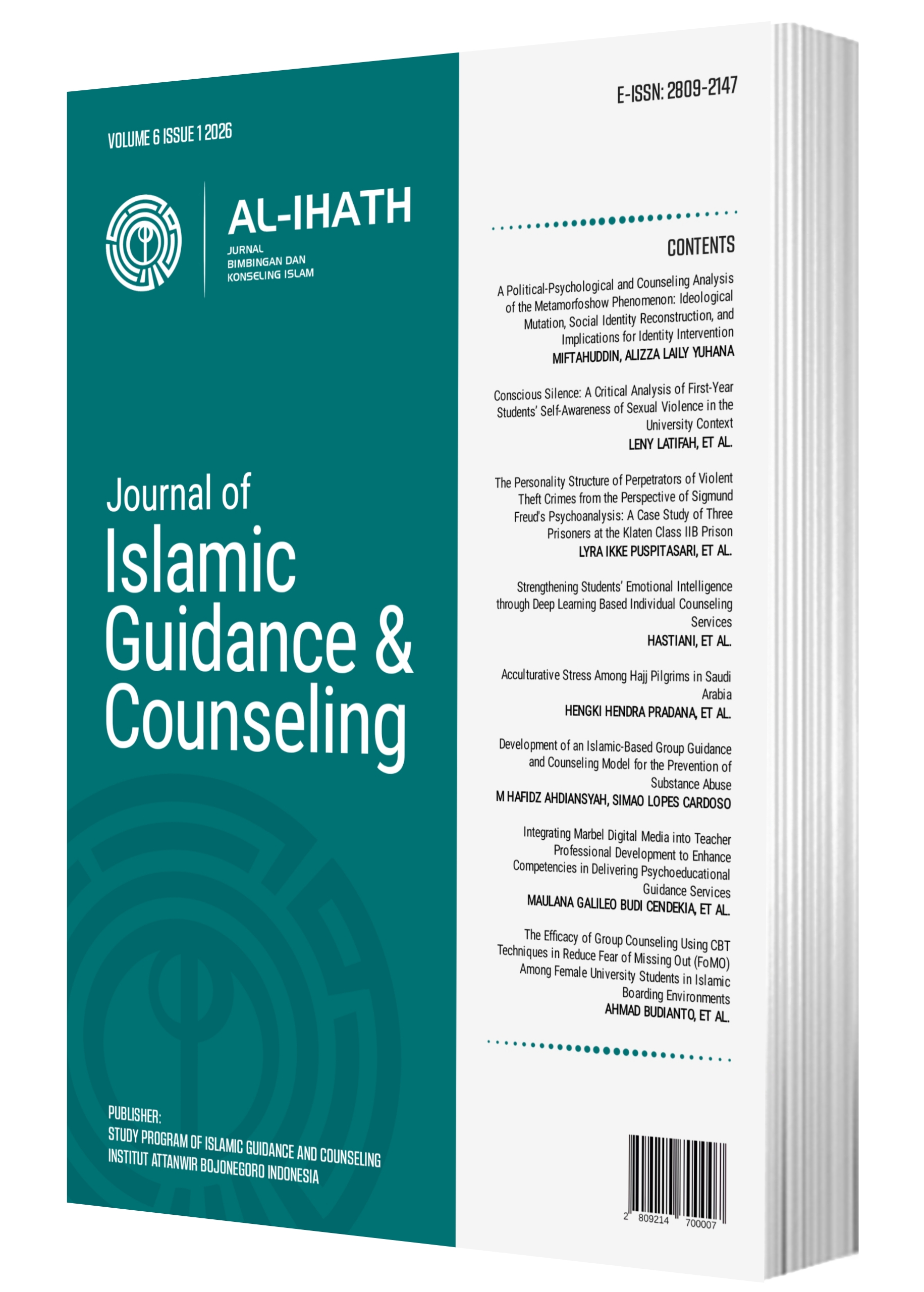
Conscious Silence: A Critical Analysis of First-Year Students’ Self-Awareness of Sexual Violence in the University Context
DOI:
https://doi.org/10.53915/jbki.v6i1.76Keywords:
Self-awareness, Conscious Silence, Sexual Violence, First-year University Students, Islamic Guidance and CounselingAbstract
Sexual violence in higher education constitutes a multidimensional problem that extends beyond regulatory and policy frameworks to encompass students’ psychological processes, particularly during the critical transition into university life. This study critically examines first-year students’ self-awareness of sexual violence in the university context and conceptualizes conscious silence as a distinct psychological response situated between awareness and agency, drawing on a Guidance and Counseling perspective. Employing a quantitative descriptive-analytic design, data were collected from 352 first-year students at Universitas PGRI Kanjurhan Malang during the 2025–2026 academic year using a Guttman-scale questionnaire assessing awareness, perceptions, lived experiences, contributory factors, and institutional services and policies related to sexual violence. Data were analyzed using descriptive statistics, including percentage distributions and response tendency patterns. The findings reveal a paradoxical condition of being aware but not empowered. While a majority of students (64.2%) had never participated in sexual violence prevention training and only 40.2% demonstrated a comprehensive understanding of sexual violence forms, a substantial proportion (82.4%) reported having witnessed or heard about sexual violence incidents, frequently responding with silence. These results indicate that silence functions not as ignorance, but as a psychologically informed yet constrained response shaped by limited agency, perceived risk, and insufficient response competencies.
References
Akhnaf, A. F., Putri, R. P., Vaca, A., Hidayat, N. P., Az-Zahra, R. I., & Rusdi, A. (2022). Self Awareness dan kecemasan pada mahasiswa tingkat akhir. Jurnal Muara Ilmu Sosial, Humaniora, Dan Seni, 6(1), 107–118.
Arum, R. W. N., & Ignacio, D. F. (2024). The Role of Peer Counseling in Adolescent Adjustment. Al-Ihath: Jurnal Bimbingan Dan Konseling Islam, 4(1), 67–71.
Bertram, M., Radl-Karimi, C. M., Loncarevic, N., Thøgersen, M., Skovgaard, T., Jansen, J., Castellani, T., Dorgelo, A., Valente, A., & Cori, L. (2016). Planning Locally Tailored Interventions on Evidence Informed Policy Making: Needs Assessment, Design and Methods. Health Systems and Policy Research, 3(2), 15.
Bhakti, C. P. (2017). Program bimbingan dan konseling komprehensif untuk mengembangkan standar kompetensi siswa. Jurnal Konseling Andi Matappa, 1(2), 131–132.
Bonar, E. E., DeGue, S., Abbey, A., Coker, A. L., Lindquist, C. H., McCauley, H. L., Miller, E., Senn, C. Y., Thompson, M. P., & Ngo, Q. M. (2022). Prevention of sexual violence among college students: Current challenges and future directions. Journal of American College Health, 70(2), 575–588.
Callan, E. (2016). Education in safe and unsafe spaces. Philosophical Inquiry in Education, 24(1), 64–78.
Cerolini, S., Zagaria, A., Franchini, C., Maniaci, V. G., Fortunato, A., Petrocchi, C., Speranza, A. M., & Lombardo, C. (2023). Psychological counseling among university students worldwide: A systematic review. European Journal of Investigation in Health, Psychology and Education, 13(9), 1831–1849.
Creswell, J. W., & Creswell, J. D. (2017). Research Design: Qualitative, Quantitative, and Mixed Methods Approaches. Thousand Oaks, CA: Sage Publications.
Daulay, M., Neviyani, N., & Firman, F. (2025). Analisis Sistematis Program BK di Perguruan Tinggi dan Implikasinya terhadap Pengembangan Layanan. Jurnal Al-Irsyad: Jurnal Bimbingan Konseling Islam, 7(1), 81–104.
Davies, S., & Berger, E. (2019). Teachers’ experiences in responding to students’ exposure to domestic violence. Australian Journal of Teacher Education (Online), 44(11), 96–109.
Diemer, M. A., Rapa, L. J., Voight, A. M., & McWhirter, E. H. (2016). Critical consciousness: A developmental approach to addressing marginalization and oppression. Child Development Perspectives, 10(4), 216–221.
Dworkin, E. R., Krahé, B., & Zinzow, H. (2021). The global prevalence of sexual assault: A systematic review of international research since 2010. Psychology of Violence, 11(5), 497.
Enache, R. G., & Matei, R. S. (2017). Study on self-awareness and vocational counseling of high school students. Agora Psycho-Pragmatica, 11(1), 57–64.
Fajria, F. (2022). Aplikasi Pencatatan dan Pelaporan Kekerasan Berbasis Android pada Kementrian Pemberdayaan Perempuan dan Perlindungan Anak. Jurnal Ilmu Komputer STIKOM Ambon, 7(2).
Fidiawati, L., Marsela, F., Rizky, R., Rahmat, C. P., & Kisanta, C. (2025). Pengembangan Modul Layanan Bimbingan Kelompok Untuk Meningkatkan Self Efficasy Mahasiswa Sebagai Upaya Pencegahan Pelecehan Seksual Di Perguruan Tinggi. TERAPUTIK: Jurnal Bimbingan Dan Konseling, 8(3), 63–69.
Fitzgerald, L. F., & Cortina, L. M. (2018). Sexual harassment in work organizations: A view from the 21st century. In APA handbook of the psychology of women: Perspectives on women’s private and public lives (pp. 215–234). American Psychological Association.
Garaigordobil, M. (2023). Educational psychology: The key to prevention and child-adolescent mental health. Psicothema, 35(4), 327–339.
Guyon, R., Fernet, M., Couture, S., Tardif, M., Cousineau, M.-M., & Godbout, N. (2024). “Finding My Worth as a Sexual Being”: A Qualitative Gender Analysis of Sexual Self-Concept and Coping in Survivors of Childhood Sexual Abuse. Archives of Sexual Behavior, 53(1), 341–357.
Halim, A. V., & Dalimoenthe, I. (2025). Optimalisasi Strategi Satgas PPKS UNJ dalam Membangun Kultur Anti Kekerasan Seksual di Lingkungan Kampus. SASKARA: Indonesian Journal of Society Studies,
Hopper, J., Lonsway, K. A., Archambault, J., Spohn, C., White, C., & Tellis, K. (2022). If a Claim of Sexual Assault Does Not Result in an Arrest, Does That Mean The Assault Did Not Happen? In Sexual Assault and Harassment in America: Examining the Facts (Vol. 48, Issue 1, p. 75). Bloomsbury Publishing USA.
Indah, G. S. F. (2025). Selinda: Permainan Petak Umpet untuk Menigkatkan Self Awareness dalam Pencegahan Pelecehan Seksual pada Anak. Jurnal EMPATI, 14(1), 59–66.
Irawan, A. W., Hidayati, D. L., & Dwisona, D. (2024). The experience of sexual harassment victims in accessing counseling services at higher education institutions in Samarinda. Gender Equality: International Journal of Child and Gender Studies, 10(2), 179–187.
Jailani, M. S., & Saksitha, D. A. (2024). Tehnik analisis data kuantitatif dan kualitatif dalam penelitian ilmiah. Jurnal Genta Mulia, 15(2), 79–91.
Kumari, F., & Syarif, J. (2023). Menapak Jejak Kekerasan Seksual di Dunia Kampus. Penerbit Adab.
Lapsley, D., & Hardy, S. A. (2017). Identity formation and moral development in emerging adulthood. Flourishing in Emerging Adulthood: Positive Development during the Third Decade of Life, 1, 14–39.
Mandell, M. L. (2024). Attachment theory as a lens for examining quiet students to prevent school avoidance. Education Inquiry, 1–17.
Masriah, M., Triadhari, I., & Rahmawati, F. (2024). Dampak Psikologis Pada Korban Kekerasan Seksual di Lingkungan Kampus. Equalita: Jurnal Studi Gender Dan Anak, 6(2), 188–205.
Moynihan, Mary M, Banyard, Victoria L, Cares, Alison C, Potter, Sharyn J, Williams, Linda M, & Stapleton, Jane G. (2014). Encouraging Responses in Sexual and Relationship Violence Prevention: What Program Effects Remain 1 Year Later? Journal of Interpersonal Violence, 30(1), 110–132.
Pinchevsky, G. M., Magnuson, A. B., Augustyn, M. B., & Rennison, C. M. (2020). Sexual victimization and sexual harassment among college students: A comparative analysis. Journal of Family Violence, 35(6), 603–618.
Powell, A., & Henry, N. (2017). Sexual violence in a digital age (Vol. 25). Springer.
Qowimah, S. N., Almahira, K. J., Rahma, D. A., Satrio, A. B., Nuzul, H. M., Puteri, S. N. Y., Lusiana, N., & Andyarini, E. N. (2021). Hubungan self confidence dan self awareness dengan komunikasi efektif pada mahasiswa-Relationship between self confidence and self awareness with effective communication in students. Indonesian Psychological Research, 3(2), 109–120.
Rahayu, S. D., Madhengsan, R. A., Alifah, N. I., Khotimah, K., & Ibad, M. N. (2024). Early Socialization and Psychological Support for Children Victims of Violence at SMP Kartika IV-I Surabaya. Al-Ihath: Jurnal Bimbingan Dan Konseling Islam, 4(1), 29–35.
Rahimsyah, A. P., & Muhajirin, M. (2025). Tingkat Kesejahteraan Psikologis Mahasiswa Program Studi Bimbingan dan Konseling Universitas Muhammadiyah Tasikmalaya. Indonesian Journal of Educational Counseling, 9(1), 85–96.
Rahmayanti, K., Hamdi, N., Awwaliyah, A., Putri, J. R., & Iqlima, A. (2024). Pentingnya Memahami Diri Sendiri (Self-Understanding) Dalam Pengembangan Diri. Jurnal Pengabdian Kepada Masyarakat Bidang Kesehatan, 6(2), 130–133.
Ramadhani, K., Ardi, Z., Yendi, F. M., & Fadli, R. P. (2024). Hubungan self-awareness dengan prokrastinasi akademik pada mahasiswa. Counseling and Humanities Review, 4(2), 12–21.
Robbani, A. N., & Nafisatuzzahra, N. (2025). Dukungan Sosial sebagai Penyangga Stres Karier pada Dewasa Awal: Telaah Literatur Tematik tentang Quarter-Life Crisis. Jurnal Educazione: Jurnal Pendidikan, Pembelajaran Dan Bimbingan Dan Konseling, 13(1), 73–82.
Sagala, R. V. (2020). Ketika negara mengatur kekerasan seksual. Guepedia.
Sihaloho, R. P. (2019). Hubungan antara self awareness dengan deindividuasi pada mahasiswa pelaku hate speech. Jurnal Ilmiah Mandala Education, 5(2), 114–123.
Soudien, C. (2015). Coming to self-awareness–in search of an education for non-violence. Pedagogy, Culture & Society, 23(3), 331–348.
Szczygiel, P. (2021). Navigating student self-disclosure through a relational lens: Examples of increased self-awareness from a social work classroom. Clinical Social Work Journal, 49(1), 77–84.
Utami, C. A., Agustina, S., Nasution, T. M. S., & Humairoh, S. M. (2023). Sosialisasi etika konseling: Menjaga kerahasiaan dan privasi klien di era digital. PENDALAS: Jurnal Penelitian Tindakan Kelas Dan Pengabdian Masyarakat, 3(3), 262–287. https://doi.org/10.47006/pendalas.v3i3.505
Valle, R. (2019). Toward a psychology of silence. The Humanistic Psychologist, 47(3), 219.
Yuliasari, H. (2020). Pelatihan konselor sebaya untuk meningkatkan self awareness terhadap perilaku beresiko remaja. Jurnal Psikologi Insight Departemen Psikologi, 4(1), 63–72.
Downloads
Published
Issue
Section
License
Copyright (c) 2026 Leny Latifah, Parid Rilo Pambudi, Siabi Ayoub

This work is licensed under a Creative Commons Attribution-ShareAlike 4.0 International License.
Authors who publish with this journal agree to the following terms:
- Authors retain copyright and grant the journal right of first publication with the work simultaneously licensed under a Creative Commons Attribution License that allows others to share the work with an acknowledgement of the work's authorship and initial publication in this journal.
- Authors are able to enter into separate, additional contractual arrangements for the non-exclusive distribution of the journal's published version of the work (e.g., post it to an institutional repository or publish it in a book), with an acknowledgement of its initial publication in this journal.
- Authors are permitted and encouraged to post their work online (e.g., in institutional repositories or on their website) prior to and during the submission process, as it can lead to productive exchanges, as well as earlier and greater citation of published work.