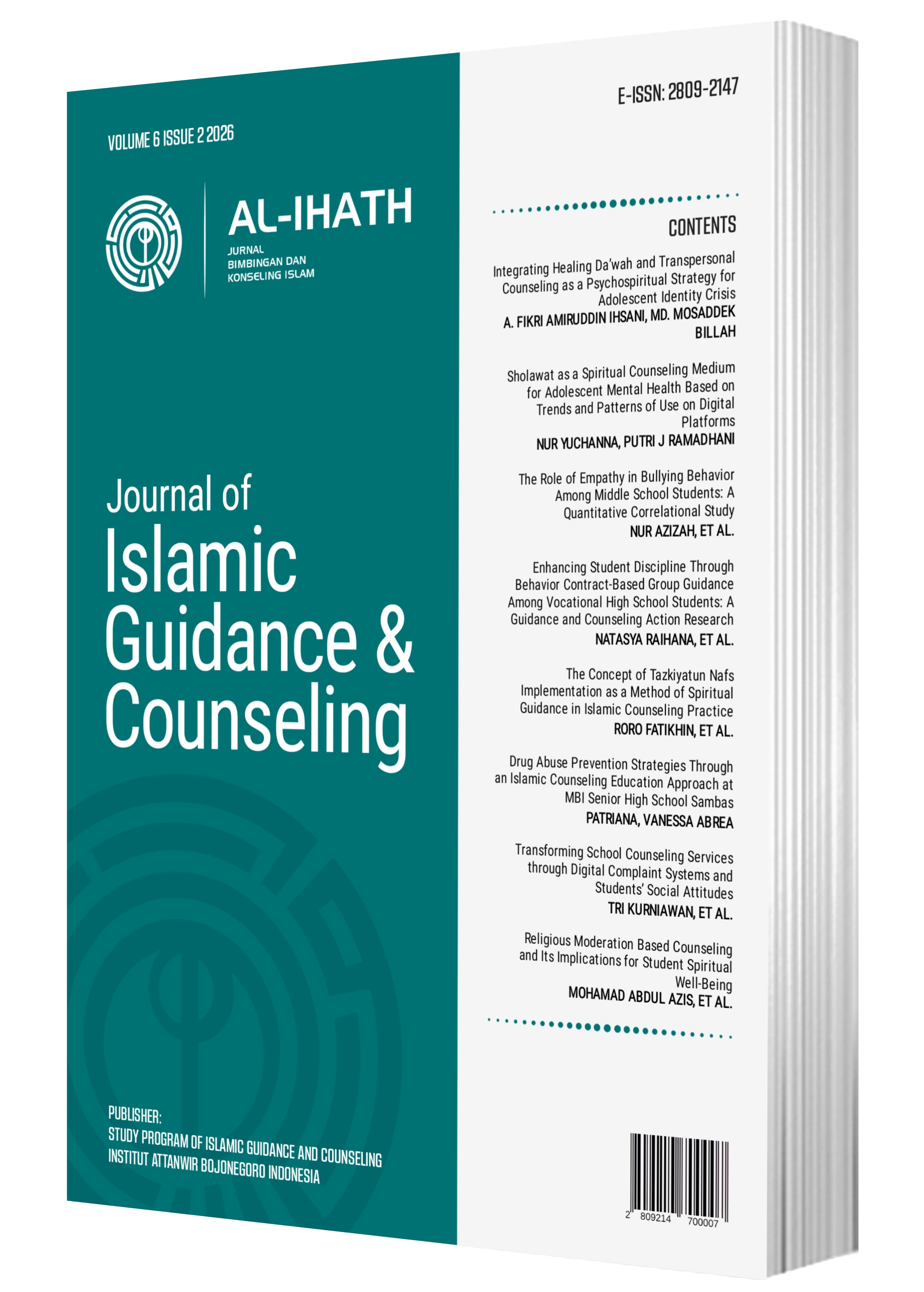
Enhancing Student Discipline Through Behavior Contract-Based Group Guidance Among Vocational High School Students: A Guidance and Counseling Action Research
DOI:
https://doi.org/10.53915/jbki.v6i2.72Keywords:
Group Guidance, Social Order, Discipline, Behavior ContractAbstract
This study addresses the issue of low student discipline at SMK Negeri 1 Nanga Pinoh, which is reflected in frequent tardiness, incomplete school uniforms, leaving the classroom without permission, and lack of order during learning activities. Initial measurements using a student discipline psychological scale indicated that discipline levels were in the low category, with the weakest aspects being discipline in submitting assignments and social discipline. This study aimed to identify students’ discipline conditions prior to intervention, describe the implementation of group guidance services using behavior contract techniques, and analyze improvements in student discipline after the intervention. The research employed Guidance and Counseling Action Research (PTBK) conducted in two cycles, each consisting of three meetings. The intervention was implemented through group guidance services integrated with behavior contract techniques, emphasizing written agreements on expected disciplined behaviors formulated collaboratively between students and counselors. The study was carried out collaboratively with the school counselor to evaluate both the process and outcomes of the intervention. Research instruments included a discipline psychological scale, observation sheets, interview guidelines, and documentation. The results showed a significant improvement in student discipline. In Cycle I, discipline achievement reached 44% and was categorized as moderate. After improvements were implemented in Cycle II, discipline increased to 74% and was categorized as good. Psychological scale results indicated a 57.5% improvement across measured aspects and a 32.5% increase between pre-test and post-test scores. These findings demonstrate that group guidance using behavior contract techniques is effective in strengthening student discipline.
References
Aini, Q., & Wibowo, M. E. (2020). Behavioral counseling to improve students' discipline in secondary schools. Jurnal Bimbingan dan Konseling, 9(2), 101–110.
Alwahbi, A. A. (2020). The use of contingency contracting in educational settings: A review of the literature. Educational Research and Reviews, 15(6), 327–335. https://doi.org/10.5897/ERR2020.3949
Andersson, C., & Granberg, C. (2022). From passenger to pilot: Using formative assessment to support students with intellectual disabilities to become self-regulated learners. Frontiers in Education, 7, 845208. https://doi.org/10.3389/feduc.2022.845208
Arif Firmansyah, F. A. (2022). Hubungan antara empati dengan perilaku bullying di SMA Pondok Modern Selamat Kendal. Jurnal Psimawa: Diskursus Ilmu Psikologi dan Pendidikan, 5(2), 75–78. https://doi.org/10.36761/jp.v5i2.2111
Arikunto, S. (2019). Prosedur penelitian: Suatu pendekatan praktik (15th ed.). Rineka Cipta.
Baeng, H. D. P. S., Dartiningsih, M. W., & Susanta, I. W. (2021). Pengaruh self-regulation (pengaturan diri) terhadap disiplin belajar siswa kelas XI MM1 SMK Negeri 1 Sukawati tahun pelajaran 2020/2021. Jurnal Bimbingan dan Konseling: Kajian dan Aplikasi, 12(2), 22–32. https://doi.org/10.59672/jbk.v12i2.1651
Boyer, W. (2023). Development, construct validation, and normalization of a new early childhood self-regulation assessment scale. Early Childhood Education Journal, 51(4), 627–640. https://doi.org/10.1007/s10643-022-01310-9
Bukori, M., & Hidayat, D. R. (2020). Group guidance services to enhance students' self-discipline behavior. Guidance and Counseling Journal, 4(1), 45–54.
Bukoting, S. (2023). Integration of character education in citizenship education learning to develop elementary school students' character. Educator: Journal of Innovation of Educators and Education Personnel, 3(2), 70–82. https://doi.org/10.51878/educator.v3i2.2389
Cameron, C. E., Kim, H., & Doromal, J. B. (2022). Among underserved children, behavioral self-regulation most consistently predicts early elementary teachers' ratings of overall social-emotional learning. Frontiers in Education, 7, 937869. https://doi.org/10.3389/feduc.2022.937869
Cantrell, R. P., Cantrell, M. L., Huddleston, C. M., & Woolridge, J. H. (1972). Contingency contracting with school truants. Journal of Applied Behavior Analysis, 5(4), 337–346. https://doi.org/10.1901/jaba.1972.5-337
Corey, G. (2017). Theory and practice of group counseling (9th ed.). Cengage Learning.
Corey, M. S., Corey, G., & Corey, C. (2018). Groups: Process and practice (10th ed.). Cengage Learning.
Durlak, J. A., Weissberg, R. P., Dymnicki, A. B., Taylor, R. D., & Schellinger, K. B. (2011). The impact of enhancing students' social and emotional learning: A meta-analysis of school-based universal interventions. Child Development, 82(1), 405–432. https://doi.org/10.1111/j.1467-8624.2010.01564.x
Faizin, M. (2024). Urgensi psikologi komunikasi dalam layanan konseling individu. Psycho Aksara: Jurnal Psikologi, 2(1), 53–62.
Hafid, A., Zahro, I. F., & Al-Husain, R. A. (2022). Pembinaan akhlak melalui pendekatan behavior. Al-Ihath: Jurnal Bimbingan dan Konseling Islam, 2(2), 145–154.
Hidayah, N., Wibowo, M. E., & Mulawarman. (2017). Educational psychology. UM Press.
Krisna, S. I. G. A. A., & Rajeg, M. I. N. (2023). Upaya meningkatkan perilaku disiplin siswa melalui layanan bimbingan kelompok pada siswa SMP. Jurnal Bimbingan dan Konseling Indonesia, 8(2). https://doi.org/10.23887/jurnal_bk.v8i2.2251
Latupeirissa, T., Loupatty, W. C., & Soumahu, S. E. (2025). The effectiveness of group counseling services in handling student indiscipline in Grade XI at Ambon Rehoboth Christian High School. Jurnal Visionary: Penelitian dan Pengembangan Dibidang Administrasi Pendidikan, 13(2), 198–206. https://doi.org/10.33394/vis.v13i2.16047
Lestari, D., & Yusuf, S. (2021). The effectiveness of group guidance in improving students' social responsibility. Jurnal Konseling Pendidikan, 5(1), 23–31.
Munawaroh, S., & Hidayat, A. (2022). Behavior modification techniques in school counseling services. Jurnal Psikologi Pendidikan, 11(2), 134–145.
Organisation for Economic Co-operation and Development. (2023). PISA 2022 results (Volume I): The state of learning and equity in education. OECD Publishing. https://doi.org/10.1787/53f23881-en
Organisation for Economic Co-operation and Development. (2024). PISA vocational education and training (VET): Assessment and analytical framework. OECD Publishing. https://doi.org/10.1787/b0d5aaf9-en
Pradana, H. H., Suwatin, W., & Fauzen, M. N. R. (2024). Efforts to prevent early marriage with counseling psychology services. Al-Ihath: Jurnal Bimbingan dan Konseling Islam, 4(2), 88–95. https://doi.org/10.53915/jbki.v4i2.539
Prayitno, & Amti, E. (2015). Dasar-dasar bimbingan dan konseling. Rineka Cipta.
Prayitno. (2012). Layanan bimbingan dan konseling kelompok. UNP Press.
Rahmatullah, A. S. (2021). Punishment from the perspective of students and Islamic boarding school education. Ta'dibuna: Journal of Islamic Education, 10(1), 74–87. https://doi.org/10.32832/tadibuna.v10i1.4052
Rahmatullah, A., & Baharun, S. (2023). Ta'zir (punishment) at Islamic boarding schools: Between tradition and human rights issues. Tribakti: Journal of Islamic Thought, 34(2), 267–280. https://doi.org/10.33367/tribakti.v34i2.3517
Rahmawati, E., & Hasanah, U. I. (2021). Imposing sanctions on students who are late to school as an effort to form disciplined character. Indonesian Journal of Teacher Education, 2(1), 236–245.
Rofiq, M. H. (2017). Student discipline through punishment in the perspective of educational stakeholders. Nidhomul Haq: Journal of Islamic Education Management, 2(2), 82–94. https://doi.org/10.31538/ndh.v2i2.25
Roorda, D. L., Koomen, H. M. Y., Spilt, J. L., & Oort, F. J. (2011). The influence of affective teacher–student relationships on students' school engagement and achievement: A meta-analytic approach. Review of Educational Research, 81(4), 493–529. https://doi.org/10.3102/0034654311421793
Rozikin, & Iswatiningsih, D. (2025). Hard education in the past and the relevance of physical punishment in schools today. SIBATIK Journal, 4(5), 541–546. https://doi.org/10.54443/sibatik.v4i5.2715
Sawaludin, N., Kadafi, A., & Christiana, R. (2026). The effectiveness of behavioral contract group counseling in improving the discipline of 11th-grade students at Pilangkenceng State High School, Madiun Regency. Jurnal Konseling Pendidikan Islam, 7(2). https://doi.org/10.32806/jkpi.v7i2.1816
Skinner, B. F. (1953). Science and human behavior. Macmillan.
Sugiyono. (2018). Metode penelitian pendidikan. Alfabeta.
Susanti, F. (2021). Patterns of giving rewards and punishments in Islamic education. Raudhah: Jurnal Tarbiyah Islamiyah, 6(1), 71–82. https://doi.org/10.48094/raudhah.v6i1.103
Tas'adi, R. (2019). The nature and basic concepts of educational psychology. Al-Taujih Journal, 5(1), 103–113. https://doi.org/10.15548/atj.v5i1.759
UNESCO. (2023). Global education monitoring report 2023: Technology in education: A tool on whose terms? UNESCO Publishing.
Winkel, W. S., & Hastuti, M. M. S. (2013). Bimbingan dan konseling di institusi pendidikan. Media Abadi.
Yalom, I. D. (2005). The theory and practice of group psychotherapy (5th ed.). Basic Books.
Zimmerman, B. J. (2002). Becoming a self-regulated learner: An overview. Theory Into Practice, 41(2), 64–70. https://doi.org/10.1207/S15430421TIP4102_2
Downloads
Published
Issue
Section
License
Copyright (c) 2026 Natasya Raihana, Novi Wahyu Hidayati, Hastiani Hastiani, Paul Rapheal Kitula

This work is licensed under a Creative Commons Attribution-ShareAlike 4.0 International License.
Authors who publish with this journal agree to the following terms:
- Authors retain copyright and grant the journal right of first publication with the work simultaneously licensed under a Creative Commons Attribution License that allows others to share the work with an acknowledgement of the work's authorship and initial publication in this journal.
- Authors are able to enter into separate, additional contractual arrangements for the non-exclusive distribution of the journal's published version of the work (e.g., post it to an institutional repository or publish it in a book), with an acknowledgement of its initial publication in this journal.
- Authors are permitted and encouraged to post their work online (e.g., in institutional repositories or on their website) prior to and during the submission process, as it can lead to productive exchanges, as well as earlier and greater citation of published work.