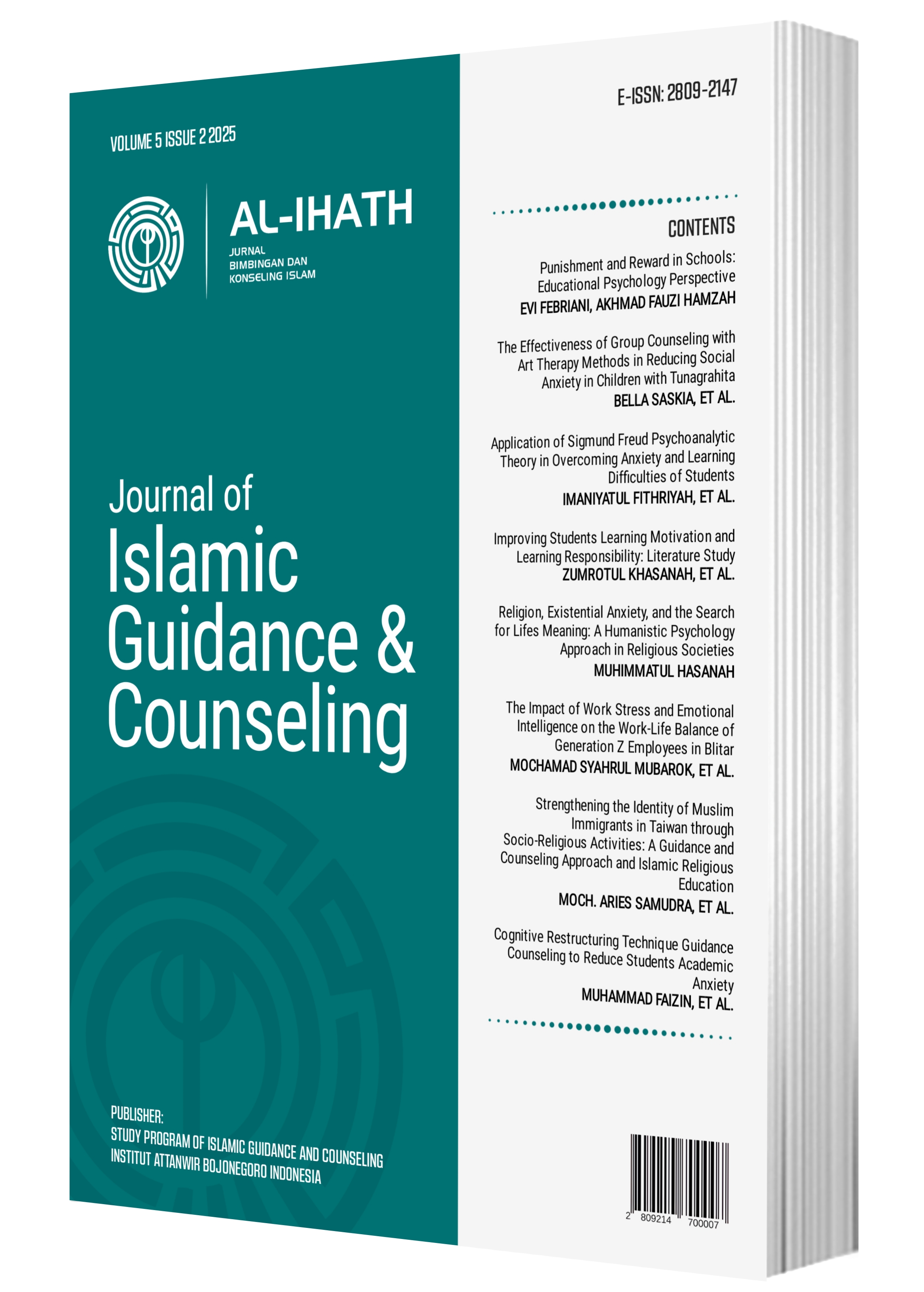
Impact of Work Stress and Emotional Intelligence on the Work-Life Balance of Generation Z Employees in Blitar
DOI:
https://doi.org/10.53915/jbki.v5i2.636Keywords:
Work-Life Balance, Work Stress, Emotional Intelligence, Workers, Generation ZAbstract
This research aims to analyze the effect of work stress and emotional intelligence on Work-Life Balance (WLB) among the Generation Z workforce (aged 18–27) in Blitar. Generation Z is a productive group of workers who prioritize meaning and flexibility in their work, but they face significant challenges in managing high work pressure. This quantitative study involved 100 respondents selected through purposive sampling. The data were analyzed using multiple linear regression analysis after fulfilling the classical assumption prerequisite tests (normality, linearity, multicollinearity, and heteroscedasticity). The hypothesis testing results indicate that, simultaneously, work stress and emotional intelligence significantly influence WLB. This is supported by an F-test value of 52.438, which is greater than the F-table value of 3.09, with a significance value of 0.000. The R Square value of 0.520 suggests that these two variables contribute 52% to WLB, while the remaining 48% is influenced by other factors. Partially (T-test), work stress showed a negative and significant effect (t-count = $-8.747$; Sig. = 0.000) on WLB, meaning that an increase in work stress will decrease WLB. Meanwhile, emotional intelligence showed a positive effect on WLB, although it was not statistically significant (t-count = 1.706; Sig. = 0.091). These findings reinforce the need for effective stress management and the constructive role of emotional intelligence in maintaining the balance between professional demands and personal needs for Generation Z.
References
BPS. (2021). Hasil Sensus Penduduk 2020.
Center, P. R. (2020). On the cusp of adulthood and facing an uncertain future: What we know about Gen Z so far.
Deloitte. (2021). Global Millennial and Gen Z Survey 2021: Highlights from Indonesia.
Febriana, S., Piscesta, F., & Putranto, Y. A. (2022). Pengaruh Work-Life Balance Terhadap Stres Kerja Pada Akuntan Pendidik Di Kota Palembang. Jurnal Informasi Akuntansi (JIA), 1(2), 129–140. https://doi.org/10.32524/jia.v1i2.655
Fisher, G. G., Bulger, C. A., & Smith, C. S. (2009). Beyond work and family: A measure of work/ nonwork interference and enhancement. Journal of Occupational Health Psychology, 14(4), 441–456.
Ghozali, I. (2018). Aplikasi analisis multivariete dengan program IBM SPSS 23.
Goleman, D. (1995). Emotional Intelligence: Why It Can Matter More Than IQ. Bantam Book.
Goleman, D., & Boyatzis, R. (2017). Emotional intelligence has 12 elements. Which do you need to work on. Harvard Business Review, 84, 1–5.
Gunadarma, L. U. (2024). Pengaruh Kecerdasan Emosi terhadap Work-Life Balance pada Wanita Karir. library.gunadarma.ac.id
Hafid, M., & Prasetio, A. P. (2017). Manajemen Kinerja : Falsafah, Teori, dan Penerapannya (6th ed.). Study & Managemen Research, XIV(3), 52–61. http://stembi.ac.id/file/6. Muhammad Hafid.pdf
Hamdali, N. T., & Liswandi, L. (2023). Examining Job Stress Among Indonesian Gen Z Employees Using Jd-R Model. Jurnal Manajemen Kewirausahaan, 20(1), 1. https://doi.org/10.33370/jmk.v20i1.983
Hikmah, M., & Lukito, H. (2021). Peran Worklife Balance dan Stres Kerja terhadap Kinerja Karyawan dengan Organizational Citizenship Behavior sebagai Variabel Mediasi. Jurnal Bisnis Dan Manajemen, 8(1), 64–74.
Lukmiati, R., Samsudin, A., & Jhoansyah, D. (2020). Pengaruh Work Life Balance terhadap Kinerja Karyawan pada Karyawan Staff PT. Muara Tunggal. Jurnal Ekobis Dewantara, 3(3), 46–50. https://doi.org/10.26460/ed_en.v3i3.1688
Mardelina, E., & Muhson, A. (2017). Mahasiswa bekerja dan dampaknya pada aktivitas belajar dan prestasi akademik. Jurnal Economia, 13(2), 201.
McDonald, P., Brown, K., & Bradley, L. (2005). Explanations for the provision‐utilisation gap in work‐life policy. Women in Management Review, 20(1), 37–55.
Nasution, S., Dharmanto, A., & Dewi, N. (2024). Pengaruh Work Life Balance dan Stress Kerja Terhadap Gen Z. Jurnal Riset Dan Inovasi Manajemen, 2(2986–3309), 90–101.
Nugraha, G., & Adiati, R. P. (2022). Hubungan antara Kecerdasan Emosional dengan Work-life Balance pada Karyawan Startup. Buletin Riset Psikologi Dan Kesehatan Mental (BRPKM), 2(1), 652–657. https://doi.org/10.20473/brpkm.v2i1.36518
Nursavilla, F., & Sri Padmantyo, M. B. A. (2020). Pengaruh Kecerdasan Emosional dan Stres Kerja Terhadap Kinerja Karyawan (Studi Pada Unit Spinning 2 PT. Dan Liris di Sukoharjo). Universitas Muhammadiyah Surakarta.
Parker, D. F., & DeCotiis, T. A. (1983). Organizational determinants of job stress. Organizational Behavior and Human Performance, 32(2), 160–177.
Ramadhani, R., Psikologi, F., & Jakarta, U. (2016). Uji Validitas Konstruk Terhadap Adaptasi Dari Wong and Law Emotional Intelligence Scale (Wleis). Jurnal Pengukuran Psikologi Dan Pendidikan Indonesia, V(2), 99–125.
Robbins, S. P., & Judge, T. A. (2017). Organizational Behavior (17th ed.). Pearson Education. Pearson Education.
Sugiyono. (2019). Metode Penelitian Kuantitatif, Kualitatif, dan R&D. CV. Alfabeta.
Wibowo, T. C. (2015). Analisis Pengaruh Kecerdasan Emosional (EQ) dan Kecerdasan Spritual (SQ) Pada Kinerja Karyawan. Jurnal Bisnis Dan Manajemen, 5(1).
Wong, C.-S., & Law, K. S. (2002). Wong and law emotional intelligence scale. The Leadership Quarterly.
Wulansari, O. D. (2023). Studi Literatur: Faktor-Faktor yang Mempengaruhi Work-Life Balance. Psychopreneur Journal, 7(1), 15–28. https://doi.org/10.37715/psy.v7i1.3404
Yuliara, I. M. (2016). Regresi Linier Berganda. Universitas Udayana.
Downloads
Published
Issue
Section
License
Copyright (c) 2025 Mochamad Syahrul Mubarok, Hengki Hendra Pradana, Alaiya Choiril Mufidah, Devia Purwaningrum

This work is licensed under a Creative Commons Attribution-ShareAlike 4.0 International License.
Authors who publish with this journal agree to the following terms:
- Authors retain copyright and grant the journal right of first publication with the work simultaneously licensed under a Creative Commons Attribution License that allows others to share the work with an acknowledgement of the work's authorship and initial publication in this journal.
- Authors are able to enter into separate, additional contractual arrangements for the non-exclusive distribution of the journal's published version of the work (e.g., post it to an institutional repository or publish it in a book), with an acknowledgement of its initial publication in this journal.
- Authors are permitted and encouraged to post their work online (e.g., in institutional repositories or on their website) prior to and during the submission process, as it can lead to productive exchanges, as well as earlier and greater citation of published work.