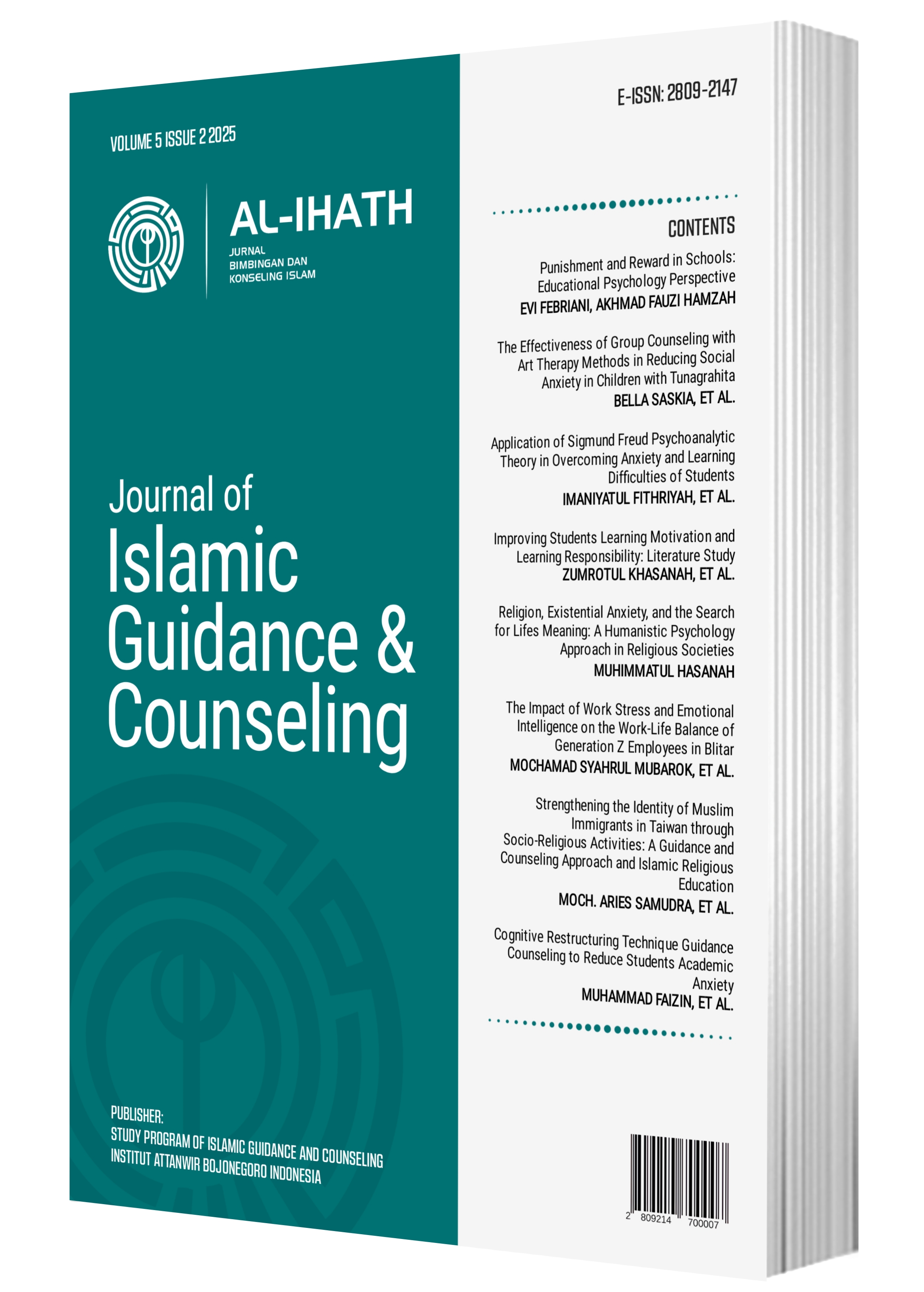
Punishment and Reward in Schools: Educational Psychology Perspective
DOI:
https://doi.org/10.53915/jbki.v5i2.627Keywords:
Punishment, Reward, Educational PsychologyAbstract
This study examines rewards and punishments in schools from an educational psychology perspective. This study is important because, from an educational psychology perspective, rewards and punishments are an integral part of education. This study used a literature review approach, drawing on references from books, journals, and other electronic media. The research concluded that rewards and punishments are part of educational psychology, particularly in the interaction between teaching and learning and evaluation. However, the punishments and rewards given to students must adhere to applicable mechanisms and regulations. Because in the learning process, teachers teach many things, including assignments, and several other aspects of character building. Punishment and rewards implemented by teachers do not mean that they dislike their students. In fact, because teachers want their students to succeed, they will reprimand them if they make mistakes and will also provide rewards when they succeed. In the context of punishment carried out by teachers against students who break the rules, this does not mean that teachers are allowed to use excessive violence. Teachers are also limited by various regulations, such as the child protection act and others. However, when teachers take affirmative action against students, some parents take action by visiting the school without asking for clarification and often even reporting the matter to the police. In the context of punishment carried out by teachers to students who break the rules, it does not mean that teachers are allowed to carry out excessive violence.
References
Asliani, Asliani. “Legal Review of Disciplinary Punishment for Students in Schools.” National Seminar on Law, Social and Economics 2, no. 1 (March 22, 2023): 143–49.
Bukoting, Sauda. “INTEGRATION OF CHARACTER EDUCATION IN CITIZENSHIP EDUCATION LEARNING TO DEVELOP THE CHARACTER OF ELEMENTARY SCHOOL STUDENTS.” EDUCATOR: Journal of Innovation of Educators and Education Personnel 3, no. 2 (August 2, 2023): 70–82. https://doi.org/10.51878/educator.v3i2.2389.
Erika, Elvita, Lukas Lukas, Puspita Dewi Debi, Yuhandra Conli Kosdamika, and Rijaya Rijaya. “PRIMARY SCHOOL TEACHERS’ PROFESSIONALITY TOWARDS PUNISHMENT AND REWARDS: A CASE STUDY IN A PUBLIC ELEMENTARY SCHOOL.” SITTAH: Journal of Primary Education 4, no. 1 (June 11, 2023): 61–72. https://doi.org/10.30762/sittah.v4i1.953.
Faizin, M. (2024). Urgensi Psikologi Komunikasi dalam Layanan Konseling Individu. Psycho Aksara: Jurnal Psikologi, 2(1), 53-62.
Fikri, Aiman. “REWARD AND PUNISHMENT IN THE PERSPECTIVE OF ISLAMIC EDUCATION: (IMPLEMENTATION OF REWARD AND PUNISHMENT IN THE PROCESS OF LEARNING ACTIVITIES).” AL-ULUM: JOURNAL OF EDUCATION AND ISLAMIC STUDIES 1, no. 1 (July 4, 2021). https://jurnal.stairahmaniyah.ac.id/index.php/alulum/article/view/5.
Firdaus, Firdaus. “The Essence of Reward and Punishment in the Discourse of Islamic Religious Education.” Al-Thariqah Journal of Islamic Religious Education 5, no. 1 (June 21, 2020): 19–29. https://doi.org/10.25299/al- thariqah.2020.vol5( 1).4882.
Hafid, A., Zahro, I. F., & Al-Husain, R. A. (2022). Pembinaan Akhlak Melalui Pendekatan Behavior. Al-Ihath: Jurnal Bimbingan dan Konseling Islam, 2(2), 145-154.
Hidayah, Nur, and et al. EDUCATIONAL PSYCHOLOGY . 2017th ed. Malang: UM Press, nd
Ichlasita, Daru Nafisyah, Sri Marmoah, and Hadiyah Hadiyah. “Evaluasi terhadap pengelolaan kelas melalui punishment dan reward pada proses pembelajaran daring di kelas II di sekolah dasar.” JPI (Jurnal Pendidikan Indonesia): Jurnal Ilmiah Pendidikan 8, no. 2 (January 18, 2023). https://doi.org/10.20961/jpiuns.v8i2.60868.
Media, Kompas Cyber. “Lerai Perkelahian Dua Siswi, Guru di Simalungun Dilaporkan ke Polisi.” KOMPAS.com, May 7, 2025. https://medan.kompas.com/read/2025/05/07/070007778/lerai-perkelahian-dua-siswi-guru-di-simalungun-dilaporkan-ke-polisi.
Media, Kompas Cyber. “Liputan Khusus Orangtua Siswa Pukul Guru Halaman 1.” KOMPAS.com. Accessed June 23, 2025. https://www.kompas.com/.
Muaja, Harly Stanly. “THE DILEMMA OF PHYSICAL PUNISHMENT BY TEACHERS TOWARDS STUDENTS IN SCHOOLS.” LEX ET SOCIETATIS 9, no. 2 (July 19, 2021). https://doi.org/10.35796/les.v9i2.35091.
Rahmatullah, Asep, and Segaf Baharun. “Ta'zir (Punishment) at Islamic Boarding Schools; Between Tradition, Conception, and Shadows of Human Rights Violations:” Tribakti: Journal of Islamic Thought 34, no. 2 (July 31, 2023): 267–80. https://doi.org/10.33367/tribakti.v34i2.3517.
Rahmatullah, Azam Syukur. “Punishment from the perspective of students and Islamic boarding school education.” Ta'dibuna: Journal of Islamic Education 10, no. 1 (March 6, 2021): 74–87. https://doi.org/10.32832/tadibuna.v10i1.4052.
Rahmawati, Ely, and Ulfa Idatul Hasanah. “Imposing Sanctions (Punishments) on Students Who Are Late to School as an Effort to Form Disciplined Character.” Indonesian Journal of Teacher Education 2, no. 1 (March 25, 2021): 236–45.
Rofiq, Muhammad Husnur. “Student Discipline Through Punishment in the Perspective of Educational Stakeholders.” Nidhomul Haq: Journal of Islamic Education Management 2, no. 2 (2017): 82–94. https://doi.org/10.31538/ndh.v2i2.25.
Rozikin, and Daroe Iswatiningsih. “HARD EDUCATION IN THE PAST AND THE RELEVANCE OF PHYSICAL PUNISHMENT IN SCHOOLS TODAY.” SIBATIK JOURNAL: Scientific Journal of Social, Economic, Cultural, Technology, and Education 4, no. 5 (April 30, 2025): 541–46. https://doi.org/10.54443/sibatik.v4i5.2715.
Sari, Milya. “Library Research in Science Education Research,” nd, 13.Sinaga, Ridwan. “The Use of Disciplinary Punishment on Children in School Environments from the Perspective of the Child Protection Law.” Scientific Journal of Law Students [JIMHUM] 2, no. 4 (June 10, 2022). https://jurnalmahasiswa.umsu.ac.id/index.php/jimhum/article/view/1741.
Sinaga, Ridwan. “Penggunaan Hukuman Disiplin Pada Anak Di Lingkungan Sekolah Dalam Perspektif Undang-Undang Perlindungan Anak.” Jurnal Ilmiah Mahasiswa Hukum [JIMHUM] 2, no. 4 (June 10, 2022). https://jurnalmahasiswa.umsu.ac.id/index.php/jimhum/article/view/1741.
Sukarwoto, Sukarwoto, Muhammad Caesar Akbar, and Narel Eka Padanta Surbakti. “THE EFFECT OF RULES AND PUNISHMENTS ON THE BEHAVIORAL MANAGEMENT OF CADETS IN CIVIL SERVANT SCHOOLS.” SIBATIK JOURNAL: Scientific Journal of Social, Economic, Cultural, Technology, and Education 2, no. 6 (May 28, 2023): 1645–52. https://doi.org/10.54443/sibatik.v2i6.873.
Supandi, Hery. “Student Smoking in School, High School Teacher in Bengkulu is Spoken by Parents.” detiknews. Accessed June 23, 2025. https://news.detik.com/berita/d-6856295/tegur-siswa-merokok-di-sekolah-mata-guru-sma-di-bengkulu-dikatapel-ortu.
Susanty, Fitri. “PATTERNS OF GIVING REWARDS AND PUNISHMENTS IN EDUCATION OF CHILDREN ACCORDING TO ISLAMIC EDUCATION.” Raudhah Proud To Be Professionals: Jurnal Tarbiyah Islamiyah 6, no. 1 (July 1, 2021): 71–82. https://doi.org/10.48094/raudhah.v6i1.103.
Tas'adi, Rasel. "The Nature and Basic Concepts of Educational Psychology, Learning and Learning and the Factors that Influence Them." Al-Taujih Journal 5, no. 1 (June 2019): 103–13. https://doi.org/10.15548/atj.v5i1.759.
Ulfah, Nur Yuliani, Dzakiah Dzakiah, and Firdiansyah Alhabsyi. “Giving Rewards and Punishments in Islamic Education.” Proceedings of Islamic Studies and Integration of Knowledge in the Era of Society (KIIIES) 5.0 1, no. 1 (August 4, 2022): 224–27.
Wahab, Muchild Sy. “CHILDREN’S PROTECTION FROM VIOLENT PRACTICES CARRIED OUT BY TEACHERS IN SCHOOLS FROM A HUMAN RIGHTS PERSPECTIVE.” LEX ADMINISTRATUM 3, no. 3 (April 26, 2015). https://ejournal.unsrat.ac.id/index.php/administratum/article/view/7628.
Downloads
Published
Issue
Section
License
Copyright (c) 2025 Evi Febriani, Akhmad Fauzi Hamzah

This work is licensed under a Creative Commons Attribution-ShareAlike 4.0 International License.
Authors who publish with this journal agree to the following terms:
- Authors retain copyright and grant the journal right of first publication with the work simultaneously licensed under a Creative Commons Attribution License that allows others to share the work with an acknowledgement of the work's authorship and initial publication in this journal.
- Authors are able to enter into separate, additional contractual arrangements for the non-exclusive distribution of the journal's published version of the work (e.g., post it to an institutional repository or publish it in a book), with an acknowledgement of its initial publication in this journal.
- Authors are permitted and encouraged to post their work online (e.g., in institutional repositories or on their website) prior to and during the submission process, as it can lead to productive exchanges, as well as earlier and greater citation of published work.