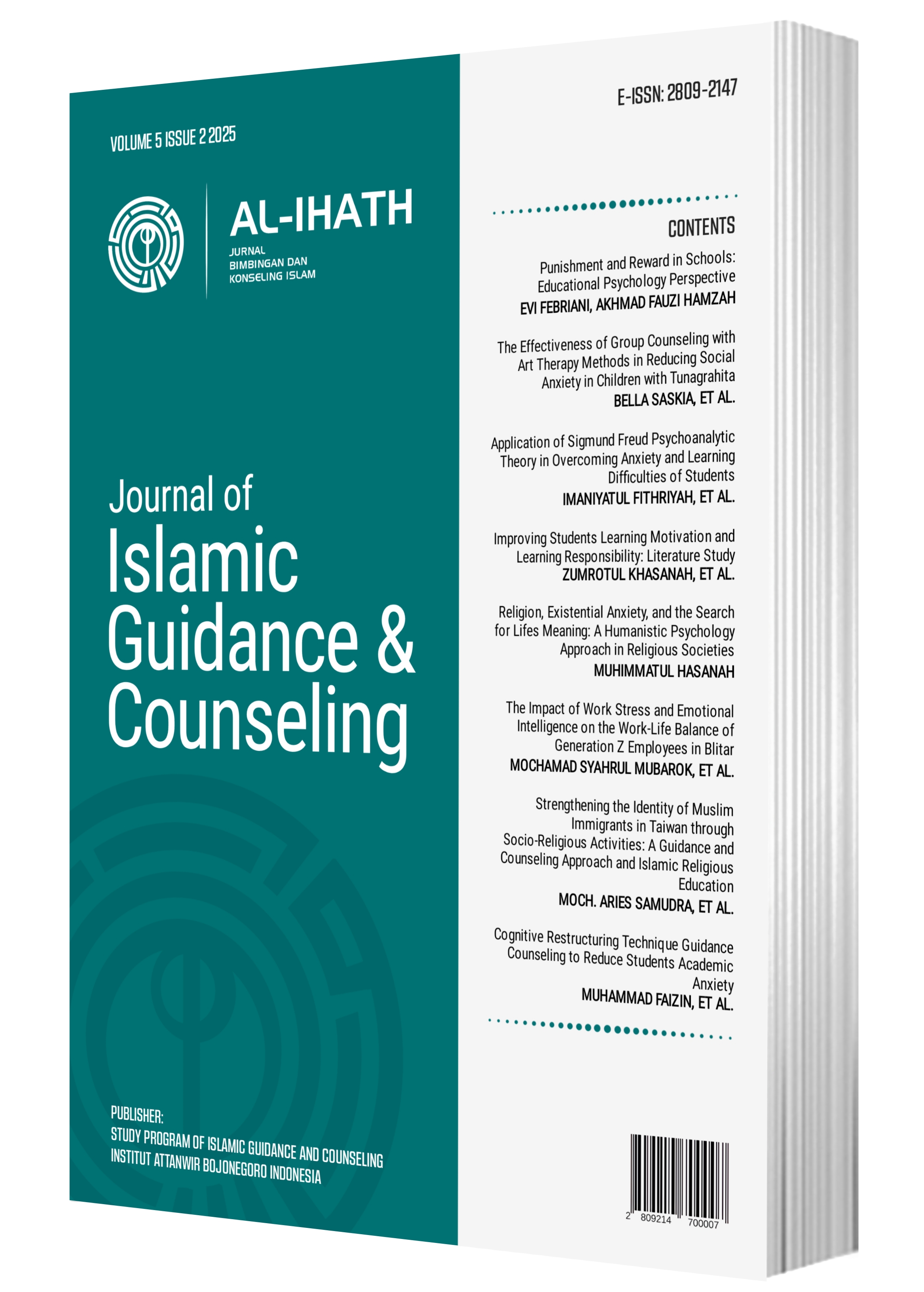
The Effectiveness of Group Counseling with Art Therapy Methods in Reducing Social Anxiety in Children with Tunagrahita
DOI:
https://doi.org/10.53915/jbki.v5i2.630Keywords:
Group Counseling, Art Therapy, Sosial Anxiety, Tunagrahita ChildrenAbstract
The existence of social anxiety that is not managed can develop into disorders that hinder daily function. Based on initial observations, some mentally retarded children show symptoms of social anxiety, such as blushing faces, lack of confidence, excessive sweating, stuttering when speaking, difficulty concentrating, closing themselves, and easily panicked. So it is necessary to reduce social anxiety through group counseling services with art therapy methods. This study aims to determine the level of social anxiety in mentally retarded children before and after group counseling with art therapy methods, and to determine the effectiveness of group counseling with art therapy methods to reduce social anxiety in mentally retarded children. The methodology in research is quantitative, type of pre-experimental research with one group pretest-posttest design. This study involved 7 subjects with conditions of age and IQ limitations determined by means of purposive sampling of 30 mentally retarded children in SLB-C Karya Ibu. The results showed the first, the TSR test (high, medium, low) was obtained the level of social anxiety in children with mental retardation increased (high and moderate) represented 95% after applied group counseling with the art therapy method of social anxiety in children with mental retardation decreased to 76%. Second, it is known from the results of the paired samples t test that the asymp.sig (2-tailed) was obtained worth 0.001 value of 0.001 <0.05, so it can be concluded HA is accepted and H0 is rejected. Means having a difference from the results of the pretest and posttest. So it is concluded that group counseling with art therapy methods is effective in reducing social anxiety in mentally retarded children in SLB C Karya Ibu.
References
Ardiansyah, Risnita, & Jailani, M. S. (2023). Teknik Pengumpulan Data Dan Instrumen Penelitian Ilmiah Pendidikan Pada Pendekatan Kualitatif dan Kuantitatif. Jurnal IHSAN : Jurnal Pendidikan Islam, 1(2), 1–9. https://doi.org/10.61104/ihsan.v1i2.57
Arliana, B., Putri, R. D., & Sari, S. P. (2022). Peningkatan Self-disclosure melalui Bimbingan Kelompok pada Siswa Kelas X di SMA Negeri 1 Rambang Niru. Jurnal Pendidikan Dan Konseling, 4(4), 1120–1123.
Astuti, I., Haryati, E., & Atika, A. (2022). Pengembangan Model Resiliensi Akademik Berbantuan Konseling Kelompok. Jurnal Teknologi Pendidikan (JTP), 15(2), 116. https://doi.org/10.24114/jtp.v15i2.39122
Batadal, I. (2021). Self Control Dalam Menekan Perilaku SOcial Anxiety Pada Remaja. Jurnal Bimbingan Dan Konseling Islam, 10(December), 44–45.
Fadhila, N. R., & Pratiwi, T. I. (2020). Hubungan Self-Efficacy dan Konsep Diri Dengan Kecemasan Sosial Pada Siswa Kelas VIII di SMPN 59 Surabaya. Jurnal BK UNESA, 11(3), 312–318. https://jurnalmahasiswa.unesa.ac.id/index.php/jurnal-bk-unesa/article/view/33340/29883
Herliza, S., & Mawardah, M. (2023). Metode Penyusunan Abjad Terhadap Kemampuan Mengenal Huruf Pada Anak Tunagrahita di SLB Negeri Sekayu. Jurnal Pengabdian Mandiri Universitas Bina Dharma, 2(10), 2061–2066.
Nuryadi et al. (2020). Dasar-dasar Statistik Penelitian. (Yogyakarta: Sibuku Media).
Prawiyogi, A. G., Sadiah, T. L., Purwanugraha, A., & Elisa, P. N. (2021). Penggunaan Media Big Book untuk Menumbuhkan Minat Membaca di Sekolah Dasar. Jurnal Basicedu, 5(1), 446–452. https://doi.org/10.31004/basicedu.v5i1.787
Riyanti, N. (2020). Teknik Restrukturisasi Kognitif Untuk Mereduksi Kecemasan Sosial Remaja. Jurnal Bimbingan Dan Konseling Borneo, 2(1), 86–92. https://doi.org/10.35334/jbkb.v2i1.1475
Ruliansyah, R., Jaya, I. D., & Syaputra, S. (2017). Aplikasi Pembelajaran Dasar Anak Retardasi Mental Berbasis Android (Studi Kasus: Sekolah Luar Biasa (SLB) C Karya Ibu Palembang). Jusifo (Jurnal Sistem Informasi), 3(1), 73–80. https://doi.org/10.19109/jusifo.v3i1.3861
SARI, S. F. M., BINAHAYATI, B., & TAFTAZANI, B. M. (2017). Pendidikan Bagi Anak Tuna Grahita (Studi Kasus Tunagrahita Sedang Di Slb N Purwakarta). Prosiding Penelitian Dan Pengabdian Kepada Masyarakat, 4(2), 217–222. https://doi.org/10.24198/jppm.v4i2.14273
Segoro, W., & Kusuma Pratiwi, W. (2021). Pengaruh Lingkungan Kerja, Disiplin Kerja Dan Motivasi Kerja Terhadap Produktivitas Kerja Karyawan Cv. Gema Teknikatama Cibitung. Jurnal Manajemen Pendidikan Dan Ilmu Sosial, 2(2), 880–888. https://doi.org/10.38035/jmpis.v2i2.701
Sina, I. (2022). METODOLOGI PENELITIAN (A. Putranto (ed.); Cetakan Pe). WIDINA BHAKTI PERSADA BANDUNG.
Soma, Y. M., & Karneli, Y. (2020). Penerapan Teknik Art Therapy untuk Mengurangi Kecemasan Sosial terhadap Korban Cyberbullying. SCHOULID: Indonesian Journal of School Counseling, 5(2), 67. https://doi.org/10.23916/08774011
Sugiyono, P. D. (2022). METODE PENELITIAN Kuantitatif, Kualitatif dan R&D (Cetakan ke). Alfabeta.
Downloads
Published
Issue
Section
License
Copyright (c) 2025 Bella Saskia, Zhila Jannati, Bela Janare Putra

This work is licensed under a Creative Commons Attribution-ShareAlike 4.0 International License.
Authors who publish with this journal agree to the following terms:
- Authors retain copyright and grant the journal right of first publication with the work simultaneously licensed under a Creative Commons Attribution License that allows others to share the work with an acknowledgement of the work's authorship and initial publication in this journal.
- Authors are able to enter into separate, additional contractual arrangements for the non-exclusive distribution of the journal's published version of the work (e.g., post it to an institutional repository or publish it in a book), with an acknowledgement of its initial publication in this journal.
- Authors are permitted and encouraged to post their work online (e.g., in institutional repositories or on their website) prior to and during the submission process, as it can lead to productive exchanges, as well as earlier and greater citation of published work.