
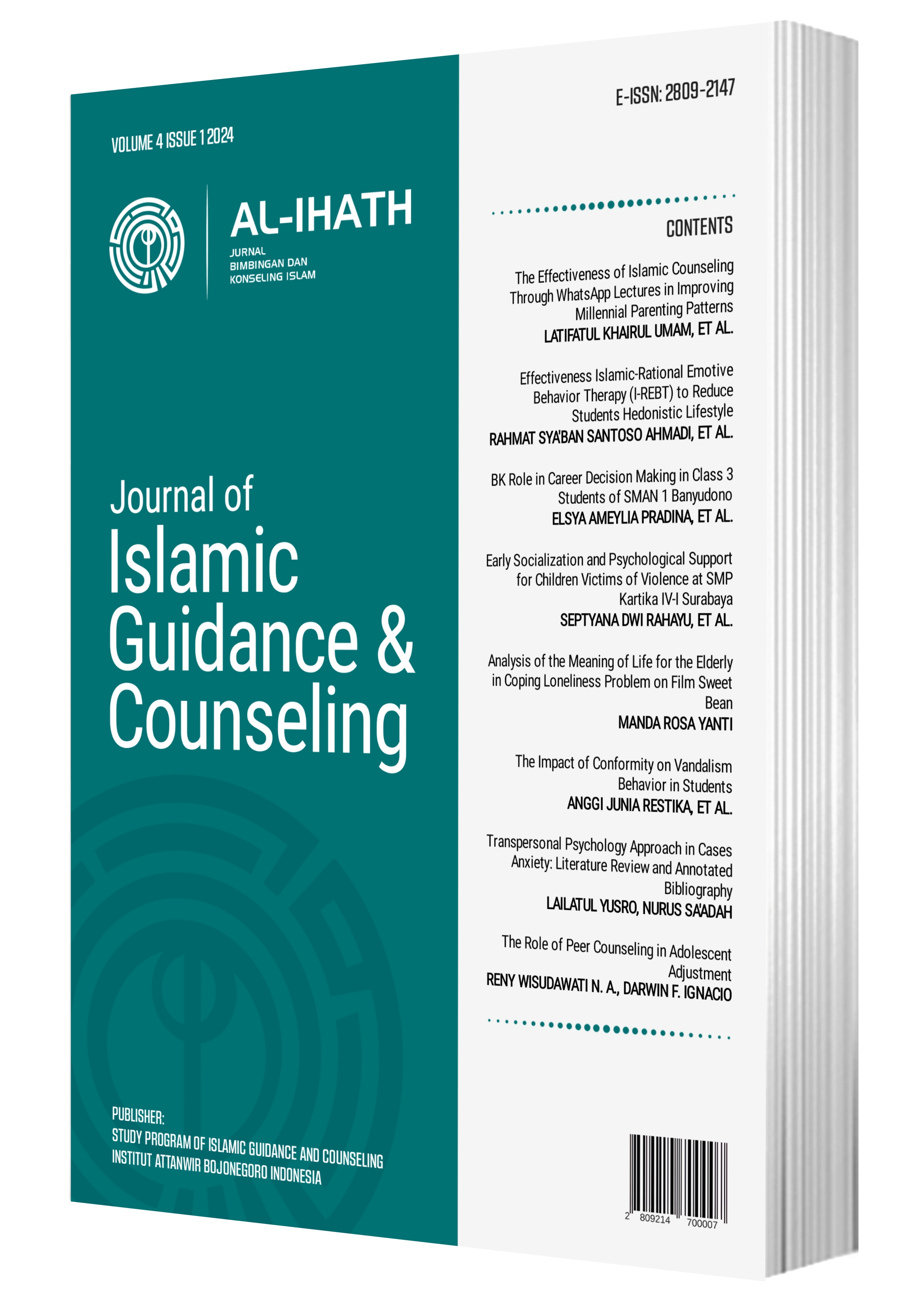
The Effectiveness of Islamic Counseling Through WhatsApp Lectures in Improving Millennial Parenting Patterns
DOI:
https://doi.org/10.53915/jbki.v4i1.37Keywords:
Islamic Counseling, WhatsApp Lectures, Parenting, Millennial ParentsAbstract
This study aims to obtain an overview of the effectiveness of providing Islamic counseling through WhatsApp lecture groups in improving millennial parenting styles, by assessing the behavior and actions taken by millennial parents towards their children after counseling with an Islamic approach through WhatsApp lectures. This research uses a survey research model. Based on the survey results, it can be seen that respondent (1) be more aware of their own mistakes (2) be more patient and painstaking. (3) be aware of the deficiency and need to spare more time with the child (4) The explanations are easy to understand and easy to practice so that result the best as they want (5) be more restrained when get angry and try to think positively (6) trying to understand the needs of children than obeying own ego (7) be more careful in doing something (8) After the Islamic counseling session that has been done, the respondent can do a different handling when facing a tantrum child afterwards. From the results of this research, it would be better for this kulWap to be carried out on a regularly scheduled basis with a plan that has been arranged and scheduled neatly. The material provided is further refined regarding parenting patterns according to Islam so that Indonesian muslim children have strong inner strength from childhood golden age.
References
Adawiyah, R. (2017). 3534-7009-1-SM.pdf. FKIP ULM Banjarmasin.
Apriastuti, A. D. (2013). Analysis of Education Level and Child Development. Journal of Health Sciences Communication Media, 4(1).
Apriastuti, A. D. (2013). Analysis of Parental Education Level and Parenting Patterns with the Development of Children Aged 48 – 60 Months. 4(1), 21–34.
Barhoumi, C. (2015). Effectiveness of WhatsApp Mobile Learning Activities Guided by Activity Theory on Students’ Knowledge Mangement. Contemporary Educational Technology, 6(3), 221-238.
Bornstein, M. H. (2002). Handbook ofparenting: Parent education in bornstein.Vol.4. New Jersey: Lawrence Erlbaum Associates Publisher.
Creswell, J. W. (2012). Educational Research: Planning, Conducting, Evaluating Quantitative and Qualitative Research (Fourth Edi). Lincoln: Pearson.
Faizin, M. (2021). Pola Asuh Orang Tua Perantau dalam Membentuk Self Control Anak di Desa Payaman Solokuro Lamongan. Al-Ihath: Jurnal Bimbingan dan Konseling Islam, 1(1), 1-17.
Haq, T. Z. (2020). Parenting Patterns in the Social Behavior of the Millennial Generation as Seen from Neuroscience.Al-Mada: Journal of Religion, Social and Culture, 3(1), 88–108.https://doi.org/10.31538/almada.v3i1.609
Khumaeroh, Siti. & Widjayatri, Deni. (2022) Parenting Patterns of Millennial Generation Parents on the Social and Emotional Development of Early Childhood.Ashil: Journal of Early Childhood Education, Indonesian Education University. Vol. 2 No. 2, October 2022, e-ISSN: 2776-4117.https://doi.org/10.33367/piaud.v1i1.2519
Lisa, W. & Astuti, A. (2018) Differences in Conscious Parenting among Millennial Parents.Faculty of Psychology, Gunadarma University. Journal of Psychology Volume 11 No. 1, June 2018
Marliani , Y. F. ( 2014 ).The influence of socialization methods and maternal attachment on the character of adolescents in Situ Gede Village, Bogor City. Thesis (unpublished). Bogor: Bogor Agricultural Institute.
Muamanah, S. (2018). The Influence of Parenting Styles on the Social and Emotional Development of Children Aged 4-5 Years in Bandarabung Village, Abung District, Surakarta, North Lampung Regency. Journal of Chemical Information and Modeling, 53(9), 1689–1699.
Rahmat, S. T. (2018). Effective Parenting Patterns in Educating Children in the Digital Era.Journal Education and Culture Missio, 10(2), 143.
Sierra, son of Farida. (2019). Guidance and counseling. Malang: Madani Media
Suharti, S., Nur, F., & Khusnah, N. (2021). WhatsApp as an online learning medium.
AKSIOMA: Journal of the Mathematics Education Study Program, 10(3), 1893.https://doi.org/10.24127/ajpm.v10i3.3 72
Sutisna, Icam. (2012). Getting to know Baumrind's Parenting Model. University Early Childhood Education Teacher Education.
Downloads
Published
Issue
Section
License
Copyright (c) 2024 Latifatul Khairul Umam, Siti Kasmila, Dadan Suherdiana, M. Irfan

This work is licensed under a Creative Commons Attribution-ShareAlike 4.0 International License.
Authors who publish with this journal agree to the following terms:
- Authors retain copyright and grant the journal right of first publication with the work simultaneously licensed under a Creative Commons Attribution License that allows others to share the work with an acknowledgement of the work's authorship and initial publication in this journal.
- Authors are able to enter into separate, additional contractual arrangements for the non-exclusive distribution of the journal's published version of the work (e.g., post it to an institutional repository or publish it in a book), with an acknowledgement of its initial publication in this journal.
- Authors are permitted and encouraged to post their work online (e.g., in institutional repositories or on their website) prior to and during the submission process, as it can lead to productive exchanges, as well as earlier and greater citation of published work.