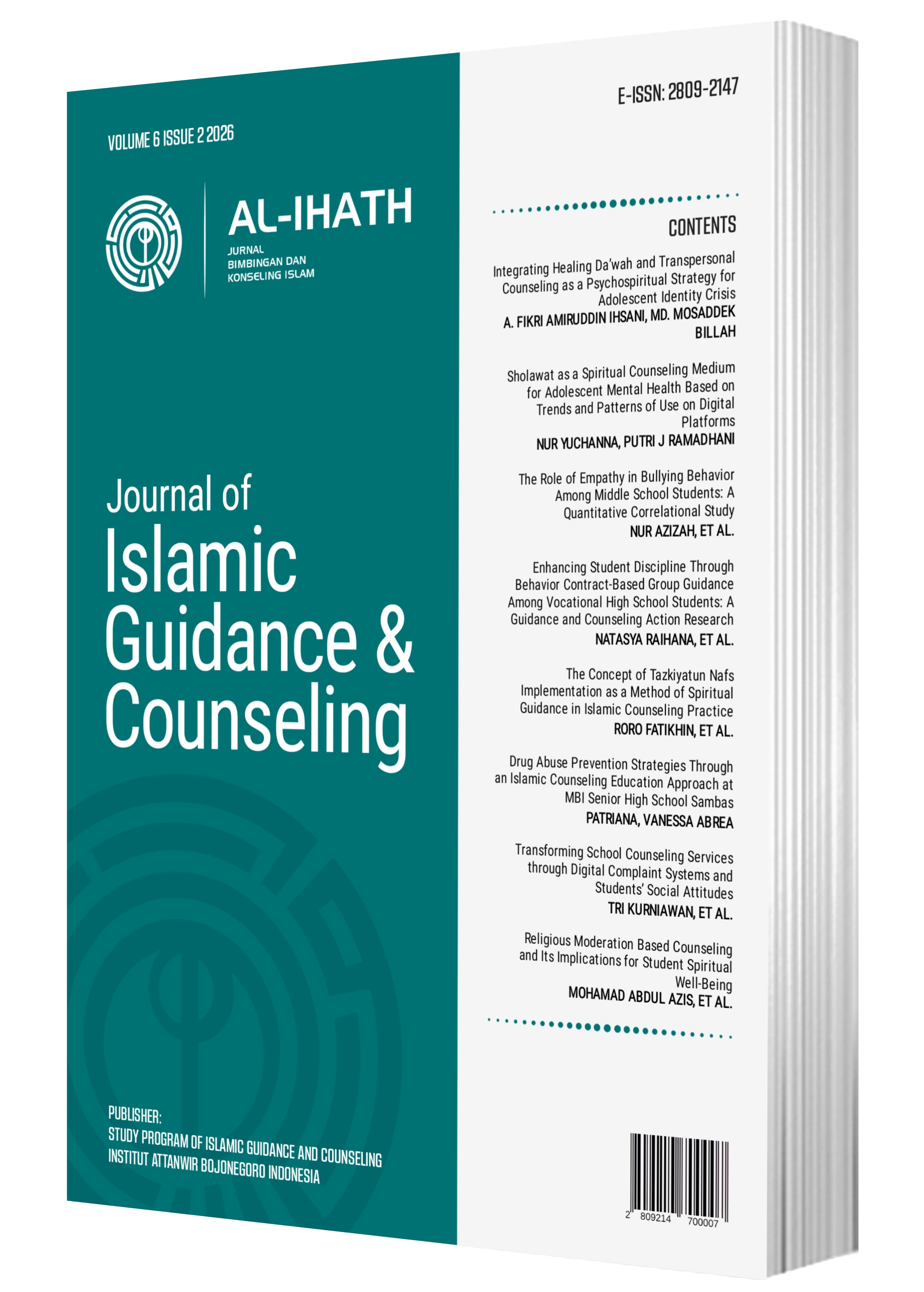
The Concept of Tazkiyatun Nafs Implementation as a Method of Spiritual Guidance in Islamic Counseling Practice
DOI:
https://doi.org/10.53915/jbki.v6i2.147Keywords:
Islamic Counseling, Spiritual Guidance, Spiritual Development, Thematic SynthesisAbstract
The increasing prevalence of psychological, spiritual, and social problems in contemporary society has highlighted the need for counseling approaches that address not only psychological symptoms but also individuals' spiritual well-being. One promising approach is tazkiyatun nafs (purification of the soul), a fundamental concept in Islamic teachings. This study aims to analyze the implementation of tazkiyatun nafs as a method of spiritual guidance in Islamic counseling and to develop a conceptual implementation model. The study employed a qualitative library research approach using documentary analysis of relevant scholarly literature. Data were analyzed through thematic synthesis, including literature identification, coding, theme development, interpretation, and conceptual synthesis. The findings reveal four major themes. First, tazkiyatun nafs serves as the foundational framework for spiritual guidance by integrating the spiritual, psychological, moral, and social dimensions of Islamic counseling. Second, its implementation follows a systematic process involving the strengthening of tawhid, purification of the heart, muhasabah (self-reflection), repentance, dhikr (remembrance of Allah), Qur'anic recitation, regular worship, and self-discipline over worldly desires. Third, this implementation promotes multidimensional development, including enhanced spirituality, psychological well-being, moral character, emotional regulation, and social adaptability. Fourth, tazkiyatun nafs demonstrates strong relevance in addressing mental health challenges, spiritual crises, moral degradation, and the complexities of the digital era. Based on these findings, this study proposes a conceptual model of tazkiyatun nafs implementation that systematically integrates spiritual foundations, implementation processes, counselee transformation, and counseling outcomes. The proposed model contributes to the advancement of Islamic counseling theory and practice by providing a holistic, integrative, and contextually responsive framework for contemporary counseling services.
References
Alif, M. (2025). Resiliensi spiritual dalam perspektif Al-Qur’an: Studi Qur’an tematik dengan pendekatan grounded theory. Salimiya: Jurnal Studi Ilmu Keagamaan Islam, 6(3), 716–724.
Alviana, N. (2024). Peran agama Islam dalam praktik bimbingan dan konseling. Al-Furqan: Jurnal Agama, Sosial, dan Budaya, 3(6), 2618–2639.
Anbiya, A. Z. (2023). Received: 29-07-2022. 7(1), 133–148. https://doi.org/10.29240/jbk.v7i1.5130
Aulia, D., Bestari, N., & Lestari, Y. I. (2026). Tazkiyatun nafs dan tantangan digital: Integrasi psikologi Islam dalam menjaga kesehatan mental. Arus Jurnal Psikologi Dan Pendidikan, 5(1), 504–514. https://doi.org/10.57250/ajpp.v5i1.2126
Dahlia, D., Wulandari, S., & Indrawan, I. (2025). Teknik pengumpulan data evaluasi pendidikan. Jotika Journal in Education, 4(2), 63–69. https://doi.org/10.56445/jje.v4i2.174
Faridah, A. (2023). Perjalanan Pemikiran Tasawuf Imam Al Ghazali Dalam Pendidikan Islam: Dari Tahap Takhalli Hingga Tajalli. Launul Ilmi: Jurnal Keislaman Dan Peradaban, 1(2 Juni), 1–19.
Fermadi, B., Pangestutiani, Y., Munir, M., Habibah, A. N., Fauzi, M. H., Said, A. A., Alwi, M. B., & Shanty, N. R. (2025). Implementasi Konsep Tazkiyatun Nafs (Penyucian Jiwa) dalam Bimbingan dan Konseling Islami di Perguruan Tinggi. Journal of Golden Generation Abdimas, 1(1), 1–25.
Fithriyyah, I. (2023). Implementasi Metode Tazkiyatun Nafs Imam Al-Ghazali Perspektif Pendidikan Islam Dalam Mengembangkan Potensi Kecerdasan Spiritual Siswa MAN 1 Kota Bengkulu. UIN Fatmawati Sukarno Bengkulu.
Hasyim, M. (2022). Pendidikan karakter holistik di era disrupsi: Mengintegrasikan konsep tazkiyatun nafs Imam Al-Ghazali. Urwatul Wutsqo: Jurnal Studi Kependidikan Dan Keislaman, 11(1), 113–120. https://doi.org/10.54437/urwatulwutsqo.v11i1.1748
Hopipah, E. N., Mansurnoor, I. A., & Rahman, Y. (2025). Integration of the Spiritual Emotional Freedom Technique ( SEFT ) Model and the Concept of Tazkiyatun Nafs from Imam Ghazali ’ s Perspective for the Recovery Process of Clients with Psychological Disorders Integration of the Spiritual Emotional Freedom Technique ( SEFT ) Model and the Concept of Tazkiyatun Nafs from Imam Ghazali ’ s Perspective for the Recovery Process of Clients with Psychological Disorders.
Hutami, H. S. (2019). Konsep Tazkiyatun Nafs Perspektif Surat Al-Muzzammil Dan Relevansi Dalam Membentuk Kepribadian Muslim. UIN Raden Intan Lampung.
Irman, I., Dasril, D., Silvianetri, S., & Yeni, P. (2022). Pengaruh Konseling Teknik Tazkiyatun Nafs dalam Mereduksi Kegelisahan Lansia. KONSELING EDUKASI" Journal of Guidance and Counseling", 6(2), 227–242.
Istiqomah, I., Mujtaba, M. S., & Anwarudin, A. (2024). Model terapi psikospiritual: Implementasi konsep Tazkiyatun Nafs Hamka dalam mengatasi penyakit jiwa. Risâlah Jurnal Pendidikan Dan Studi Islam, 10(1), 397–408.
Jannah, R. (2022). Peranan Bimbingan Konseling Islam dalam Mengaktifkan Kecerdasan Spiritual Santri Pondok Pesantren Darul Khair Babakan Lebaksiu Tegal. Al-Ihath: Jurnal Bimbingan Dan Konseling Islam, 2(1), 1–16.
Jariyah, A., & Mujab, M. (2025). Konsep pendidikan akhlak tasawuf sebagai solusi krisis moral di era modern. IQRO: Journal of Islamic Education, 8(2), 791–802. https://doi.org/10.24256/iqro.v8i2.7603
Kamaluddin, R. T., Hafidhuddin, D., & Alim, A. (2024). Tazkiyatun Nafs dalam Al-Qur’an & relevansinya terhadap terapi spiritual pada era disrupsi. Islamic Literature: Journal of Islamic Civilisations, 1(1), 46–72.
Maulana, M. A. (2024). Psikologi Islam Dan Implikasinya Dalam Praktik Bimbingan Konseling Sebagai Upaya Menjaga Kesehatan Mental. Al-Isyraq: Jurnal Bimbingan, Penyuluhan, Dan Konseling Islam, 7(2), 641–654.
MOH, S. S. (2025). Agama dan pendidikan dalam perspektif filsafat pendidikan Islam. Journal of Creative Power and Ambition (JCPA), 1(2), 83–90.
Mursalin, M. (2024). Pendekatan Tasawuf Dan Psikoterapi Perspektif Islam. Cons-Iedu, 4(1), 77–90. https://doi.org/10.51192/cons.v4i1.813
Mutmainah, M. (2021). Metode Muhasabah: Analisis Pendekatan Psikologi Sufistik Perspektif Al –Ghazali:(Konsep Pendidikan Ruhaniyah Melalui Tazkiyatun nafs). Syaikhuna: Jurnal Pendidikan Dan Pranata Islam, 12(1), 41–51.
Nurrisa, F., & Hermina, D. (2025). Pendekatan kualitatif dalam penelitian: Strategi, tahapan, dan analisis data. Jurnal Teknologi Pendidikan Dan Pembelajaran| E-ISSN: 3026-6629, 2(3), 793–800.
Putra, A. D. (2024). Konsep tazkiyatun nafs Imam Al-Ghazali dan Ibnu Qayyim Al-Jauziyah: Studi komparasi. UIN Sultan Syarif Kasim Riau.
Putra, D. P. (2025). Bimbingan Konseling Islam Untuk Problematika Krisis Etik di Masyarakat. Widya Bhakti: Jurnal Penelitian Dan Pemberdayaan Masyarakat, 1(1), 13–20.
Putri, F. E. (2025). Konsep Tazkiyatun Nafs dalam Tasawuf sebagai Upaya Pembentukan Akhlak Mulia. AN-NUR: Jurnal Pendidikan Dan Pembelajaran, 1(3), 585–595. https://doi.org/10.65802/an-nur.v1i3.90
Rara, R. R. (2024). Pemikiran Imam Al-Ghazali tentang konsep tazkiyatun nafs dan kontekstualisasinya dengan mata pelajaran Akidah Akhlak. UIN Raden Intan Lampung.
Saefudin, M. (2026). The Objectives and Principles of Islamic Education: An Analytical Study on the Orientation of Insan Kamil Formation in the Modern Era. Lentera Pendidikan: Jurnal Ilmu Pendidikan Dan Keguruan Islam, 2(1), 35–41.
Sagita, M. N. (2023). Peran Tasawuf dalam Mengatasi Krisis Masyarakat Modern. Gunung Djati Conference Series, 19, 64–71.
Sassi, K. (2025). Spiritualitas pilar kesehatan mental: Studi tematik ayat-ayat ketentraman jiwa. Jurnal Pendidikan Integratif, 6(3).
Sholihudin. (2025). Konsep Tazkiyatun Nafs dalam Bimbingan Konseling Islam: Pendekatan Spiritual Terhadap Kesehatan Mental Sholihudin1 1Universitas Sunan Drajat Lamongan. 01, 120–133.
Suhartawan, B. (2025). Konsep Al-Qur’an Tentang Tazkiyatun Nafs dan Aplikasinya (Kajian Tafsir Tematik). Ar-Rasikhin: Jurnal Ilmu Al-Qur’an Dan Tafsir, 1(2), 123–143.
Sulastri, S. (2025). Konsep tazkiyatun nafs terhadap pengendalian hawa nafsu di usia remaja (studi analisis ayat-ayat tazkiyatun nafs perspektif Tafsir Al-Azhar karya Abdul Malik Karim Amrullah w. 1401 H). STKQ Al Hikam.
Suriati, S., Suriyati, S., Anis, M., Muhlis, M., & Riska, R. (2026). Implementasi bimbingan dan penyuluhan Islam dalam meningkatkan kualitas spiritual masyarakat multikultural. Jurnal Mimbar: Media Intelektual Muslim dan Bimbingan Rohani, 12(1), 56–66. https://doi.org/10.47435/mimbar.v12i01.4170
Wahyuni, A. S., Mecca, C. S., Andika, F., Ramadhan, I. Y., Sinaga, L. C., Farlis, N. M., & Yusri, N. N. (2025). Peran iman dan ibadah dalam menjaga kesehatan mental umat Muslim. Tashdiq: Jurnal Kajian Agama dan Dakwah, 16(3), 51–60.
Yandri, H., & Juliawati, D. (2025). Spiritual Counseling Grounded in Buya Hamka ’ s Tazkiyatun an-Nafs : Relevance and Implementation in the Context of Psychological Issues. 7(1), 146–159. https://doi.org/10.32939/ijcd.v7i1.5772
Zakia, A. Z., Faylasufa, H. N., Nur, A., & Ilman, A. Z. (2024). Aplikasi tazkiyatun nafs dalam psikoterapi Islam. Hisbah: Jurnal Bimbingan Konseling Dan Dakwah Islam, 21(2), 108–129. https://doi.org/10.14421/hisbah.2024.212-07
Downloads
Published
Issue
Section
License
Copyright (c) 2026 Roro Fatikhin, Mustolikh Khabibul Umam, Khasanah Khasanah, Hilya Alfaniya

This work is licensed under a Creative Commons Attribution-ShareAlike 4.0 International License.
Authors who publish with this journal agree to the following terms:
- Authors retain copyright and grant the journal right of first publication with the work simultaneously licensed under a Creative Commons Attribution License that allows others to share the work with an acknowledgement of the work's authorship and initial publication in this journal.
- Authors are able to enter into separate, additional contractual arrangements for the non-exclusive distribution of the journal's published version of the work (e.g., post it to an institutional repository or publish it in a book), with an acknowledgement of its initial publication in this journal.
- Authors are permitted and encouraged to post their work online (e.g., in institutional repositories or on their website) prior to and during the submission process, as it can lead to productive exchanges, as well as earlier and greater citation of published work.