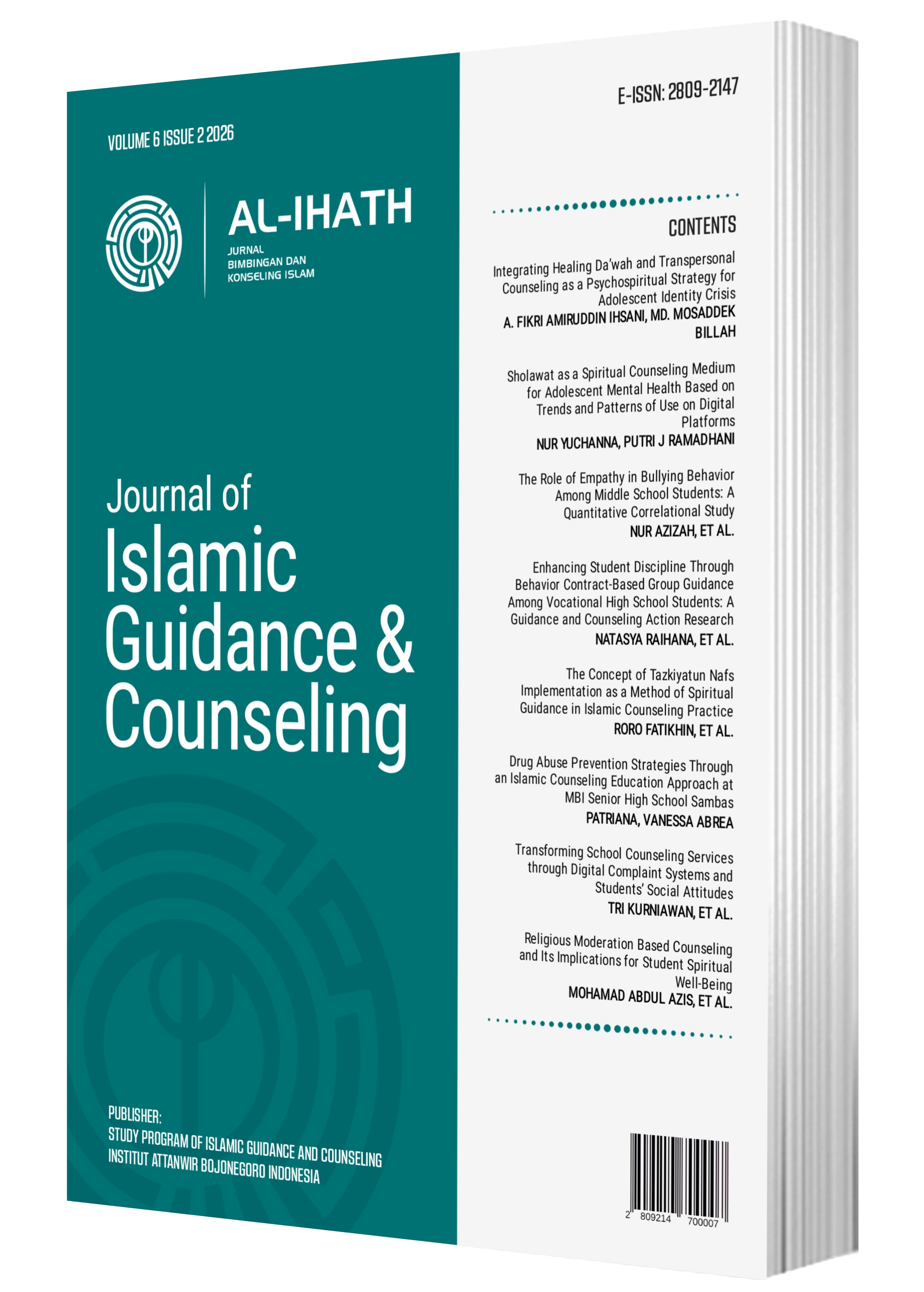
Drug Abuse Prevention Strategies Through an Islamic Counseling Education Approach at MBI Senior High School Sambas
DOI:
https://doi.org/10.53915/jbki.v6i2.145Keywords:
Drug Abuse Prevention, Islamic Counseling , Educational Approach, Guidance and CounselingAbstract
The background of this study is based on the increasing vulnerability of adolescents to drug abuse, which requires preventive efforts grounded in religious values and contextual counseling approaches. This study aims to analyze strategies for preventing drug abuse through an educational Islamic counseling approach at Madrasah Aliyah Muhammad Basiuni Imran Sambas. This study employs a qualitative approach using a phenomenological method. The research subjects include guidance and counseling teachers and students. Data collection techniques were carried out through observation, interviews, and documentation. Data analysis uses an interactive model consisting of data reduction, data display, and conclusion drawing and verification, with data validity ensured through triangulation. The findings of the study on drug abuse prevention through educational and Islamic counseling approaches at Madrasah Aliyah Muhammad Basiuni Imran (MBI) Sambas indicate the following: first, the implementation of Islamic counseling education is conducted through various activities such as socialization, counseling sessions, and the integration of materials into the learning process and Guidance and Counseling (GC) services. In addition, the methods used are varied, including lectures, group discussions, and the use of educational videos. Second, the Islamic counseling approach is applied through the provision of religious values that emphasize strengthening faith, morality, and students’ self-control. This process is carried out through guidance, advice, and self-reflection aimed at helping students understand the meaning of life and avoid behaviors prohibited in Islam, including drug abuse. The study concludes that prevention efforts are carried out in an integrated manner through educational activities, counseling, and the internalization of Islamic values, although they have not yet involved external stakeholders.
References
Adz-Dzaky. (2002). Konseling dan Psikoterapi Islam. Fajar Pustaka Baru.
Alif, M. (2025). Resiliensi spiritual dalam perspektif Al-Qur’an: Studi Qur’an tematik dengan pendekatan grounded theory. Salimiya: Jurnal Studi Ilmu Keagamaan Islam, 6(3), 716–724.
Arifin, H. M. (2009). Pokok-Pokok Pikiran tentang Bimbingan dan Penyuluhan Agama. Bulan Bintang.
Bandura, A. (1977). Social learning theory. Prentice Hall.
Bloom, T. (1956). Taxonomy of educational objectives. Longmans.
BNN. (2023). Laporan Kinerja. https://ppid.bnn.go.id/konten/unggahan/2020/10/Laporan-Kinerja-BNN-2023.pdf
Botvin, G. J., & Griffin, K. W. (2014). Life Skills Training: Preventing Substance Misuse by Enhancing Individual and Social Competence. New Directions for Youth Development.
Casey, B. J., Jones, R. M., & Hare, T. A. (2008). The adolescent brain. Annals of the New York Academy of Sciences, 112(1), 111–126. https://doi.org/10.1196/annals.1440.010
Corey, G. (2013). Theory and Practice of Counseling and Psychotherapy (9th ed.). Brooks/Cole, Cengage Learning.
Corey, G. (2017). Theory and Practice of Counseling and Psychotherapy (10th ed.). Cengage Learning.
Cuijpers, P. (2002). Effective ingredients of school-based drug prevention programs: A systematic review. Addictive Behaviors, 27(6), 1009–1023. https://doi.org/10.1016/S0306-4603(02)00295-2
Dishion, T. J., & Tipsord, J. M. (2011). Peer contagion in child and adolescent social and emotional development. Annual Review of Psychology, 62, 189–214. https://doi.org/10.1146/annurev.psych.093008.100412
Durlak, J. A., Weissberg, R. P., Dymnicki, A. B., Taylor, R. D., & Schellinger, K. B. (2011). The impact of enhancing students' social and emotional learning: A meta-analysis of school-based universal interventions. Child Development, 82(1), 405–432. https://doi.org/10.1111/j.1467-8624.2010.01564.x
Faggiano, F., Galanti, M. R., Bohrn, K., Burkhart, G., Vigna-Taglianti, F., Cuomo, L., Fabiani, L., Panella, M., Perez, T., Siliquini, R., van der Kreeft, P., Vassara, M., & Wiborg, G. (2008). The effectiveness of a school-based substance abuse prevention program: EU-Dap cluster randomised controlled trial. Preventive Medicine, 47(5), 537–543. https://doi.org/10.1016/j.ypmed.2008.06.018
Faggiano, F., Minozzi, S., Versino, E., & Buscemi, D. (2014). Universal school-based prevention for illicit drug use. Cochrane Database of Systematic Reviews, 2017(8). https://doi.org/10.1002/14651858.CD003020.pub3
Faggiano, F., Vigna-Taglianti, F., Burkhart, G., Bohrn, K., Cuomo, L., Gregori, D., Panella, M., Scatigna, M., Siliquini, R., Varona, L., van der Kreeft, P., Vassara, M., Wiborg, G., & Galanti, M. R. (2010). The effectiveness of a school-based substance abuse prevention program: 18-month follow-up of the EU-Dap cluster randomized controlled trial. Drug and Alcohol Dependence, 108(1–2), 56–64. https://doi.org/10.1016/j.drugalcdep.2009.11.018
Flick, U. (2018). An Introduction to Qualitative Research (6th ed.). SAGE Publications Ltd.
Foxcroft, D. R., & Tsertsvadze, A. (2011). Universal school-based prevention programs for alcohol misuse in young people. Cochrane Database of Systematic Reviews, (5), CD009113. https://doi.org/10.1002/14651858.CD009113
Ginanjar, T., & Mihajra, S. (2025). Strengthening teenagers’ awareness about the dangers of drugs through Islamic counseling at Madrasah Aliyah. Jurnal Bimbingan Penyuluhan Islam, 7(1), 31–42. https://doi.org/10.32332/56ceqj18
Griffin, K. W., & Botvin, G. J. (2010). Evidence-based interventions for preventing substance use disorders in adolescents. Child and Adolescent Psychiatric Clinics of North America, 19(3), 505–526. https://doi.org/10.1016/j.chc.2010.03.005
Hawari, D. (2016). Penyalahgunaan dan ketergantungan narkoba. FKUI.
Hawkins, J. D., Catalano, R. F., & Miller, J. Y. (1992). Risk and protective factors for alcohol and other drug problems in adolescence and early adulthood: Implications for substance abuse prevention. Psychological Bulletin, 112(1), 64–105. https://doi.org/10.1037/0033-2909.112.1.64
Hurlock, E. B. (2014). Psikologi Perkembangan. Erlangga.
Koenig, H. G. (2012). Religion, spirituality, and health: The research and clinical implications. ISRN Psychiatry, 2012, 1–33. https://doi.org/10.5402/2012/278730
Latipun. (2015). Psikologi konseling. UMM Press.
Lemstra, M., Bennett, N., Nannapaneni, U., Neudorf, C., Warren, L., Kershaw, T., & Scott, C. (2010). A systematic review of school-based marijuana and alcohol prevention programs targeting adolescents aged 10–15. Addiction Research & Theory, 18(1), 84–96. https://doi.org/10.3109/16066350802673224
Marceau, K. (2023). The role of parenting in developmental trajectories of risk for adolescent substance use: A bioecological systems cascade model. Frontiers in Psychology, 14, 1277419. https://doi.org/10.3389/fpsyg.2023.1277419
Mason, M. J., Zaharakis, N. M., & Benotsch, E. G. (2020). Social networks, spirituality, and substance use among adolescents: A systematic review. Substance Use & Misuse, 55(8).
Maududi, A. A. A., Najihah, N., Wardian, N. R., Ramadhini, R. E., Atsaury, M. S., Nusantara, A. C. P., Syafitri, A. H. D., & Syabani, S. N. (2026). Edukasi tentang pengetahuan dan sikap remaja terhadap penyalahgunaan NAPZA pada siswa SMP Al-Amanah tahun 2025. Jurnal Riset Ilmu Kesehatan Umum dan Farmasi (JRIKUF), 4(1), 33–40. https://doi.org/10.57213/jrikuf.v4i1.941
Miles, M. B., & Huberman, A. M. (1994). Qualitative data analysis: An expanded sourcebook. Sage Publications.
Munadiah Wahyuddin, Irfan, I., Aswar, A., & Nurpadila, N. (2021). Efektivitas media sosial terhadap pengetahuan remaja tentang Napza. Bina Generasi: Jurnal Kesehatan, 12(2), 29–35. https://doi.org/10.35907/bgjk.v12i2.170
Musnamar, T. (1992). Dasar-dasar konseptual bimbingan dan konseling Islam. UII Press.
Newton, N. C., Champion, K. E., Slade, T., Chapman, C., Stapinski, L., Koning, I., Tonks, Z., & Teesson, M. (2017). A systematic review of combined student- and parent-based programs to prevent alcohol and other drug use among adolescents. Drug and Alcohol Review, 36(3), 337–351. https://doi.org/10.1111/dar.12497
Notoatmodjo, S. (2014). Ilmu perilaku kesehatan. Rineka Cipta.
Onrust, S. A., Otten, R., Lammers, J., & Smit, F. (2016). School-based programmes to reduce and prevent substance use in different age groups: What works for whom? Systematic review and meta-regression analysis. Clinical Psychology Review, 44, 45–59. https://doi.org/10.1016/j.cpr.2015.11.002
Porath-Waller, A. J., Beasley, E., & Beirness, D. J. (2010). A meta-analytic review of school-based prevention for cannabis use. Health Education & Behavior, 37(5), 709–723. https://doi.org/10.1177/1090198110361315
Prayitno. (2017). Dasar-dasar bimbingan dan konseling. Rineka Cipta.
Rahayu, N. P., Santosa, B., Kamal, M., & Rahmi, A. (2022). Efektivitas bimbingan dan konseling Islam untuk meningkatkan self control korban penyalahgunaan narkotika di Lembaga Permasyarakatan Kelas II A Rantauprapat. Jurnal Pendidikan Tambusai, 6(1), 4520–4527. https://doi.org/10.31004/jptam.v6i1.3580
Rahmawati, H. K., & Nafi, A. (2022). Layanan bimbingan konseling Islam dalam mengurangi kecemasan bagi korban penyalahgunaan Napza. Jurnal Konseling Pendidikan Islam, 3(2), 389–397. https://doi.org/10.32806/jkpi.v3i2.37
Rasydy, L. O. A., Yuniarto, A., Megawati, S., Rangkuti, S. N., Nurfi, A., & Junaedi, A. L. (2023). Konseling dan edukasi bahaya penyalahgunaan obat Napza di kalangan remaja. Monsu’ani Tano Jurnal Pengabdian Masyarakat, 6(1), 162. https://doi.org/10.32529/tano.v6i1.2433
Rohrbach, L. A., Sun, P., & Sussman, S. (2010). One-year follow-up evaluation of the Project Towards No Drug Abuse (TND) dissemination trial. Preventive Medicine, 51(3–4), 313–319. https://doi.org/10.1016/j.ypmed.2010.07.016
Ryan, S. M., Jorm, A. F., & Lubman, D. I. (2010). Parenting factors associated with reduced adolescent alcohol use: A systematic review of longitudinal studies. Australian and New Zealand Journal of Psychiatry, 44(9), 774–783. https://doi.org/10.1080/00048674.2010.501759
Santrock, J. W. (2012). Perkembangan Masa Hidup. Erlangga.
Sholihah, Q. (2015). Efektivitas program P4GN terhadap pencegahan penyalahgunaan Napza. Jurnal Kesehatan Masyarakat, 10(2), 153. https://doi.org/10.15294/kemas.v10i2.3376
Silalahi, M. C., & Suryani, I. (2025). Effectiveness of self-management techniques based on Islamic counselling in reducing social media addiction among students. Journal of General Education and Humanities, 4(4), 1747–1760. https://doi.org/10.58421/gehu.v4i4.747
Sitnick, S. L., Shaw, D. S., & Hyde, L. W. (2014). Precursors of adolescent substance use from early childhood and early adolescence: Testing a developmental cascade model. Development and Psychopathology, 26(1), 125–140. https://doi.org/10.1017/S0954579413000539
Spoth, R., Greenberg, M., & Turrisi, R. (2008). Preventive interventions addressing underage drinking: State of the evidence and steps toward public health impact. Pediatrics, 121(4), S311–S336. https://doi.org/10.1542/peds.2007-2243E
Steinberg, L. (2008). A social neuroscience perspective on adolescent risk-taking. Developmental Review, 28(1), 78–106. https://doi.org/10.1016/j.dr.2007.08.002
Sussman, S., Dent, C. W., & Stacy, A. W. (2002). Project Towards No Drug Abuse: A review of the findings and future directions. American Journal of Health Behavior, 26(5), 354–365. https://doi.org/10.5993/AJHB.26.5.4
Sutoyo, A. (2013). Bimbingan dan konseling Islami. Pustaka Pelajar.
Tobler, N. S., Lessard, T., Marshall, D. G., Ochshorn, P., Roona, M. R., Streke, A. V., & Stackpole, K. M. (1999). Effectiveness of school-based drug prevention programs for marijuana use. Journal of Primary Prevention, 20(1), 63–83. https://doi.org/10.1177/0143034399201008
United Nations Office on Drugs and Crime. (2023). World drug report. UNODC.
World Health Organization. (2017). Prevention of drug use and treatment of drug use disorders in young people. WHO Press.
World Health Organization. (2018). Health education and promotion. WHO.
Yin, R. K. (2018). Case Study Research and Applications: Design and Methods. Sage Publications.
Yonker, J. E., Schnabelrauch, C. A., & DeHaan, L. G. (2012). The relationship between religiosity and adolescent adjustment: A meta-analysis. Journal of Adolescence.
Downloads
Published
Issue
Section
License
Copyright (c) 2026 Patriana Patriana, Vanessa Abrea

This work is licensed under a Creative Commons Attribution-ShareAlike 4.0 International License.
Authors who publish with this journal agree to the following terms:
- Authors retain copyright and grant the journal right of first publication with the work simultaneously licensed under a Creative Commons Attribution License that allows others to share the work with an acknowledgement of the work's authorship and initial publication in this journal.
- Authors are able to enter into separate, additional contractual arrangements for the non-exclusive distribution of the journal's published version of the work (e.g., post it to an institutional repository or publish it in a book), with an acknowledgement of its initial publication in this journal.
- Authors are permitted and encouraged to post their work online (e.g., in institutional repositories or on their website) prior to and during the submission process, as it can lead to productive exchanges, as well as earlier and greater citation of published work.