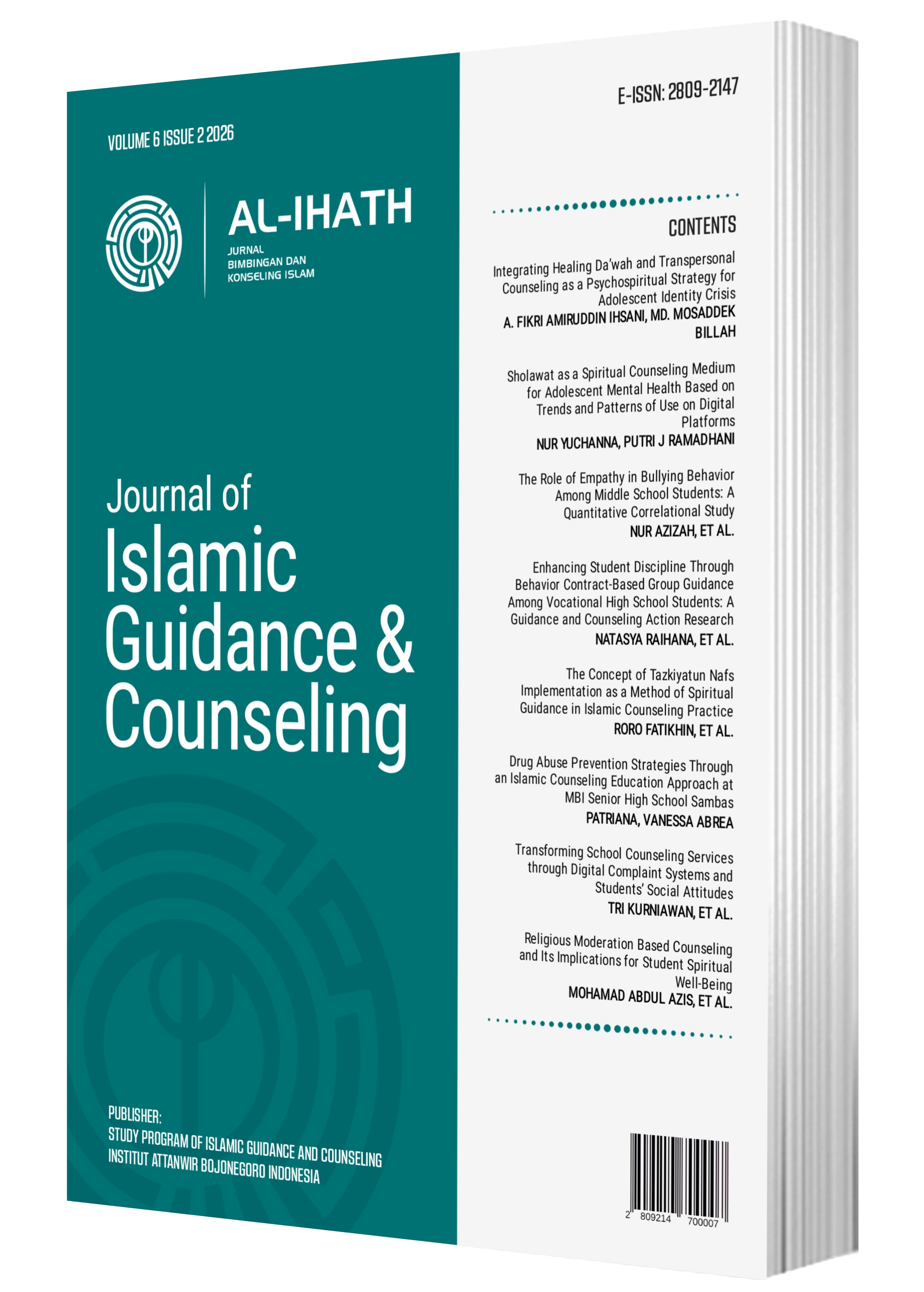
The Role of Empathy in Bullying Behavior Among Middle School Students: A Quantitative Correlational Study
DOI:
https://doi.org/10.53915/jbki.v6i2.132Keywords:
Bullying, Empathy, CorrelationalAbstract
School education plays a vital role in enhancing human quality of life. However, schools also face significant issues, such as bullying. Bullying can be defined as the use of power to hurt an individual or group verbally, physically, or psychologically, leaving the victim feeling distressed, traumatized, and powerless. One contributing factor to bullying behavior among students is a lack of empathy toward their peers. Empathy is the ability to sense another person's emotional state, feel sympathy, attempt to solve problems, and see situations from others' perspectives. Students who engage in bullying often exhibit low levels of empathy. This study aims to examine the relationship between the level of empathy and bullying behavior in junior high school using a descriptive quantitative method. Data analysis was conducted using Spearman’s Rank Correlation. The results indicate that empathy significantly influences bullying behavior, with a p-value of 0.000 < 0.05 and a correlation coefficient of r = -0.464. This finding suggests that higher levels of empathy among students are associated with lower incidences of bullying behavior. Empathy serves as a fundamental and essential basis for building relationships, connections, and positive social interactions. Relationships grounded in high empathy tend to be healthier. By fostering high empathy in students, bullying behavior can be prevented through the cultivation of empathetic attitudes in individuals.
References
Arif Firmansyah, F. A. (2022). Hubungan Antara Empati dengan Perilaku Bullying di SMA Pondok Modern Selamat Kendal. Jurnal Psimawa, 5(2), 75–78. https://doi.org/10.36761/jp.v5i2.2111
Bete, M. N., & Arifin. (2023). Peran guru dalam mengatasi bullying di SMA Negeri Sasitamean Kecamatan Sasitamean Kabupaten Malaka. Jurnal Ilmu Pendidikan (JIP), 8(1), 15–25. https://doi.org/10.59098/jipend.v8i1.926
Christiana, E. (2024). Identifikasi Kecenderungan Perilaku Perundungan di Kalangan Siswa Sekolah Menengah Atas. 62(0754).
Coloroso, B. (2014). The Bully, The Bullied and the Bystander. Harper Collins.
Confer, J. A., Schleihauf, H., & Engelmann, J. M. (2024). Children and adults ’ intuitions of what people can believe. 447–461. https://doi.org/10.1111/cdev.13988
Davis, M. H. (1980). A multidimensional approach to individual differences in empathy.
Dewi, P. F. S. (2023). PELATIHAN EMPATI UNTUK MENURUNKAN PERILAKU BULLYING. Jurnal Intervensi Psikologi, 15, 51–62.
Dianes, M., & Alizamar. (2019). The tendency of bullying behavior in SMP N 12 Padang and implications for guidance and counseling services. Jurnal Neo Konseling, 1(4). https://doi.org/10.24036/00168kons2019
Durrotul, Y., Nashori, H. F., & Rachmy, R. (2021). The effect of empathy to bystander ’ s role towards bullying at school through moral disengagement as a mediator. 1(1), 16–23.
Fazry, L., & Apsari, N. C. (2021). Pengaruh Media Sosial Terhadap Perilaku Cyberbullying Di Kalangan Remaja. Jurnal Penelitian Dan Pengabdian Kepada Masyarakat (JPPM), 2(2), 272. https://doi.org/10.24198/jppm.v2i2.34679
Hartini, S., Marlina, L., & Oktarini, M. (2025). The Phenomenon of Bullying in School Environments : Strategies and Challenges. International Journal of Education, 4(1), 52–65.
Haru, E. (2023). Perilaku Bullying Di Kalangan Pelajar. Jurnal Alternatif Wacana Ilmiah Interkultural, 11(2), 59–71. https://doi.org/10.60130/ja.v11i2.111
Jia, Y., Konold, T. R., Cornell, D., & Huang, F. (2018). The impact of validity screening on associations between self-reports of bullying victimization and student outcomes. Educational and Psychological Measurement, 78(1), 80–102. https://doi.org/10.1177/0013164416671767
Kosgolla, J. V, Smith, D. C., Begum, S., & Reinhart, C. A. (2023). Assessing the self-reported honesty threshold in adolescent epidemiological research : comparing supervised machine learning and inferential statistical techniques. Kosgolla et Al. BMC Medicl Research Methodology, 1–9.
Leleang, A. I. T., Dewi, E. M. P., & Hamid, A. N. (2021). The correlation between empathy and bullying behavior in senior high school students in Makassar city. Pinisi: Journal of Art, Humanity & Social Studies, 1(6), 112–120.
Lusiana, S. N. E. L., & Siful Arifin. (2022). Dampak Bullying Terhadap Kepribadian Dan Pendidikan Seorang Anak. Kariman: Jurnal Pendidikan Keislaman, 10(2), 337–350. https://doi.org/10.52185/kariman.v10i2.252
Maduraras, D. (2024). Peran Pengawasan Orangtua, Literasi Media Sosial dan Pengungkapan Diri Daring Terhadap Perilaku Perundungan Siber pada Remaja. Universitas Muhammadiyah Surakarta.
Narmurodova, G. I. (2021). Empathy as an expression of emotions and mood in English lingvoculture. International Journal of Linguistics, Literature and Culture, 7(6), 506–510. https://doi.org/10.21744/ijllc.v7n6.1977
Navabinejad, S. (2025). The influence of agreeableness on perceived social support: The mediating role of empathy. Journal of Personality and Psychosomatic Research, 3(3), 1–9. https://doi.org/10.61838/kman.jppr.3.3.1
Nelvidawati, N., & Kasman, M. (2023). Penggunaan Korelasi Spearman Untuk Menguji Hubungan Suhu Dan Besarnya Curah Hujan Bulanan di Kota Padang. Jurnal Daur Lingkungan, 6(1), 34. https://doi.org/10.33087/daurling.v6i1.181
Paramita, S., & Palipung, R. Y. (2024). The Impact of Bullying on Adolescent : A Systematic Review. International Journal of Scientific Research and Management, 12(12), 2092–2100. https://doi.org/10.18535/ijsrm/v12i12.sh01
Pratama, H. A., S Zenju, N., & Purnamasari, I. (2017). Pengaruh Kinerja Pegawai Terhadap Penyelenggaraan Diklat Di Pusat Pelatihan Manajemen Dan Kepemimpinan Pertanian (Ppmkp) Ciawi Bogor. Jurnal Governansi, 2(1), 23–34. https://doi.org/10.30997/jgs.v2i1.203
Putra, R. P., & Fathiyah, K. N. (2024). Adolescent Empathy Concerning Parenting Style and Peer Social Support Based on Gender Differences 1. International Journal of Islamic Educational Psychology, 5(1), 43–64.
Putri, E. D. (2022). Kasus Bullying di Lingkungan Sekolah : Dampak Serta Penanganannya. Keguruan: Jurnal Penelitian, Pemikiran Dan Pengabdian, 10, 24–30.
Putri, R. K. (2018). Meningkatkan self-acceptance (penerimaan diri) dengan konseling realita berbasis budaya Jawa. Prosiding SNBK (Seminar Nasional Bimbingan Dan Konseling) 2, 2(1), 118–128. http://prosiding.unipma.ac.id/index.php/SNBK/article/view/480
Rachman, N. A., Harum, A., & Akademik, P. (n.d.). Penerapan Konseling Realita dengan Prosedur WDEP untuk Mengurangi Perilaku Prokrastinasi Akademik Siswa SMP Muhammadiyah 12 Makassar. 3, 1–7.
Rasdiany, A. N., & Karneli, Y. (2021). Konseling Individual Menggunakan Teknik WDEP untuk Meningkatkan Keterampilan Belajar Siswa. Jurnal Aplikasi IPTEK Indonesia, 5(1), 36–43. https://doi.org/10.24036/4.15437
Riska Maelani, Ratna Purwanty, D. P. R. (2022). Peran Guru dalam Penanaman Karakter Fairness pada Siswa Sekolah Dasar. Jurnal Ilmiah Pendidikan Dasar, 07, 207–215.
Rizka Febrianti, Yogi Damai Syaputra, T. W. O. (2024). Dinamika Bullying di Sekolah: Faktor dan Dampak. Indonesian Journal of Educational Counseling, 8(1), 9–24. https://doi.org/10.30653/001.202481.336
Robert Maribe Branch. (2009). Instructional Design: The ADDIE Approach. https://doi.org/10.1007/978-0-387-09506-6
Sasmita, H., & Karneli, Y. (2020). Layanan bimbingan konseling sebagai upaya pembentukan kemandirian siswa. 1(2), 37–47.
Setiawati, D., Shiddiq, M., & Fathoni, A. (2020). Relational Bullying in Religious School at the Senior High School Level. 491(Ijcah), 170–173.
Siregar, S. H. (2020). Efektivitas Teknik Homerome Dalam Layanan Bimbingan Kelompok Untuk Meningkatkan Interaksi Sosial Siswa Di Smp It Al-Ikhsan Boarding School Kecamatan Siak Hulu. Skripsi. http://repository.uin-suska.ac.id/28205/2/SKRIPSI SITI HABSYAH SIREGAR.pdf
Soejanto, L. T. (2016). Tingkat Empati Mahasiswa Program Studi Bimbingan dan Konseling Universitas Kanjuruhan Malang. Jurnal Konseling Dan Pendidikan, 3(2), 49–57.
Solang, D. J. (2025). The Role of Empathy in Social Intelligence to Reduce Cyberbullying Among Adolescents. International Journal of Science and Society, 7(2), 612–625.
Sudijono, A. (2008). Pengantar Statistik Pendidikan (1st ed.). Raja Grafindo.
Sugiyono. (2009). Metode Penelitian Kuantitatif, Kualitatif, dan R&D. Alfabeta.
Sukmawati, I., Fenyara, A. H., Fadhilah, A. F., & Herbawani, C. K. (2021). Dampak Bullying Pada Anak Dan Remaja Terhadap Kesehatan Mental. Prosiding Seminar Nasional Kesehatan Masyarakat 2021, 2(1), 126–144.
Sulejmani, H., & Ziberi, F. (2024). Bullying in Schools : Patterns , Reactions , and Intervention Strategies among Adolescents. International Journal of Research an Innovation in Science, VIII(2454), 1863–1873. https://doi.org/10.47772/IJRISS
Tika evi. (2020). Manfaat Bimbingan dan Konseling Bagi Siswa. PENDIDIKAN Dan KONSELING, 2, 2–5.
Yusra, Z., Zulkarnain, R., & Sofino, S. (2021). Pengelolaan Lkp Pada Masa Pendmik Covid-19. Journal Of Lifelong Learning, 4(1), 15–22. https://doi.org/10.33369/joll.4.1.15-22
Ulum, I. F. (2025). Perilaku cyberbullying sebagai masalah sosial remaja di era digital : analisis kajian literatur tentang perilaku , pengaruh lingkungan dan implikasinya bagi kesehatan mental . 3, 1263–1269.
Valencia, M. (2025). The Lingering Impact Of Words: Verbal Bullyinng, Emotion Regulation, ang Forgiveness Among High. International Journal of Application on Social Science and Humanities, 3(3), 135–142.
Yusuf, H., & Fahrudin, A. (2012). Perilaku Bullying: Asesmen Multidimensi dan Intervensi Sosial. Jurnal Psikologi Undip, 11 No. 2, 1–10.
Downloads
Published
Issue
Section
License
Copyright (c) 2026 Nur Azizah, Elisabeth Christiana, Denok Setiawati , Bakhrudin All Habsy, Patricia Pinheiro

This work is licensed under a Creative Commons Attribution-ShareAlike 4.0 International License.
Authors who publish with this journal agree to the following terms:
- Authors retain copyright and grant the journal right of first publication with the work simultaneously licensed under a Creative Commons Attribution License that allows others to share the work with an acknowledgement of the work's authorship and initial publication in this journal.
- Authors are able to enter into separate, additional contractual arrangements for the non-exclusive distribution of the journal's published version of the work (e.g., post it to an institutional repository or publish it in a book), with an acknowledgement of its initial publication in this journal.
- Authors are permitted and encouraged to post their work online (e.g., in institutional repositories or on their website) prior to and during the submission process, as it can lead to productive exchanges, as well as earlier and greater citation of published work.