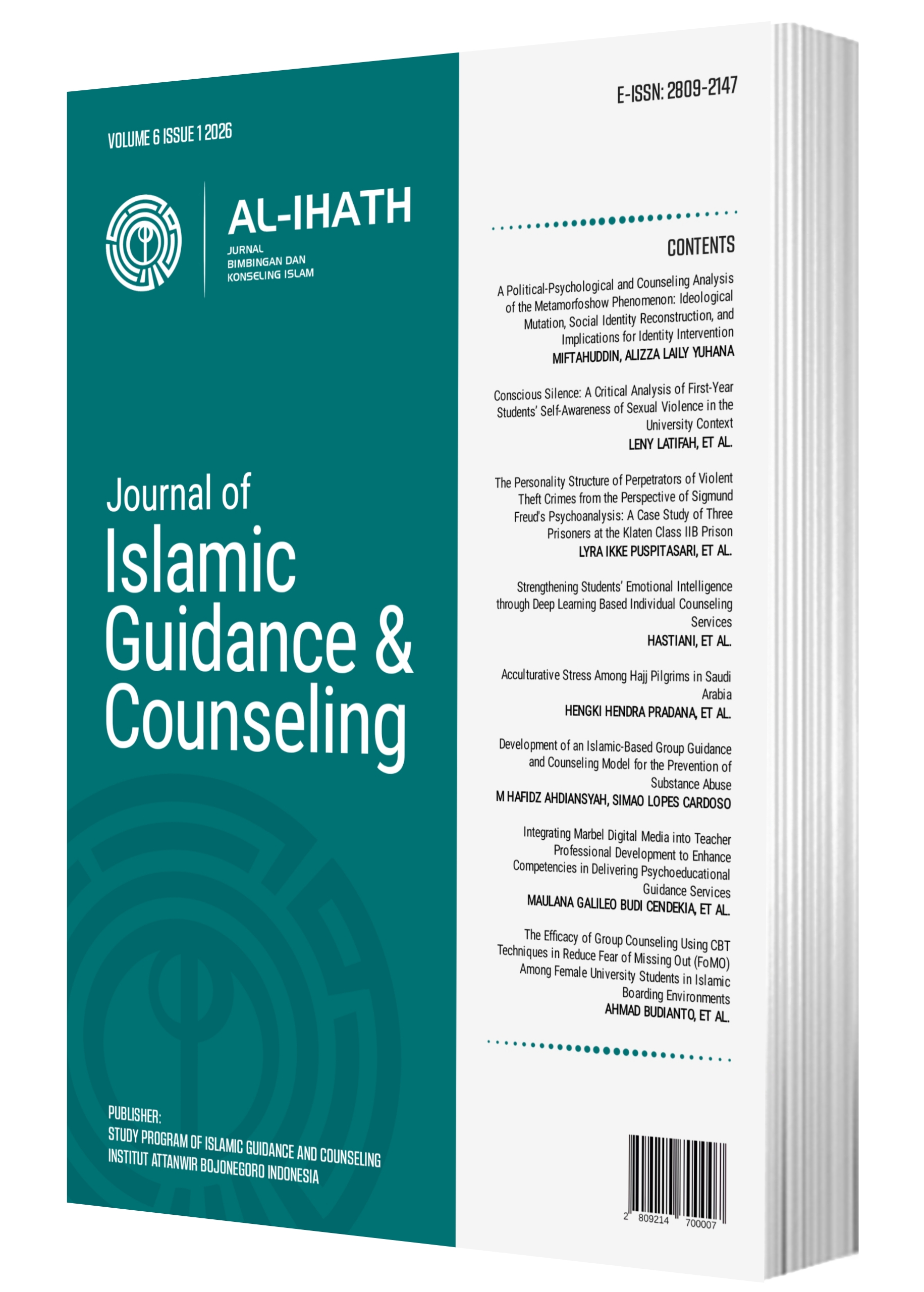
The Efficacy of Group Counseling Using CBT Techniques in Reduce Fear of Missing Out (FoMO) Among Female University Students in Islamic Boarding Environments
DOI:
https://doi.org/10.53915/jbki.v6i1.107Keywords:
Fear of Missing Out (FoMO), Group Counseling, Cognitive Behavioral Therapy, Female Students, Social MediaAbstract
The phenomenon of Fear of Missing Out (FoMO) has increased along with the growing use of social media among university students, including female students living in a student Islamic boarding school environment. FoMO is characterized by feelings of fear, worry, and anxiety when individuals perceive that they are missing out on others’ social experiences, which may negatively affect psychological well-being and academic concentration. This study aimed to examine the effectiveness of group counseling using Cognitive Behavioral Therapy (CBT) techniques in reducing FoMO behavior among Among Female University Students in Islamic Boarding Environments of Institut Attanwir Bojonegoro.This study employed a quantitative approach with a pre-experimental design using a one group pretest–posttest design. The research participants consisted of eight female students selected through purposive sampling based on a high level of FoMO. The instrument used was a FoMO behavior scale that had been tested for validity and reliability. Data were analyzed using the nonparametric Mann–Whitney U Test. The results indicated a significant decrease in FoMO behavior after the implementation of group counseling with CBT techniques. The significance value (sig. 2-tailed) of 0.001 (< 0.05) demonstrated a meaningful difference between pretest and posttest scores. These findings suggest that CBT-based group counseling is effective in helping female students modify irrational thoughts, reduce social anxiety, and improve self-control related to social media use. Therefore, group counseling with CBT techniques can be considered an applicable psychological intervention to reduce FoMO behavior in student Islamic boarding school settings in the digital era.
References
Alt, D., & Boniel-Nissim, M. (2018). Parent–Adolescent Communication and Problematic Internet Use: The Mediating Role of Fear of Missing Out (FoMO). Journal of Family Issues, 39(13), 3391–3409. https://doi.org/10.1177/0192513X18783493
Azwar, S. (2018). Metode penelitian psikologi edisi II.
Beck, A. T., & Dozois, D. J. A. (2011). Cognitive therapy: Current status and future directions. Annual Review of Medicine, 62, 397–409. https://doi.org/10.1146/annurev-med-052209-100032
Budianto, A., Faizin, M., & Romadhoni, P. (2025). Efektivitas Bimbingan Kelompok Teknik Kognitif Perilaku untuk Mereduksi Perilaku Merokok pada Siswa. JKaKa: Jurnal Komunikasi Dan Konseling Islam, 5(2), 88–102. https://doi.org/https://doi.org/10.30739/jkaka.v5i2.4311
Budianto, A., Sugihartoad, D. Y. P., & Awalya. (2020). Effectiveness of guidance group role playing and symbolic modeling to improve students’ interpersonal communication skills. European Journal of Psychological Research, 7(2), 139–147. https://www.idpublications.org/wp-content/uploads/2020/12/Full-Paper-EFFECTIVENESS-OF-GUIDANCE-GROUP-ROLE-PLAYING-AND-SYMBOLIC-MODELLING-TO-IMPROVE-STUDENTS-INTERPERSONAL.pdf
Corey, G., & Corey, M. S. (2016). Group psychotherapy.
Drakel, W. J. . P. M. H. . & M. T. (2018). Perilaku mahasiswa dalam menggunakan media sosial di Universitas Sam Ratulangi Manado. In HOLISTIK. Journal of Social and Culture.
Elhai, J. D., Levine, J. C., Dvorak, R. D., & Hall, B. J. (2016). Fear of missing out, need for touch, anxiety and depression are related to problematic smartphone use. Computers in Human Behavior, 63, 509–516. https://doi.org/10.1016/j.chb.2016.05.079
Zahro, I.F. (2024). Uncovering the Fear of Missing Out (FoMO): The Relationship with the Intensity of Social Media Use. Al-Ihath: Jurnal Bimbingan Dan Konseling Islam, 4(2), 129–136. https://doi.org/10.53915/jbki.v4i2.581
Gazda, G. M. (1969). Group counseling: A developmental approach. Canadian Journal of Counselling and Psychotherapy, 3(4).
Hofmann, S. G., Asnaani, A., Vonk, I. J. J., Sawyer, A. T., & Fang, A. (2012). The efficacy of CBT: a review of meta-analyses. Cognitive Therapy Research, 36(5), 427–440. https://doi.org/10.1007/s10608-012-9476-1.The
Mumpuni, S. dias, K, H. A., & Nugroho, R. A. (2023). Konseling Kelompok untuk Mengurangi Fenomena Fear Of Missing Out (FoMO) Remaja Kota Tegal. Advice: Jurnal Bimbingan Dan Konseling, 4(2), 46–53. https://doi.org/10.32585/advice.v4i2.2740
Nida, F., & Aulia, R. (2025). Systematic Review Tentang Pengaruh Resiliensi terhadap Kesejahteraan Psikologis pada Dewasa Muda. Jurnal Riset Psikologi, 5(3), 18–30. https://doi.org/https://doi.org/10.57250/ajsh.v5i3.2101
Przybylski, A. K., Murayama, K., Dehaan, C. R., & Gladwell, V. (2013). Com puters in Human Behavior Motivational , emotional , and behavioral correlates of fear of missing out. Computers in Human Behavior, 29(4), 1841–1848. https://doi.org/10.1016/j.chb.2013.02.014
Stanisławski, K. (2019). The Coping Circumplex Model: An Integrative Model of the Structure of Coping With Stress (p. 10). https://doi.org/https://doi.org/10.3389/fpsyg.2019.00694
Sugiyono, D. (2013). Metode penelitian pendidikan pendekatan kuantitatif, kualitatif dan R&D.
Trudel-Fitzgerald, Claudia, Boucher, Gabrielle, Morin, Clara, Mondragon, Pamela, Guimond, Anne-Josée, Nishimi, Kristen, Choi, Karmel W., Denckla, C. (2024). Coping and emotion regulation: A conceptual and measurement scoping review. Canadian Psychology, 65(3), 149–162. https://psycnet.apa.org/buy/2024-33170-001
Tutgun-Ünal, A., & Deniz, L. (2015). Development of the Social Media Addiction Scale. AJIT-e: Online Academic Journal of Information Technology, 6(21), 51–70. https://doi.org/https://doi.org/10.5824/1309-1581.2015.4.004.x
Wibowo, M. E. (2005). Konseling kelompok perkembangan.
Downloads
Published
Issue
Section
License
Copyright (c) 2026 Ahmad Budianto, Misbachul Anam, Mohammad Toha Johariansyah, Zahrotun Nisa, Nanang Husniadi

This work is licensed under a Creative Commons Attribution-ShareAlike 4.0 International License.
Authors who publish with this journal agree to the following terms:
- Authors retain copyright and grant the journal right of first publication with the work simultaneously licensed under a Creative Commons Attribution License that allows others to share the work with an acknowledgement of the work's authorship and initial publication in this journal.
- Authors are able to enter into separate, additional contractual arrangements for the non-exclusive distribution of the journal's published version of the work (e.g., post it to an institutional repository or publish it in a book), with an acknowledgement of its initial publication in this journal.
- Authors are permitted and encouraged to post their work online (e.g., in institutional repositories or on their website) prior to and during the submission process, as it can lead to productive exchanges, as well as earlier and greater citation of published work.