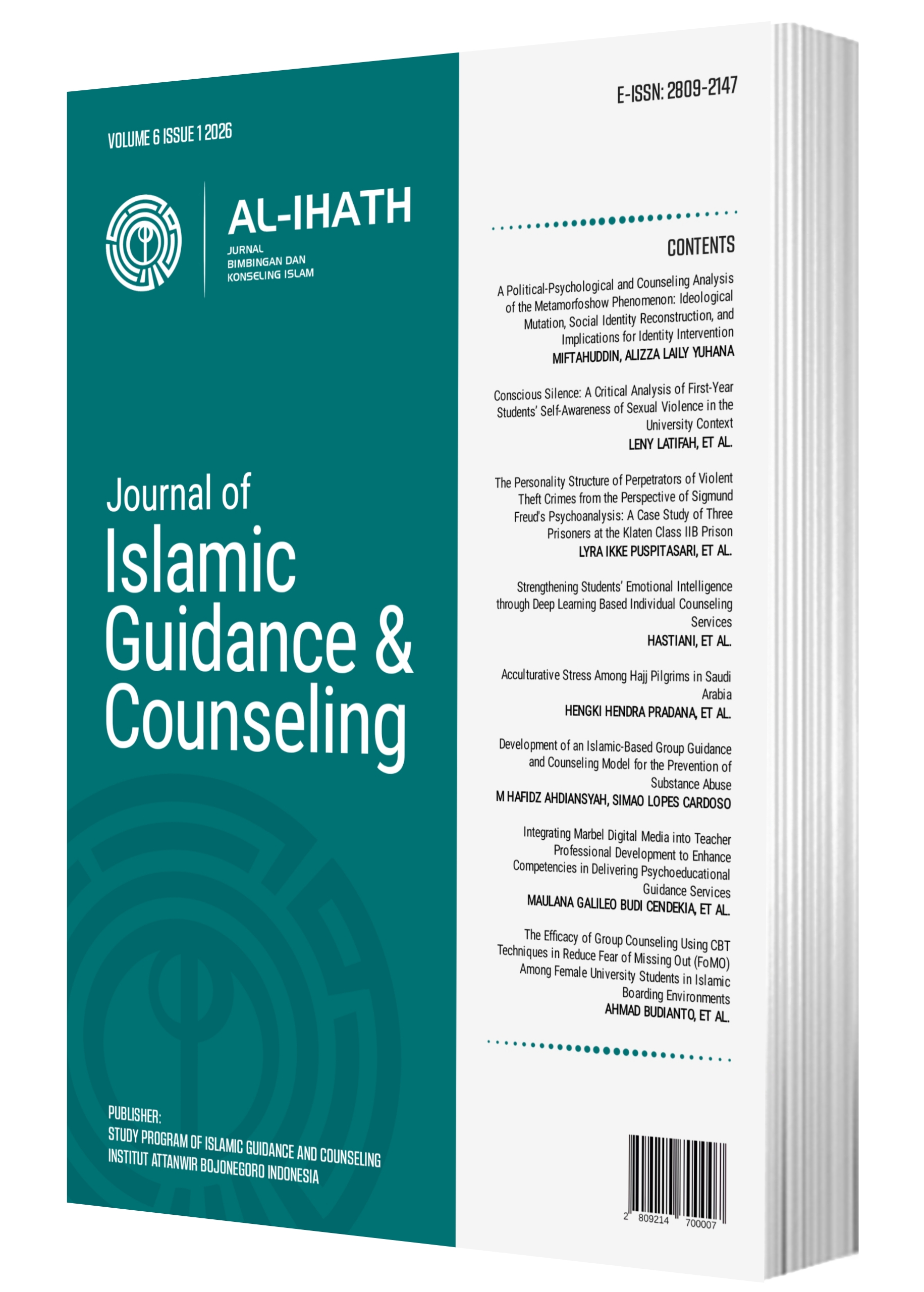
Development of an Islamic-Based Group Guidance and Counseling Model for the Prevention of Substance Abuse
DOI:
https://doi.org/10.53915/jbki.v6i1.100Keywords:
Islamic-Based Guidance Group Model, Narcotics, Psychotropics, Additives AbuseAbstract
This research addresses the critical challenge of adolescent substance abuse by developing and evaluating an Islamic-based group guidance and counseling model. Utilizing a Research and Development (R&D) methodology, the study focuses on students at an Islamic senior secondary school in Indonesia to bridge the gap between conventional counseling and faith-integrated interventions. The developed model incorporates twelve core components including rationale, Islamic-based materials, and structured implementation stages grounded in the principles of taqwa (moral consciousness) and tazkiyatun nafs (self-purification). The intervention was tested using a quasi-experimental pretest-posttest control group design involving eleventh-grade students. Quantitative analysis revealed a significant transformative impact; baseline self-prevention levels rose from an initial average of 63.9% to 84.2% following the intervention, representing a robust 20.3% increase. Statistical validation through a paired t-test confirmed the model’s effectiveness with a value of 10.912 (p < .001). The findings suggest that integrating Quranic values and ethical reflection into group dynamics creates a moral shield, fostering internalized self-regulation and spiritual resilience against negative peer influences. This research provides a scientifically validated and spiritually responsive framework for school counselors to effectively prevent narcotics, psychotropic, and addictive substances abuse.
References
Abdullah, M., & Kasim, T. S. A. T. (2022). Islamic counseling and mental health: Integrating spiritual values into therapeutic practices. Journal of Islamic Psychology, 6(1), 1-12.
Barry, C. M., Padilla-Walker, L. M., & Nelson, L. J. (2021). The role of peers and moral identity in adolescent risk behavior. Journal of Adolescence, 88, 1-12. https://doi.org/10.1016/j.adolescence.2021.02.003
Boateng, G. O., Neilands, T. B., Frongillo, E. A., Melgar-Quiñonez, H. R., & Young, S. L. (2022). Best practices for developing and validating scales for behavioral research. Frontiers in Public Health, 10, 847581. https://doi.org/10.3389/fpubh.2022.847581
Carey, J. C., & Dimmitt, C. (2023). Evidence-based school counseling: An update on outcomes and practices. Professional School Counseling, 26(1).
Corey, G., Corey, M. S., & Corey, C. (2023). Groups: Process and practice (10th ed.). Cengage Learning.
Creswell, J. W., & Plano Clark, V. L. (2022). Designing and conducting mixed methods research (3rd ed.). SAGE Publications.
Dishion, T. J., & Tipsord, J. M. (2021). Peer contagion in adolescent problem behavior. Child Development Perspectives, 15(2), 91-96. https://doi.org/10.1111/cdep.12403
Floridi, L., & Cowls, J. (2024). A unified framework of artificial intelligence ethics. AI and Ethics, 4(1), 1-12. https://doi.org/10.1007/s43681-023-00321-9
Gladding, S. T. (2022). Groups: A counseling specialty. Pearson.
Goleman, D. (2023). Emotional intelligence: Why it can matter more than IQ (Updated ed.). Bantam Books.
Haque, A., Khan, F., Keshavarzi, H., & Rothman, A. (2021). Integrating Islamic spirituality in psychotherapy: Theory and practice. Journal of Religion and Health, 60(5), 3373-3391. https://doi.org/10.1007/s10943-021-01275-6
Hawkins, J. D., Catalano, R. F., & Arthur, M. W. (2021). Promoting science-based prevention in communities. Addictive Behaviors, 114, 106739. https://doi.org/10.1016/j.addbeh.2020.106739
Inkster, B., & Sarda, S. (2024). Digital mental health and artificial intelligence: New frontiers in personalized care. npj Digital Medicine, 7, Article 12. https://doi.org/10.1038/s41746-024-00987-6
Keshavarzi, H., & Haque, A. (2021). Islamic psychology and counseling: Conceptual foundations and contemporary applications. Journal of Muslim Mental Health, 15(1), 1-8.
Lakens, D. (2022). Sample size justification. Collabra: Psychology, 8(1), Article 33267. https://doi.org/10.1525/collabra.33267
Lickona, T. (2022). Character matters: How to help our children develop good judgment. Simon & Schuster.
McKenney, S., Reeves, T. C., & Herrington, J. (2023). Educational design research: Past, present, and future. Educational Researcher, 52(2), 98-110. https://doi.org/10.3102/0013189X221140200
Mertens, D. M. (2023). Research and evaluation in education and psychology (5th ed.). SAGE Publications.
Miller, T. W. (2022). Adolescent substance abuse prevention: Evidence-based group interventions. Journal of Child & Adolescent Substance Abuse, 31(4), 243-255. https://doi.org/10.1080/1067828X.2022.2034671
Rahman, A., & Ahmad, S. (2021). Islamic-based group guidance and student awareness. Journal of Faith-Based Counseling, 4(2).
Reeves, T. C., & McKenney, S. (2024). Educational design research: Methodological perspectives. British Journal of Educational Technology, 55(1), 3-18. https://doi.org/10.1111/bjet.13321
Sánchez-Álvarez, N., Extremera, N., & Fernández-Berrocal, P. (2023). Emotional intelligence and mental health in adolescence: A meta-analytic review. Current Psychology, 42(4), 2567-2579. https://doi.org/10.1007/s12144-021-02697-9
Shatte, A. B. R., Hutchinson, D. M., & Teague, S. J. (2022). Machine learning in mental health: A systematic review. Psychological Medicine, 52(7), 1304-1315. https://doi.org/10.1017/S0033291720001511
Sink, C. A., & Ockerman, M. S. (2021). School counseling research and evaluation. Professional School Counseling, 25(1), 1-12. https://doi.org/10.1177/2156759X20980161
Steinberg, L. (2022). Adolescence (12th ed.). McGraw-Hill Education.
UNESCO. (2023). Global education monitoring report: Enrollment and facilities. UNESCO.
Vaidyam, A. N., Wisniewski, H., Halamka, J. D., & Torous, J. B. (2023). Digital technology and adolescents exposure to risky behaviors. Journal of Medical Internet Research.
Van der Zanden, P. J., Denessen, E., Cillessen, A. H., & Meijer, P. C. (2022). Critical environments for moral, social, and psychological development. Educational Research Review.
World Health Organization. (2022). Global report on substance abuse in youth. WHO Press.
Zamani, Z., & Ahmad, R. (2023). Faith-based preventive counseling in modern education. Asian Journal of Educational Research.
Downloads
Published
Issue
Section
License
Copyright (c) 2026 M Hafidz Ahdiansyah, Simao Lopes Cardoso

This work is licensed under a Creative Commons Attribution-ShareAlike 4.0 International License.
Authors who publish with this journal agree to the following terms:
- Authors retain copyright and grant the journal right of first publication with the work simultaneously licensed under a Creative Commons Attribution License that allows others to share the work with an acknowledgement of the work's authorship and initial publication in this journal.
- Authors are able to enter into separate, additional contractual arrangements for the non-exclusive distribution of the journal's published version of the work (e.g., post it to an institutional repository or publish it in a book), with an acknowledgement of its initial publication in this journal.
- Authors are permitted and encouraged to post their work online (e.g., in institutional repositories or on their website) prior to and during the submission process, as it can lead to productive exchanges, as well as earlier and greater citation of published work.